Volume discounts award percentage or fixed markdowns based strictly on the physical quantity of items purchased (such as Buy 2 get 10% off, Buy 3 get 15% off), whereas price-based promotions calculate discounts using product price rankings (such as Buy 2 Get 1 Free, where the lowest-priced item is discounted) or cart-level spend milestones (such as Spend $50, Get $10 off). While volume discounts deliver predictable, mathematically bounded gross margins and encourage higher unit velocity, price-ranked promotions introduce acute margin volatility when shoppers combine products with wide price disparities. For high-volume Shopify merchants, choosing between volume tiers and price-based mechanics fundamentally dictates inventory turnover, Average Order Value (AOV), and net cash flow.
In competitive ecommerce environments, failing to model the financial mechanics behind quantity breaks versus price-ranked promotions leads to catastrophic margin leakage. When merchants deploy “Buy 2 Get 1 Free” without restricting catalog price ranges, customers frequently pair expensive hero garments with low-cost accessories, skewing refund allocations and inflating carrier shipping freight. This strategic guide analyzes the unit economics of volume discounting versus price-based promotions, provides mathematical formulas for break-even elasticity, and outlines a verified 7-point QA acceptance testing matrix for seamless Shopify deployment.
1. Core Differences: Volume vs. Price-Ranked Mechanics
To design profitable merchandising campaigns, merchants must understand the structural differences between quantity triggers, price-ranking algorithms, and cart spend milestones:
- Volume Discounts (Quantity Breaks): The promotional trigger is strictly the number of physical units in the cart. Once a quantity threshold is crossed (e.g., 3 units), a discount rate applies across the qualifying items. Volume promotions can be structured as all-units (discounting every unit purchased) or incremental marginal tiers (discounting only units purchased beyond the threshold).
- Price-Ranked Discounts (Cheapest Free / BOGO): The promotion targets products based on their relative unit prices. In a classic “Buy 2 Get 1 Free” promotion, the checkout engine sorts all qualifying items in descending price order and discounts the lowest-priced item (rank N) by 100%.
- Spend-Based Order Goals: The promotional trigger is the aggregate monetary subtotal of the cart (e.g., Spend $50, Save $10, or Spend $100, Unlock Free Shipping). Unlike volume tiers, spend goals do not require customers to buy multiple units of a specific SKU, making them ideal for multi-category catalog expansion.
All-Units vs. Incremental Tiered Discounting
In economic pricing literature (e.g., Journal of Marketing Research), volume discounts are bifurcated into two distinct structural models:
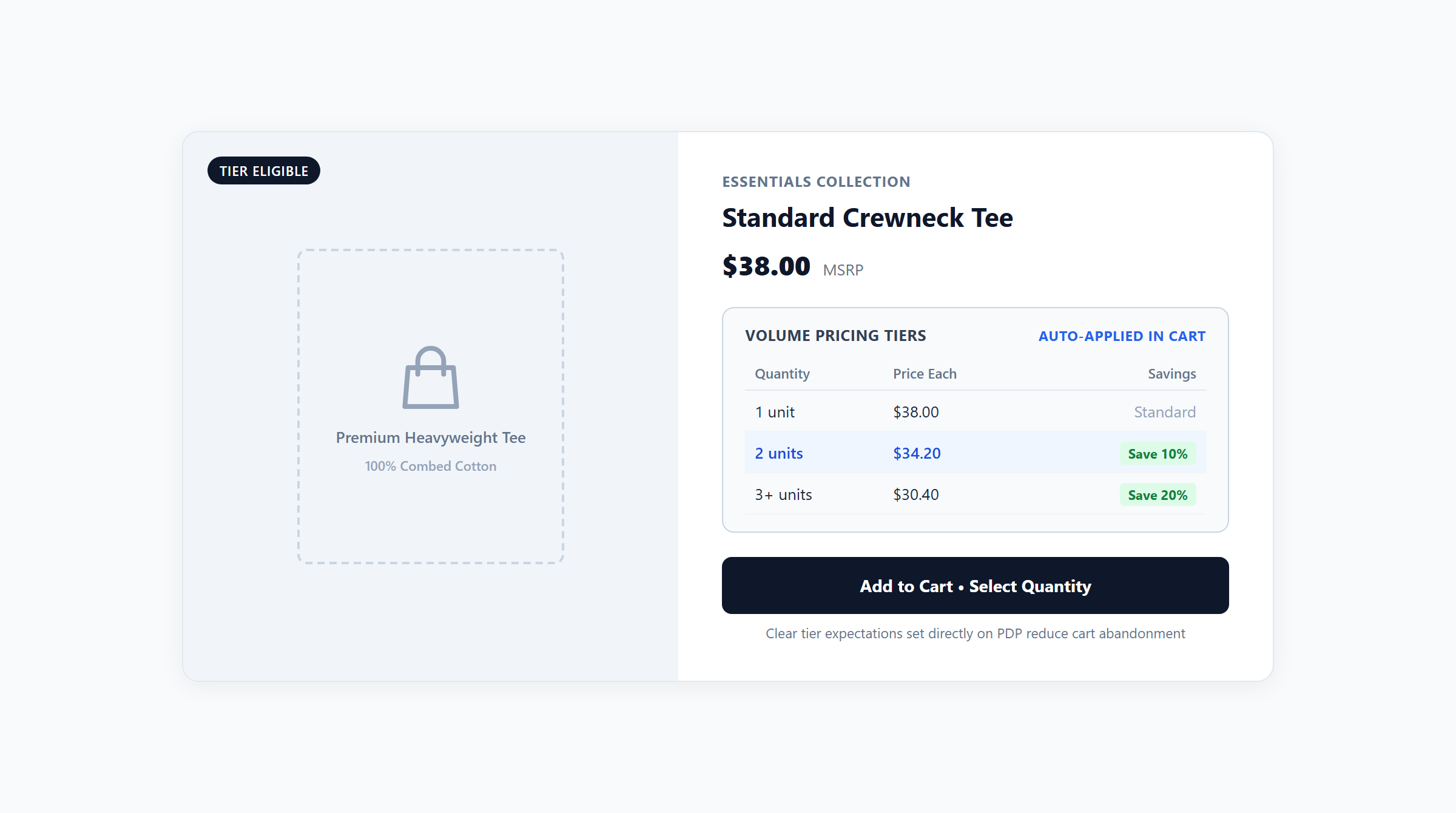
- All-Units Discounting: Crossing a quantity barrier retroactively discounts every single unit in the basket. For example, buying 1 shirt costs $20.00; buying 3 shirts triggers a 10% discount across all 3 units, reducing each shirt to $18.00 ($54.00 total). While highly intuitive to shoppers, all-units discounting creates steep “cliff effects” where purchasing an additional item can actually reduce the total cart price.
- Incremental (Marginal) Discounting: The discount applies strictly to the additional units purchased above the tier threshold. The first 2 shirts remain at $20.00 each ($40.00), while the 3rd shirt receives a 20% discount ($16.00), totaling $56.00. Incremental discounting eliminates cliff effects and preserves superior gross margins, but requires clearer customer communication on product display pages.
Modern Shopify promotional apps—such as Easy Deals—execute both all-units and incremental volume discounting directly through Shopify Functions running in WebAssembly (Wasm) at checkout under a strict 5ms runtime budget.
2. Cart Economics & Margin Impact Analysis
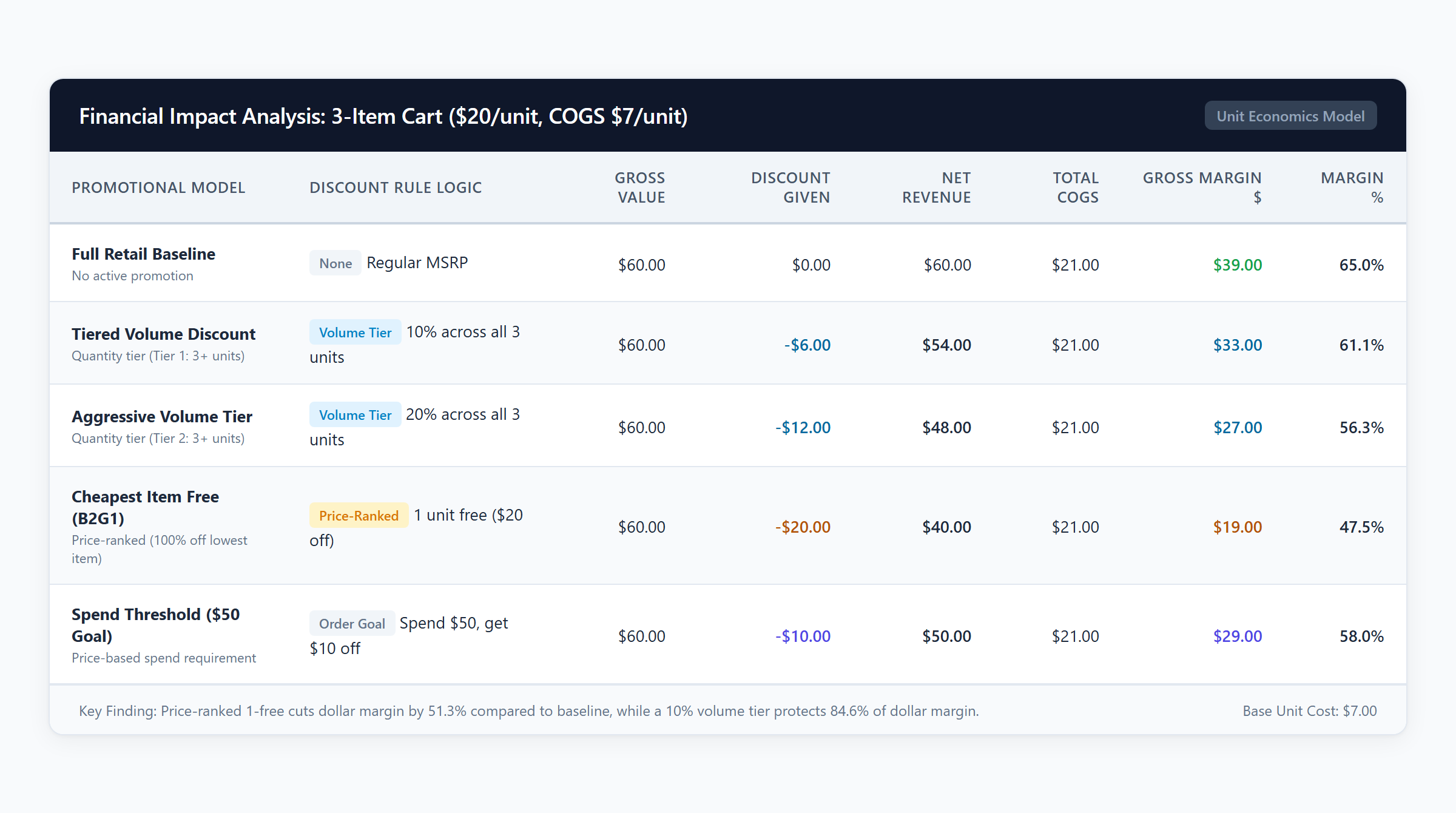
To demonstrate how promotional choice influences merchant profitability, let us analyze an identical 3-item cart across three different promotional structures using audited cost metrics from our financial model. In each scenario, the customer purchases 3 units of the Classic Heavyweight Cotton Tee ($20.00 retail price, $7.00 unit COGS, representing $60.00 gross value and $21.00 total product COGS):
| Promotional Structure | Gross Cart Value | Discount Applied | Net Revenue Collected | Total Product COGS | Gross Profit ($) | Gross Profit Margin (%) |
|---|---|---|---|---|---|---|
| Scenario 1: 10% Volume Tier Buy 3, Save 10% across all units |
$60.00 | $6.00 | $54.00 | $21.00 (3x $7.00) |
$33.00 | 61.1% |
| Scenario 2: Buy 2 Get 1 Free (BOGO) Cheapest item 100% free on 3 units |
$60.00 | $20.00 | $40.00 | $21.00 (3x $7.00) |
$19.00 | 47.5% |
| Scenario 3: Spend $50, Get $10 Off Fixed monetary cart order goal |
$60.00 | $10.00 | $50.00 | $21.00 (3x $7.00) |
$29.00 | 58.0% |
| Scenario 4: Price-Disparity Cart $75 Jacket + $20 Tee (Cheapest Free) |
$95.00 | $20.00 | $75.00 | $31.00 ($25 + $6) |
$44.00 | 58.7% |
The comparative data reveals startling disparities in merchant net retention. In Scenario 1 (10% volume discount), the merchant collects $54.00 net, yielding $33.00 in gross profit and maintaining a 61.1% profit margin. In Scenario 2 (Buy 2 Get 1 Free), the effective discount skyrockets to 33.3% ($20.00 off), causing gross profit to plummet to just $19.00 (a 42.4% reduction in profit dollars) and compressing margins to 47.5%.
While BOGO promotions generate high consumer excitement, they demand nearly double the unit sales volume to achieve parity with modest percentage-based volume tiers. For stores selling manufactured goods with substantial COGS, unconstrained BOGO promotions frequently become unprofitable once shipping and credit card processing fees are factored in.
3. The Mathematics of Price Disparity: When Price-Ranked Discounts Collapse
The primary vulnerability of price-ranked discounts (such as “Buy 2 Get the 3rd Free”) emerges when promotions are applied across heterogeneous catalogs with high price variance. When customers add items with widely divergent price points to their cart, the cheapest-item algorithm produces unpredictable commercial results.
Mathematical Proof of Price-Disparity Volatility
Consider a merchant who activates a storewide “Buy 2 Get 1 Free (Cheapest Item Free)” promotion across their entire catalog. Let us model two distinct customer shopping carts:
- Cart A (Homogeneous Basket): Customer adds 3 outerwear items priced at $75.00 each. Gross value = $225.00. The cheapest item is $75.00. The customer pays $150.00 net. The effective discount rate is exactly 33.3%.
- Cart B (Disparate Basket): Customer adds two $75.00 outerwear items and one $20.00 cotton t-shirt. Gross value = $170.00. The cheapest item is the t-shirt ($20.00). The customer pays $150.00 net. The effective discount rate drops to just 11.8% ($20.00 / $170.00).
- Cart C (Extreme Disparity Basket): Customer adds one $75.00 jacket, one $20.00 shirt, and one $10.00 pair of socks. Gross value = $105.00. The cheapest item is the $10.00 socks. The customer pays $95.00 net. The effective discount is only 9.5%.
While Cart B and Cart C protect merchant margins, they frequently generate consumer resentment. Shoppers expecting a massive “Free Item” promotion discover that their actual savings amount to less than 10% because the promotion targeted a trivial accessory. Conversely, when shoppers intentionally manipulate the promotion by selecting three high-ticket items, merchant margins collapse.
Volume discounts completely avoid price-disparity friction. A 10% volume discount applies uniformly to all qualifying units, delivering consistent percentage savings to the shopper and predictable dollar contributions to the merchant regardless of catalog variance.
4. Break-Even Volume Elasticity & Margin Sensitivity
Before launching a volume discounting tier, ecommerce directors must calculate the Break-Even Volume Elasticity. This economic metric establishes the exact percentage increase in unit sales required to maintain identical gross profit dollars after discounting unit prices.
Break-Even Sales Lift Formula:
Lift_breakeven = D_pct / (Margin_gross - D_pct)
Where D_pct represents the proposed volume discount percentage and Margin_gross represents the store’s baseline gross margin percentage prior to discounting.
Worked Elasticity Calculation
Suppose your store operates with a baseline 65.0% gross margin on apparel. You are evaluating whether to offer a 15% volume discount for customers purchasing 3 or more units:
Lift_breakeven = 0.15 / (0.65 - 0.15) = 0.15 / 0.50 = 0.30 (30.0%)
To generate the exact same gross profit dollars after instituting a 15% volume tier, your store must increase total unit sales volume by at least 30.0%. If your merchandising campaign generates a 45% lift in unit movement, the campaign generates substantial net incremental profit. However, if your baseline gross margin is lower—for example, 40.0%—the required unit lift explodes:
Lift_breakeven (40% margin) = 0.15 / (0.40 - 0.15) = 0.15 / 0.25 = 0.60 (60.0%)
For low-margin merchants, even modest volume discounts require heroic conversion increases to break even. This mathematical reality underscores why high-ticket and low-margin retailers must restrict volume tiers to high-margin SKUs or deploy spend-based order goals instead.
5. Stacking Rules, Fulfillment & Inventory Realities
Deploying volume and price-based promotions requires navigating Shopify’s discount architecture, refund allocation rules, and warehouse fulfillment constraints.
Shopify Discount Stacking Permissions
Shopify organizes discounts into three native classes: Product, Order, and Shipping. Volume discounts created as automatic product discounts will not combine with checkout coupon codes or free shipping promotions unless reciprocal combination permissions are toggled on in the Shopify Admin. Furthermore, Shopify limits stores to a hard platform ceiling of 25 concurrent active automatic discounts. Apps built on Shopify Functions—such as Easy Deals—consolidate multi-tier quantity rules within a single active app function, bypassing this platform limit entirely.
Partial Returns and Refund Pro-Rating
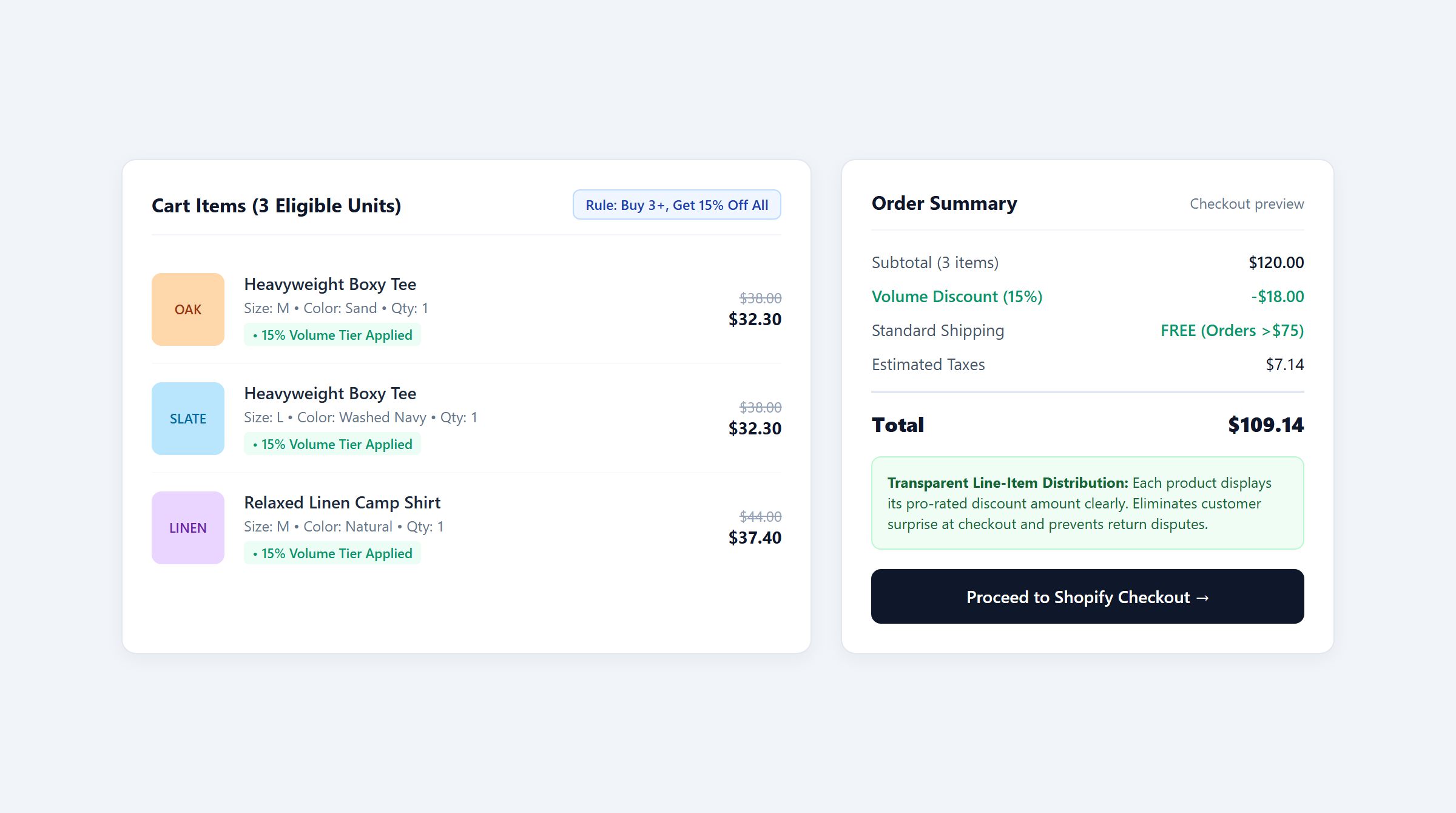
When a customer purchases a 3-unit volume bundle and subsequently returns one item, how does Shopify calculate the refund? Under Shopify’s native architecture, percentage volume discounts are pro-rated across all qualifying line items. In Scenario 1 ($60 gross, $6 discount, $54 net paid for 3 tees), each t-shirt has a recognized net revenue of $18.00 ($20.00 – $2.00). If the customer returns one tee, Shopify refunds exactly $18.00—preventing the customer from exploiting the multi-unit discount while returning individual items.

Warehouse Fulfillment & Dimensional Weight Costs
Volume promotions deliberately drive higher units per order. However, shipping 3 heavy hoodies requires significantly larger packaging than shipping a single unit. Major parcel carriers (USPS, FedEx, UPS) assess freight charges based on Dimensional Weight (DIM weight). If a volume promotion increases order weight past shipping threshold boundaries, carrier surcharges will erode your projected margins unless your pricing model accounts for packaging overhead.
6. Comprehensive Comparison Matrix: Promotional Mechanics Evaluated
To determine the optimal promotional structure for your store’s merchandising strategy, compare the operational trade-offs outlined below:
| Decision Dimension | Volume Quantity Tiers (Buy More Save More) | Price-Ranked Discounts (Buy 2 Get 1 Free / BOGO) | Cart Spend Goals (Spend $100, Save $15) |
|---|---|---|---|
| Primary Commercial Objective | Clear unit inventory and increase item depth per SKU. | High-converting customer acquisition and clearance marketing. | Expand basket breadth and increase storewide AOV. |
| Gross Margin Predictability | High: Discount percentage is strictly capped and predictable. | Volatile: Varies dramatically based on cart item price disparity. | High: Monetary deduction scales predictably against cart size. |
| Catalog Applicability | Best for consumable, multi-pack, or sizing-standard apparel goods. | Best for tight collections with homogeneous price points. | Best for diverse, multi-category catalogs and gift shops. |
| Cliff Effect Vulnerability | Moderate under all-units models; zero under incremental tiers. | Low to moderate depending on item price distribution. | High at boundary thresholds (e.g., $49.98 vs $50.00 minimum spend). |
| Fulfillment / Shipping Impact | Increases physical parcel weight and potential DIM weight surcharges. | Increases parcel weight without capturing additional merchandise revenue. | Captures higher dollar revenue to offset carrier shipping costs. |
| Shopify Engine Execution | Native engine lacks tiered breaks; requires Shopify Functions app. | Supported natively as Buy X Get Y (limited to fixed item pairs). | Supported natively as order discounts; optimized via Functions apps. |
| Customer Perceived Value | Moderate to high: appeals to bulk buyers and repeat replenishment shoppers. | Maximum: “FREE” triggers powerful psychological conversion response. | High: clear reward milestones encourage cart stretch behavior. |
7. Implementation Blueprint with Easy Deals
For Shopify merchants seeking to deploy advanced volume tiers and spend milestones without wrestling with complex Liquid theme modifications, Easy Deals provides an enterprise-grade solution built directly on Shopify Functions. Available on the Shopify App Store for $9.99/month following a 7-day free trial, Easy Deals simplifies promotional execution:
- Install Easy Deals from the Shopify App Store: Seamlessly integrate the app with your Shopify admin.
- Select Your Campaign Architecture: Choose from pre-configured promotional modules, including Tiered Quantity Breaks, Incremental Volume Bundles, Buy X Get Y, or Multi-Tier Cart Spend Goals.
- Configure Visual PDP Tables: Automatically display responsive volume tier pricing tables directly above the “Add to Cart” button on qualifying product pages.
- Enable Sliding Cart Drawer Parity: Deploy dynamic progress bars in your cart drawer that display real-time tier milestones and upsell suggestions.
- Set Margin Safeguards: Establish minimum price floors and collection exclusion lists to prevent low-margin accessories from diluting promotional profit.
- Publish via Shopify Functions: Save your campaign to deploy WebAssembly logic into Shopify’s checkout pipeline for zero-latency execution.
8. Pre-Launch Acceptance Testing Matrix: 7-Point QA Checklist
Before launching volume discounts or price-based promotions to live shoppers, conduct thorough end-to-end verification using this 7-point QA acceptance checklist:
| Test Item | Testing Objective | Verification Methodology | Expected System Behavior |
|---|---|---|---|
| QA-01: Quantity Tier Trigger Test | Verify volume discount activation across tier boundaries. | Add 1, 2, and 3 qualifying items sequentially to the cart. | Discount applies immediately upon reaching tier quantity; subtotal reflects rate. |
| QA-02: PDP Pricing Table Accuracy | Ensure product page pricing tables match checkout deductions. | Compare unit prices displayed in PDP volume table against cart subtotal. | Per-unit prices and percentage savings match checkout line items exactly. |
| QA-03: Cart Drawer Parity Verification | Prevent visual discrepancies between cart and checkout. | Inspect cart slide-out subtotal, tier badges, and discount summaries. | Savings displayed in cart drawer match checkout summary to the penny. |
| QA-04: Price Disparity Stress Test | Test cheapest-item discount behavior with disparate items. | Add one $75.00 jacket and two $20.00 shirts to cart in a BOGO campaign. | System discounts exactly one $20.00 shirt; gross profit remains within target range. |
| QA-05: Reciprocal Shipping Stacking Test | Confirm volume promotions combine with shipping rates. | Apply volume tier and enter free shipping promotional code at checkout. | Both promotions execute simultaneously without conflict error messages. |
| QA-06: Partial Return Pro-Rata Audit | Ensure refund calculations reflect net paid prices. | Complete test volume order; simulate partial return of 1 item in Admin. | Refund amount equals pro-rated discounted net price, protecting merchant margin. |
| QA-07: Mobile Responsiveness Test | Verify user experience on mobile viewports. | Test volume selector tables and cart drawer progress bars on iOS and Android. | Tier tables wrap neatly; quantity buttons and progress bars render cleanly. |
9. Frequently Asked Questions (FAQ)
What is the difference between volume discounts and price-based discounts?
Volume discounts depend strictly on the physical quantity of items purchased (e.g., Buy 3 items, get 15% off), whereas price-based discounts evaluate item prices (such as discounting the cheapest item in a BOGO offer) or cart-level spend milestones (Spend $100, get $15 off).
Can I set up tiered volume discounts using native Shopify settings?
Native Shopify discount settings do not support tiered volume breaks on a single SKU. While you can create basic Buy X Get Y promotions, setting up tiered quantity breaks (e.g., Buy 2 get 10%, Buy 3 get 15%, Buy 4 get 20%) requires an app built on Shopify Functions such as Easy Deals.
Why are BOGO promotions riskier for profit margins than volume tiers?
Buy 2 Get 1 Free represents an effective 33.3% discount on qualifying merchandise. If customers select items with wide price disparities, or if unit COGS and carrier shipping freight are high, gross profits can drop precipitously compared to controlled 10% or 15% volume tiers.
How do partial refunds work when a volume discount was applied?
Shopify automatically pro-rates volume discounts across all qualifying items in the order. If a customer buys 3 shirts for $54.00 net ($18.00 each) and returns one shirt, Shopify calculates the maximum refund as $18.00, protecting the merchant from margin leakage.
Can volume discounts combine with free shipping on Shopify?
Yes, provided reciprocal combination permissions are enabled. In the Shopify Admin, check the “Shipping discounts” box under the volume discount’s Combinations panel, and ensure your shipping discount rule allows combinations with product discounts.