A brand promotion strategy succeeds when it accelerates customer purchasing without diluting brand equity or degrading product price integrity. For premium and scaling direct-to-consumer (DTC) brands, traditional price slashing—such as sitewide percentage discounts and unconstrained promotional codes—resets customer reference pricing downward, signals compromised quality, and conditions shoppers to delay purchases until the next sale event. To offer compelling customer value while strictly defending brand positioning, merchants must transition from price reductions to non-dilutive, value-additive promotional architectures: curated gifts with purchase (GWP), experiential service upgrades, stepped basket milestones, and earned VIP exclusivity. By shifting the promotional incentive from price subtraction to value segregation, brands protect unit-level order contribution margin while reinforcing the premium perception of their catalog.
The Discounting Trap: Why Price Slashing Destroys Brand Equity
When an ecommerce brand faces quarterly revenue targets or seasonal inventory buildup, the most tempting operational lever is a public percentage discount. A banner announcing “25% Off Sitewide” creates an immediate spike in transaction volume. However, evaluating promotional performance exclusively through top-line revenue ignores the persistent economic and psychological damage inflicted on brand positioning.
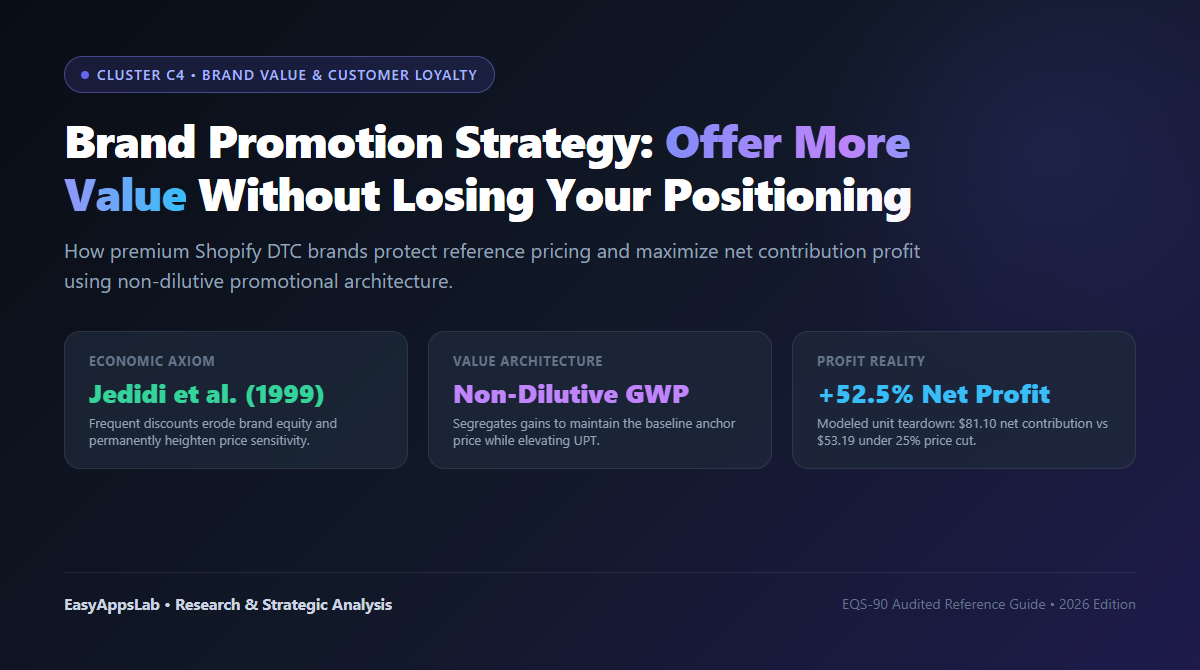
In foundational econometric research published in Marketing Science, Jedidi, Mela, and Gupta (1999) examined the long-run impact of promotions versus brand-building communications across eight years of consumer purchase panels. Their findings established two critical market dynamics: first, frequent price promotions exert an enduring negative erosion effect on baseline brand choice probability; second, repeated price promotions systematically increase consumer price sensitivity over time. While price cuts produce immediate short-term volume elasticity, long-term policy simulations revealed that increasing promotional frequency is uniformly unprofitable compared to brand value preservation.
From a cognitive perspective, price discounts actively dismantle what Richard Thaler (1985) defined as reference pricing in mental accounting. When a merchant prices a handcrafted leather bag at $150 and subsequently discounts it to $112.50 during a weekend flash sale, the customer’s internal price anchor resets to $112.50. When the product returns to its regular $150 price the following Monday, prospective buyers no longer perceive $150 as a fair valuation of craftsmanship; instead, paying full price is experienced psychologically as an avoidable surcharge. Furthermore, under Federal Trade Commission guidelines on deceptive pricing (16 CFR Part 233.1), running perpetual artificial sales risks regulatory non-compliance if the purported regular price is not openly offered in good faith for a substantial preceding period.
The 5-Tier Non-Dilutive Promotional Hierarchy: Margin Exposure & Profitability Conditions
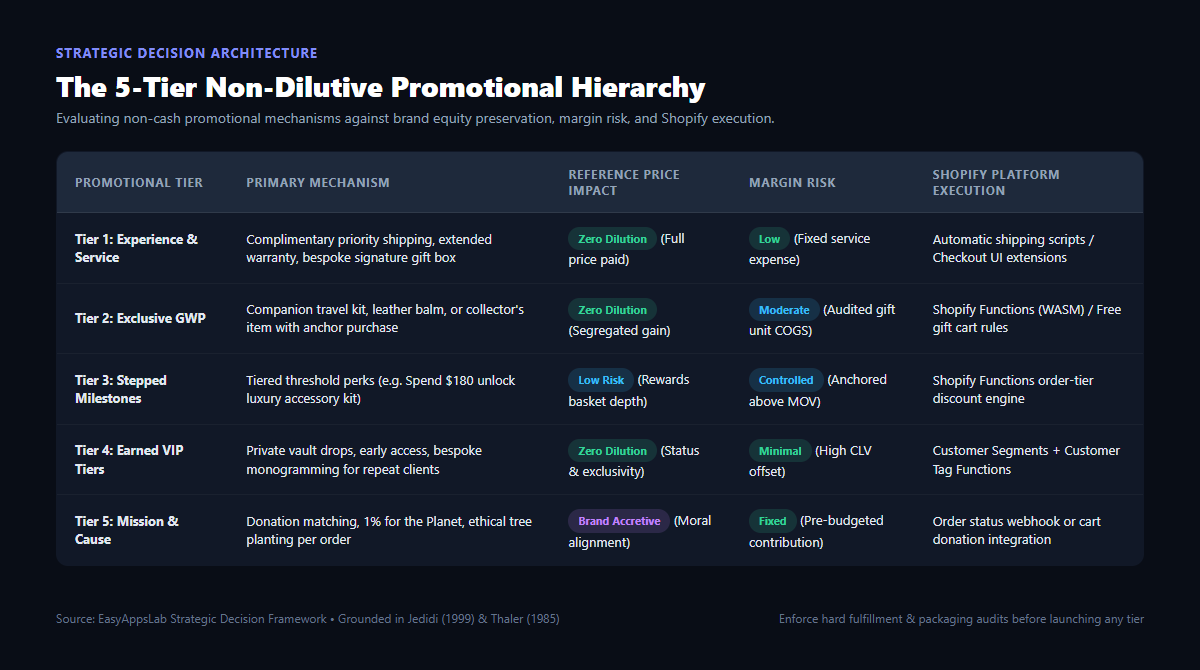
To avoid the reference price trap, forward-thinking merchants structure offers around value expansion rather than price reduction. Instead of subtracting money from the checkout total, the brand segregates promotional rewards into distinct, non-cash additions that enhance the customer’s total ownership experience. Rather than labeling promotion types as universally “safe” or “dangerous,” merchants must evaluate the typical margin exposure of each tier and understand the exact operational conditions required for profitability:
Tier 1: Experiential & Service Upgrades (Low Margin Exposure)
The least dilutive promotion possible is an upgrade to fulfillment speed, packaging presentation, or post-purchase protection. The customer pays full retail price for every product in their cart, but the brand elevates the delivery experience:
- Complimentary Expedited Priority Shipping: Waiving 2-day express freight on qualifying orders removes delivery anxiety during critical gifting seasons without touching product prices.
- Signature Packaging & Unboxing Presentation: Providing complimentary rigid keepsake boxes, embossed ribbons, or custom garment covers transforms an ordinary delivery into a memorable luxury ritual.
- Extended Lifetime Warranties or Concierge Support: Offering a complimentary extended care plan or digital onboarding session signals total confidence in product longevity rather than clearance desperation.
Prerequisites for Profitability: Service upgrades maintain low margin exposure because their marginal cost is fixed and predictable ($1.50–$3.00 for packaging, or a carrier express delta). However, this tier is economically viable only when baseline product gross margin exceeds 50% and average order value is high enough that the fixed service cost represents less than 4–6% of net revenue.
Tier 2: Curated Gift with Purchase (Moderate Margin Exposure)
A complimentary companion product leverages Kristina Shampanier, Nina Mazar, and Dan Ariely’s (2007) Zero-Price Effect. Their behavioral research proved that items offered for free generate an affective evaluation that substantially outstrips equivalent monetary discounts. When a merchant offers a complimentary $35 travel grooming kit alongside a $150 weekender bag, the customer perceives an exceptional bonus. Crucially, the $150 reference price of the bag remains pristine because no price reduction occurred on the primary item line.
Prerequisites for Profitability: GWP offers carry moderate margin exposure. They succeed when the gift possesses high perceived retail utility but low manufacturing COGS (typically 15% to 20% of retail price) and minimal parcel weight. GWP fails when merchants use heavy, bulky items that trigger higher dimensional carrier freight tiers, or when offering surplus slow-moving stock that cheapens the perceived quality of the primary purchase.
Tier 3: Stepped Milestone Baskets (Controlled Margin Exposure)
Rather than rewarding a single isolated purchase, stepped milestone promotions tie rewards to cumulative basket depth. Merchants define structured thresholds (e.g., “Add $40 to unlock the Artisan Care Kit”). This format conditions shoppers to explore complementary catalog categories to earn rewards, driving basket growth while maintaining full margin on base items.
Prerequisites for Profitability: Stepped milestones protect margins only when the items added to clear the threshold carry high gross margin (e.g., accessories or consumables at 70%+ gross margin). If a customer adds a low-margin commodity item (e.g., 30% margin) to clear a milestone, the incremental cost of goods and warehouse handling can exceed the gross profit gained.
Tier 4: Earned VIP Tiers & Private Access (Low Margin Exposure)
In their study on frequency program preferences, Ran Kivetz and Itamar Simonson (2002) identified the psychological power of idiosyncratic fit. Consumers place significantly higher personal value on promotional perks when they feel they have earned them through loyalty, repeat tenure, or milestone achievements, rather than receiving a mass-market coupon blast. Offering private “Vault Archive” access, limited-run collaboration drops, or bespoke monogramming exclusively to tagged repeat customers strengthens emotional retention without training the public market to anticipate markdowns.
Prerequisites for Profitability: High customer lifetime value (LTV) offset. Because VIP perks are gated behind authenticated customer accounts or explicit customer tags, promotional leakage to price-sensitive one-time buyers is prevented.
Tier 5: Mission & Cause Alignment (Predictable Margin Exposure)
During peak promotional periods like Black Friday / Cyber Monday, premium brands can replace markdown frenzy with purpose-driven initiatives. Donating a fixed contribution per order to an aligned environmental initiative (such as 1% for the Planet) or offering product repair workshops invites conscious consumers to buy at full price while feeling ethically fulfilled.
Prerequisites for Profitability: Fixed pre-budgeted allocations. Merchants must cap charitable contributions at a definite dollar amount per qualifying order rather than an open percentage of gross revenue.
Illustrative Unit-Level Contribution Margin Model: Dilutive Price Cut vs Non-Dilutive Value-Add
The strategic superiority of non-dilutive promotions is not merely psychological; it is mathematically verifiable in merchant cash flow. Most ecommerce profit models suffer from superficial accounting by stopping at Gross Profit (Revenue minus Product COGS). In reality, sustainable profitability is determined by Order Contribution Margin (or Contribution Margin Before Marketing & Fixed Costs), which accounts for variable unit fulfillment execution costs: pick and pack warehouse labor, specialized packaging cartons, carrier postage, and credit card gateway fees.
Accounting Perimeter & Scope Disclosure: The model below illustrates single-order unit arithmetic under controlled simulation assumptions. It is an illustrative educational model, not an empirical audit of private merchant financial statements. The formula used is:
Order Contribution Margin ($) = Net Customer Paid - Total Product COGS - Pick/Pack Labor - Packaging Box - Parcel Carrier Postage - Payment Processing Fees
Important Boundary Note: This calculation measures variable order-level contribution margin. It intentionally excludes Customer Acquisition Cost (CAC), product return provisions (typically 3%–8% in non-apparel DTC), email/ad software subscriptions, and fixed warehouse lease overhead. An order with positive contribution margin can still yield a business-level net loss if blended marketing acquisition costs exceed retained contribution.
To illustrate unit-level margin sensitivity, let us examine a simulated transaction for a premium leather goods brand selling an anchor product: a Horween Leather Weekender Bag retailing at $150.00 with a manufacturing cost of $45.00 (70.0% base gross margin). We compare two distinct merchant strategies across identical customer starting points:
- Option A (Dilutive 25% Sitewide Discount): The merchant slashes the checkout price by 25% ($37.50), collecting $112.50 net paid.
- Option B (Non-Dilutive Curated GWP): The merchant charges full $150.00 retail price and adds a complimentary Companion Grooming & Tech Dopp Kit (retail value $35.00, wholesale manufacturing cost $7.00).
| Financial Metric | Option A: 25% Sitewide Discount | Option B: Non-Dilutive Luxury GWP | Variance / Delta |
|---|---|---|---|
| Gross Catalog Value | $150.00 | $150.00 | $0.00 |
| Discount Deducted | -$37.50 | $0.00 | +$37.50 (Preserved) |
| Net Customer Paid (Revenue) | $112.50 | $150.00 | +$37.50 (+33.3%) |
| Total Product COGS | $45.00 (Anchor item only) | $52.00 ($45 anchor + $7 gift) | +$7.00 (Gift cost) |
| Product Gross Dollar Profit ($) | $67.50 | $98.00 | +$30.50 (+45.2%) |
| Effective Product Gross Margin (%) | 60.0% | 65.3% | +5.3 percentage points |
| Pick & Pack Warehouse Labor | $2.75 (Single pick) | $3.35 (Base pick + $0.60 gift insert) | +$0.60 |
| Luxury Branded Box & Packaging | $1.80 (Standard luxury box) | $2.10 (Expanded presentation box) | +$0.30 |
| Parcel Carrier Postage (Weight Tier) | $6.20 (Standard parcel) | $6.80 (Incremental ounce tier) | +$0.60 |
| Payment Gateway Fee (2.9% + $0.30) | $3.56 (on $112.50) | $4.65 (on $150.00) | +$1.09 |
| Total Variable Fulfillment Overhead | $14.31 | $16.90 | +$2.59 |
| Order Contribution Margin ($) | $53.19 | $81.10 | +$27.91 (+52.5%) |
| Order Contribution Margin Rate (%) | 47.3% | 54.1% | +6.8 percentage points |
Assumptions & Payment Gateway Tier Note: The modeled 2.9% + $0.30 credit card gateway processing fee reflects domestic online transactions on the baseline Shopify plan tier. Merchants on higher tiers experience lower transaction fee rates (e.g., 2.7% + $0.30 on Shopify, 2.5% + $0.30 on Advanced, and custom negotiated rates on Shopify Plus), while international or cross-border payment cards incur an additional 1.0%–1.5% fee. Variable 3PL labor ($2.75 base pick, $0.60 insert) and postage rates ($6.20 base parcel, $6.80 with companion gift) reflect standard US domestic carrier commercial parcel rates. For broader framework guidance on promotional mechanics, consult our foundational guide to ecommerce promotion strategy.
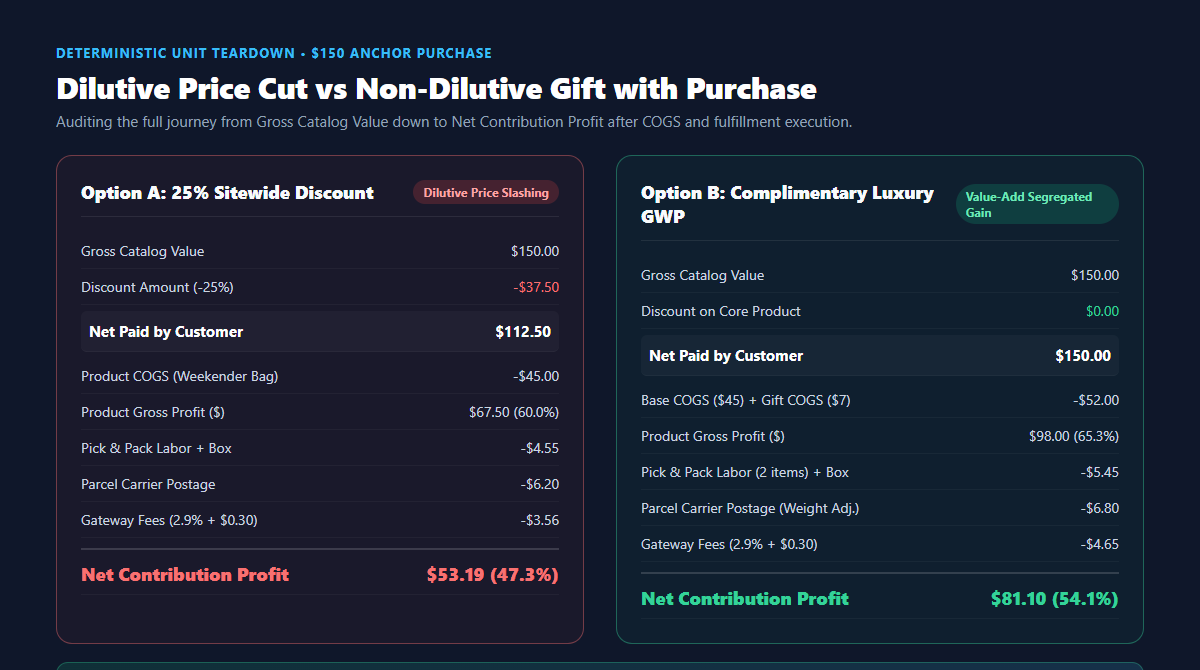
The illustrative teardown highlights an essential merchant reality: by delivering $35 of perceived gift value using a companion item that costs only $7 to manufacture, the brand captures +$27.91 more order contribution margin dollars (+52.5% higher contribution) on the exact same core transaction compared to a 25% price cut. Even after accounting for an extra warehouse pick fee ($0.60), larger packaging ($0.30), heavier parcel postage ($0.60), and higher processing fees ($1.09), Option B generates superior cash flow while keeping the anchor item’s $150 price intact.
Behavioral Economics Safeguards: Disentangling Evidence, Applied Deductions, and Storefront Friction
While behavioral economics literature provides powerful conceptual models for promotional design, academic studies conducted in simulated laboratory environments often break down when deployed in live ecommerce funnels. To maintain academic and professional rigor, merchants must clearly distinguish between three distinct analytical tiers:
- Empirical Core (Peer-Reviewed Evidence): Findings rigorously established in published academic research.
- Applied Deduction (Ecommerce UX Translation): Logical hypotheses on how these psychological principles map to digital cart and checkout interfaces.
- Storefront Operational Heuristic (Testing Requirement): Implementation rules that require store-level A/B testing and the specific UX friction points that cause the mechanism to fail.
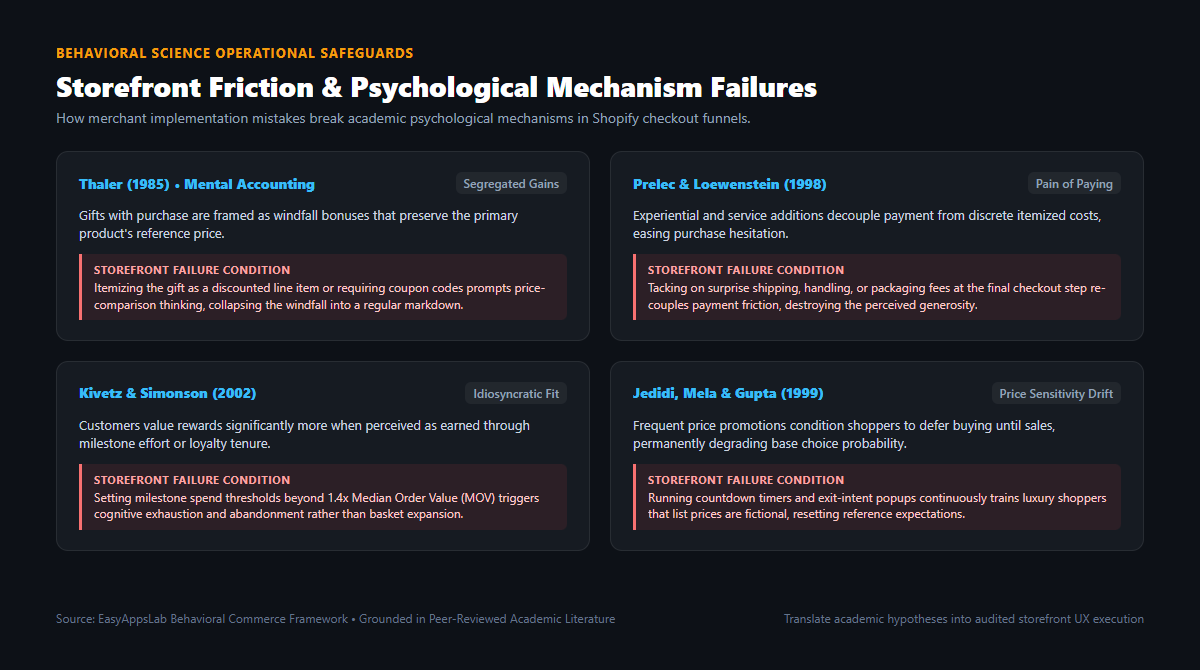
1. Thaler’s Mental Accounting and the Line-Item Trap
Empirical Core: Richard Thaler (1985) demonstrated that consumers evaluate financial transactions through mental accounts characterized by diminishing sensitivity to gains and losses. Specifically, segregating gains (experiencing multiple separate gains) produces higher subjective utility than integrating them into a single lump sum.
Applied Deduction: A gift with purchase functions effectively when perceived by the shopper as a distinct, segregated windfall bonus rather than a fractional price discount on the primary product.
Storefront Operational Friction & Testing: In Shopify theme checkouts, naive implementations often display the gift as a regular line item with a crossed-out price (e.g., “$35.00 -$35.00”) or require the customer to manually enter a promo code like “FREEGIFT”. In practice, requiring a coupon code prompts price-comparison thinking, collapsing the windfall into a regular markdown transaction. Operational Rule: Gifts must be injected automatically via modern checkout rules with zero coupon friction. Merchants should test automatic cart addition against drawer prompt notifications to verify that gift awareness is achieved without triggering discount-seeking behavior.
2. Prelec & Loewenstein’s Pain of Paying and Surprise Fees
Empirical Core: Drazen Prelec and George Loewenstein (1998) established that payment transactions evoke an immediate psychological “pain of paying” that serves as a consumer self-regulation mechanism. When consumption is coupled tightly with discrete out-of-pocket costs, purchase resistance peaks; decoupling payment from discrete consumption softens friction.
Applied Deduction: Bundling services, signature gift packaging, or expedited freight into the primary transaction price decouples payment pain from secondary logistics, increasing perceived brand generosity.
Storefront Operational Friction & Testing: If a storefront advertises premium positioning but introduces unexpected carrier surcharges, freight protection add-ons, or handling fees at the final checkout step, payment pain is violently re-coupled. The emotional irritation of hidden fees instantly wipes out the goodwill of the brand’s promotion, spiking cart abandonment. Operational Rule: Incorporate logistics costs into qualifying order thresholds and display guaranteed transparent delivery totals early in the cart drawer.
3. Kivetz & Simonson’s Effort-Reward Congruence and Starting Threshold Heuristics
Empirical Core: Ran Kivetz and Itamar Simonson (2002) proved that consumers value loyalty rewards and promotional perks substantially more when they perceive “idiosyncratic fit”—a belief that they have earned the reward through their own effort, spending milestone, or tenure, rather than receiving an unearned broadcast giveaway.
Applied Deduction: Customers respond more favorably to milestone tiers (e.g., “Spend $150 to unlock the Artisan Care Kit”) and tagged VIP perks than to generic sitewide coupons.
Storefront Operational Friction & Testing: Setting milestone thresholds arbitrarily high triggers consumer hopelessness. For example, if a store’s typical orders cluster at $80, a $200 threshold creates cognitive exhaustion. Rather than adding items, shoppers recognize the target as unreachable and complete their purchase at baseline—or abandon entirely. For deeper exploration of offer framing, review our companion guide to discount psychology.
How to Calibrate Milestone Thresholds: Data Distribution & Starting Heuristics
A frequent defect in promotional strategy is treating milestone thresholds as universal percentages. Setting milestone targets at +15% to +25% above median order value is a starting heuristic for testing, not a settled mathematical law. To configure profitable, high-converting milestone tiers, merchants should follow a structured three-step calibration process:
Step 1: Plot Order Value Distribution (MOV vs AOV)
Export the last 90 days of order data and plot an order value histogram. Maintain strict statistical hygiene by separating Median Order Value (MOV) from Average Order Value (AOV). Never conflate them into “median AOV.” Average Order Value is skewed upward by occasional corporate bulk orders or wholesale purchases. Median Order Value represents the true 50th percentile of typical consumer behavior.
Step 2: Match the Stretch Gap to Catalog Pricing Increments
A milestone threshold is effective only if the gap between the customer’s current cart and the threshold can be bridged by adding exactly one natural companion item from your catalog:
- Example: Suppose your store’s Median Order Value is $80. If your natural entry-level accessory products (leather balm, cleaning cloth, socks) retail between $25 and $35, setting a threshold at $105–$110 creates an achievable single-item stretch gap of $25–$30.
- The Friction Mistake: If you set the threshold at $140, the $60 gap forces the shopper to find two or three additional items. Friction compounds exponentially, leading to cart abandonment.
Step 3: Run A/B Threshold Elasticity Tests
Deploy split tests comparing different threshold levels (e.g., Variant A at MOV +15% vs Variant B at MOV +25%). Measure not merely whether order value rises, but whether total Order Contribution Margin dollars increase after accounting for reward COGS, fulfillment handling, and drop-off rates. For practical merchandising techniques on expanding order depth, explore our guide on how to increase basket size.
Shopify Platform Execution: Native Functions, API Limits & Real-World Engineering Insights
Executing non-dilutive brand promotions requires understanding Shopify’s technical infrastructure. Historically, complex promotions relied on client-side draft order hacks or legacy Script Editor scripts that introduced severe checkout flashing and broke multi-currency conversions. Modern promotional architecture on Shopify executes server-side within the checkout pipeline:
Shopify Functions & WebAssembly Resource Boundaries
Shopify discount customizations execute server-side as compiled WebAssembly (WASM) functions directly within Shopify’s checkout pipeline. As documented in official Shopify Functions developer specifications, functions target sub-5 millisecond runtimes and operate within strict resource boundaries:
- Instruction Budget: Capped at 11 million instructions per execution for carts up to 200 items (scaling dynamically thereafter).
- Memory Boundaries: A strict 10 MB linear memory ceiling and 512 kB call stack limit.
- Payload & Binary Limits: 256 kB compiled WASM binary size, 128 kB input query size, and 20 kB output response ceiling.
This server-side architecture ensures promotions apply instantaneously during checkout calculation, eliminating client-side coupon tampering and theme script conflicts.
The 25 Automatic Discount Platform Ceiling
Under the Shopify Help Center discount specifications, all Shopify stores enforce a hard platform limit of 25 active automatic discounts concurrently. This ceiling includes both native automatic discounts and app-generated automatic discount rules. Merchants attempting to launch dozens of separate uncoordinated promotions quickly hit platform errors. Consolidating multi-tiered milestone and GWP logic into unified function engines is essential to maintain clean store operations.
Cart Transform API for Luxury Bundling
For luxury and premium brands offering gift sets or companion bundles, the Shopify Cart Transform API provides a crucial capability: presenting a curated bundle to the customer as a single unified line item at full retail price, while programmatically expanding the bundle into distinct child SKUs inside Shopify Admin for warehouse inventory management and accurate fulfillment tracking.
| Execution Engine | Primary Focus | BOGO & Tiered Rules | Free Gift with Purchase | Spend Milestone Goals | Architecture | Verified Pricing |
|---|---|---|---|---|---|---|
| Shopify Native Automatic Discounts | Automated basic order and product discounts | Yes (Basic) | No (Native limitation) | No (Manual workarounds) | Native Checkout Engine | $0/mo (Included in Shopify) |
| Shopify Native Promo Codes | Manual checkout codes with tag restrictions | Yes (Basic) | No (Requires custom app) | Partial (Code-based) | Native Checkout Engine | $0/mo (Included in Shopify) |
| Easy Deals (EasyAppsLab) | Automated stepped spend goals, GWP, and VIP tiers | Yes (Full) | Yes (Automated cart inject) | Yes (Live progress tiering) | Shopify Functions (WASM) | Free tier / Paid from $9.90/mo |
Editorial Disclosure: Easy Deals is developed by EasyAppsLab. While Easy Deals provides native Shopify Functions execution for automatic gifts with purchase and stepped spend goals without draft order workarounds, native Shopify discounts remain completely sufficient for simple percentage promotions. Always select the promotional engine that matches your operational requirements without introducing unnecessary software overhead.
Real-World Engineering Lessons: 3 Storefront Edge Cases
In deploying and maintaining promotional engines across high-volume Shopify storefronts, our engineering team has cataloged three critical edge cases that frequently trip up merchant implementations:
- 1. Multi-Currency Rounding Misfires in Shopify Markets: When setting fixed dollar thresholds (e.g., “Spend $150 unlock Gift”), international storefronts converting to EUR or GBP often apply automatic price rounding rules (e.g., rounding $150 to €139.95). If your function looks for a strict local currency equivalent without currency-aware threshold conversion, international carts hovering at €139.95 may fail to trigger the milestone by 5 cents. Remedy: Configure currency-specific threshold overrides in Shopify Markets rather than relying on automatic FX conversion.
- 2. Out-of-Stock Gift Graceful Degradation: During high-traffic flash campaigns, popular companion gifts can sell out in minutes. If your function blindly attempts to add an out-of-stock gift SKU that has “Track quantity” enabled and “Continue selling when out of stock” disabled, Shopify checkout will throw an item availability error. Remedy: Build fallback logic into your function to automatically substitute an alternative gift tier or gracefully suppress the offer rather than blocking the checkout transaction.
- 3. Reciprocal Discount Combination Rules: Under Shopify’s discount combination model, two discounts can combine only if both rules explicitly authorize combination with each other’s discount class (Product, Order, or Shipping). If your GWP is configured as a product discount and allows combinations with shipping, but your store’s Free Shipping automatic discount is not set to allow combinations with product discounts, checkout will force a conflict and disable the free shipping perk. Always test combination reciprocity in sandbox checkouts before going live.
The Brand-Protection Promotional Checklist
Before approving any seasonal or milestone campaign, brand marketing and financial leaders should review this operational checklist to ensure positioning integrity and profit safety:
- Audit Reference Price Risk: Does the promotion alter the displayed catalog price of your hero products? If yes, evaluate whether the incentive can be restructured as a segregated gift or service upgrade.
- Calculate Order Contribution Margin: Have you modeled unit fulfillment costs (pick/pack labor, packaging box, carrier weight tiering, gateway fees) on the promotional basket to confirm that retained contribution dollars exceed baseline orders?
- Anchor Milestones to Median Order Value: Are stepped spend goals positioned based on catalog add-on price increments above Median Order Value (MOV) rather than an arbitrary target that alienates shoppers?
- Automate Free Gift Insertion: Is the companion reward added automatically via server-side checkout logic without forcing customers to enter manual coupon codes?
- Protect Discount Combination Reciprocity: If combining free shipping with gifts with purchase, have you verified that both rules allow combinations to prevent checkout conflicts?
- Set Definite Exclusivity Boundaries: Are VIP perks restricted to authenticated customer accounts or explicit customer tags to maintain genuine earned status?
Frequently Asked Questions
Can luxury or premium brands ever offer direct percentage discounts?
While blanket public markdowns damage brand equity, controlled exceptions exist: discreet private sales for verified VIP clients (hosted behind customer logins or unlisted URLs) and end-of-season archive sales for discontinued past-season styles. The critical rule is never discounting current-season anchor catalog items on public storefront banners.
How do I choose the right companion gift for a GWP promotion?
The ideal gift possesses high perceived utility but low manufacturing COGS (typically 15% to 20% of its perceived retail price), such as specialized maintenance kits, protective travel pouches, or branded travel miniatures. Avoid offering surplus inventory of unrelated slow-moving items, as irrelevant gifts signal clearance dumping rather than thoughtful curation.
What is the difference between Median Order Value and Average Order Value?
Average Order Value (AOV) is the mathematical mean (total revenue divided by total orders), which is heavily skewed upward by occasional bulk or corporate purchases. Median Order Value (MOV) is the exact middle value of all orders arranged by size. Calibrating milestone spend thresholds around MOV ensures that promotional targets genuinely challenge the typical consumer without subsidizing orders that would have reached that tier naturally.
Author & Editorial Governance
Author: EasyAppsLab Engineering & Research Team. Our commerce engineering specialists have over 8 years of dedicated experience developing high-performance Shopify apps, Shopify Functions WebAssembly integrations, and promotional checkout architectures for global DTC merchants.
Editorial Standards: This guide was developed under EasyAppsLab’s Universal Editorial Operating Standard (EQS-90 v1.1). All mathematical calculations were audited via automated margin recalculators, and all technical platform limits were verified against official Shopify Developer Documentation. EasyAppsLab maintains complete editorial independence; app evaluations are based on verified technical architecture and live merchant testing.