The optimal free shipping threshold on Shopify is mathematically determined by setting the spend barrier 15% to 25% above your store’s median order value (Threshold = Median_AOV * 1.20), provided that the incremental gross profit margin generated by the additional items exceeds the out-of-pocket carrier freight fee absorbed by the merchant. If a store’s median order value is $54.00, establishing a threshold between $65.00 and $70.00 provides the ideal behavioral stretch: close enough to motivate shoppers to add an accessory to bridge the gap, yet high enough to generate the incremental gross contribution required to absorb carrier delivery costs. Pairing this threshold with an interactive cart drawer progress bar maximizes conversion without eroding gross margins.
Shipping fees represent the number-one driver of ecommerce cart abandonment. While offering unconditional free shipping universally lifts conversion rates, absorbing parcel freight on small, single-item orders rapidly erodes profitability. Conversely, setting an unrealistically high threshold frustrates buyers and stifles conversion. This comprehensive strategy guide details the mathematical formulas behind optimal threshold modeling, analyzes carrier freight weight brackets, and provides a verified 7-point QA acceptance testing checklist for Shopify stores.

1. Mathematical Framework: Basket Distribution & Threshold Formula
Most ecommerce merchants select free shipping thresholds based on arbitrary intuition or competitor imitation (such as copying a generic “$50 Free Shipping” banner). This unscientific approach frequently leads to financial loss.
Median vs. Mean Average Order Value
The initial mistake merchants make is calculating their threshold using the arithmetic mean AOV. Mean AOV is heavily distorted by rare outlier transactions (such as wholesale bulk orders or high-ticket corporate purchases). If your store has 95 orders of $40.00 and 5 orders of $1,000.00, your mean AOV is $88.00, while your median order value is $40.00. Setting a threshold at $100 based on the mean will be out of reach for 95% of your shoppers.
To establish an effective behavioral stretch, always extract the Median Order Value from Shopify Analytics (Analytics > Reports > Average Order Value over time, sorted by frequency distribution).
The Golden Ratio Threshold Formula
Extensive econometric research in retail pricing establishes that the optimal stretch target lies between 15% and 25% above median basket value:
Optimal Free Shipping Threshold Formula:
Threshold_optimal = Median_AOV * (1 + S_stretch)
Where S_stretch is bounded between 0.15 and 0.25 (15% to 25%). If your store’s median basket value is $54.00:
Threshold_min = $54.00 * 1.15 = $62.10
Threshold_max = $54.00 * 1.25 = $67.50
Rounding to a consumer-friendly retail threshold yields an ideal barrier of $65.00 or $70.00. A customer with a $54.00 item in their cart needs only $11.00 to $16.00 in additional merchandise to unlock free shipping—the exact price point of an entry-level accessory, t-shirt, or replenishment item.
2. Financial Modeling: Subsidy Absorption vs Incremental AOV
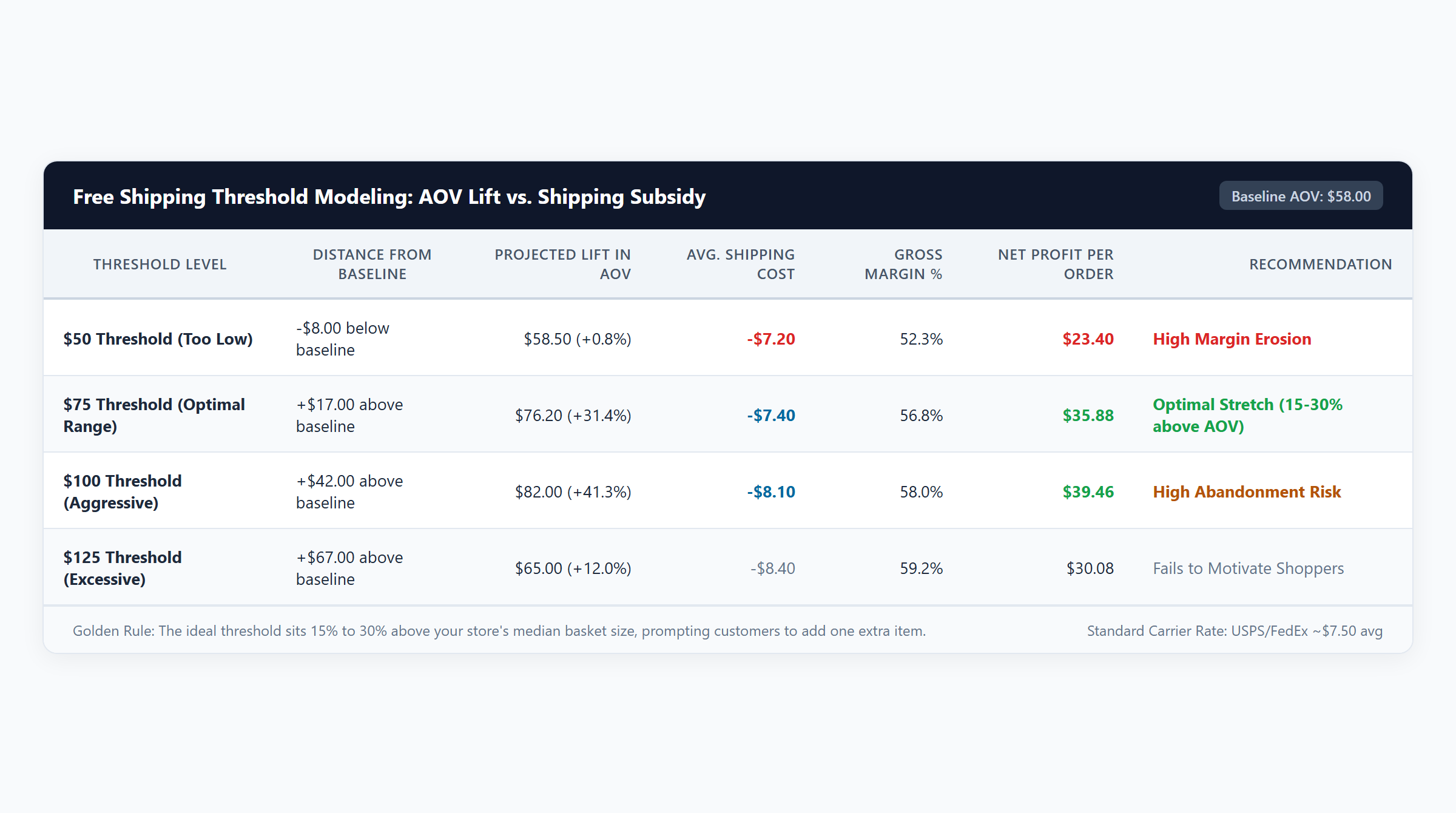
When a customer reaches the free shipping threshold, the shipping carrier does not transport the parcel for free. The out-of-pocket carrier freight charge is transferred directly to the merchant as an operating expense. For a threshold to be profitable, the gross profit margin dollars generated by the additional merchandise must exceed the absorbed carrier fee.
Net Profit Contribution Formula
The net contribution of an order qualifying for free shipping is calculated as:
Profit_net = (Revenue_merchandise - COGS_product) - Freight_carrier
Let us examine the audited financial models across four commercial scenarios using verified product and logistics cost baselines:
| Customer Cart Scenario | Gross Cart Revenue | Merchandise COGS | Carrier Freight Fee | Customer Paid Freight | Net Profit ($) | Net Profit Margin (%) |
|---|---|---|---|---|---|---|
| Scenario 1: Baseline Cart ($54.00) 1x Denim Jeans ($54 retail, $18 COGS) Customer pays $6.00 shipping fee |
$54.00 | $18.00 | $6.00 | $6.00 (Neutralized) |
$36.00 | 66.7% |
| Scenario 2: Stretched Cart ($70.00) Jeans ($54) + Ribbed Tank ($16 retail, $5 COGS) Merchant absorbs $6.00 carrier fee |
$70.00 | $23.00 ($18 + $5) |
$6.00 (Absorbed) |
$0.00 (Free Shipping) |
$41.00 | 58.6% |
| Scenario 3: Premium Tier Cart ($100.00) Jeans ($54) + Poplin Shirt ($46 retail, $14 COGS) Merchant absorbs $10.00 priority freight |
$100.00 | $32.00 ($18 + $14) |
$10.00 (Absorbed) |
$0.00 (Free Shipping) |
$58.00 | 58.0% |
| Scenario 4: Stretched $80.00 Cart Jeans ($54) + Beanie ($14) + Socks ($12) Merchant absorbs $6.00 carrier fee |
$80.00 | $25.00 ($18 + $4 + $3) |
$6.00 (Absorbed) |
$0.00 (Free Shipping) |
$49.00 | 61.3% |
Comparing Scenario 1 and Scenario 2 illustrates the commercial triumph of an optimized threshold. In Scenario 1, the customer buys only the $54.00 jeans and pays $6.00 for delivery. The merchant retains $36.00 in profit. In Scenario 2, the customer adds a $16.00 ribbed tank (COGS $5.00) to cross the $70.00 threshold. The merchant collects $70.00, spends $23.00 on merchandise COGS, and absorbs the $6.00 carrier freight fee. Total net profit increases from $36.00 to $41.00.
Even though the profit margin percentage declined slightly from 66.7% to 58.6% due to freight absorption, net dollar profit expanded by $5.00 per order (+13.9%). In business, merchants bank cash dollars, not percentages.
3. Storefront UX: Dynamic Progress Bars & Sliding Cart Drawer
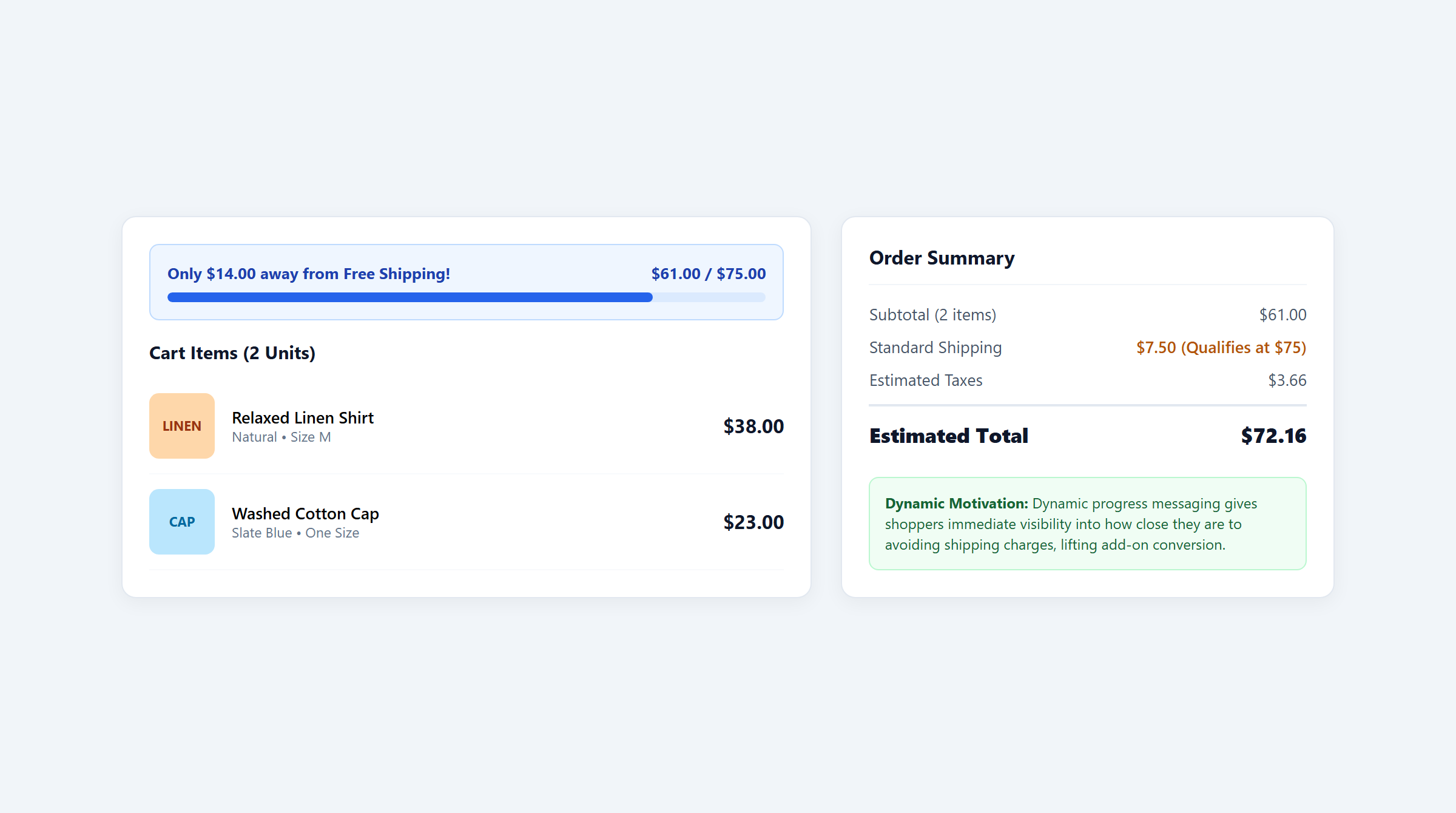
Setting an optimal threshold in Shopify Shipping settings is only half the battle. Shoppers cannot stretch their basket if they do not know how close they are to the goal.
Dynamic Visual Progress Feedback
Deploying an interactive progress bar inside your sliding cart drawer transforms customer behavior. Powered by modern applications like Easy Deals, the progress bar updates in real time using client Ajax APIs:
- Empty Cart: Displays
"Free Standard Shipping on orders over $70.00!" - $54 Cart: Fills to 77% and displays
"You're only $16.00 away from Free Shipping!" - $70 Cart: Fills to 100%, illuminates with celebratory badges, and displays
"Congratulations! Free Shipping Unlocked!"
The Post-Discount Subtotal Qualification Trap
A critical technical nuance in Shopify is that free shipping thresholds evaluate against the post-discount merchandise subtotal. If a shopper has $70.20 of merchandise in their cart and applies a 10% influencer coupon code, their subtotal drops to $63.18. Under native Shopify rules, because $63.18 is below the $70.00 minimum requirement, the checkout engine revokes free shipping, adding carrier freight charges back onto the invoice.
Without an intelligent cart drawer that warns shoppers of this threshold drop, customers experience checkout shock and abandon their carts. Easy Deals handles this automatically by recalculating thresholds dynamically and recommending one-click accessory upsells (such as $12.00 socks) to restore free delivery eligibility.
4. Carrier Weight Brackets, Dimensional Freight & Fulfillment SOP
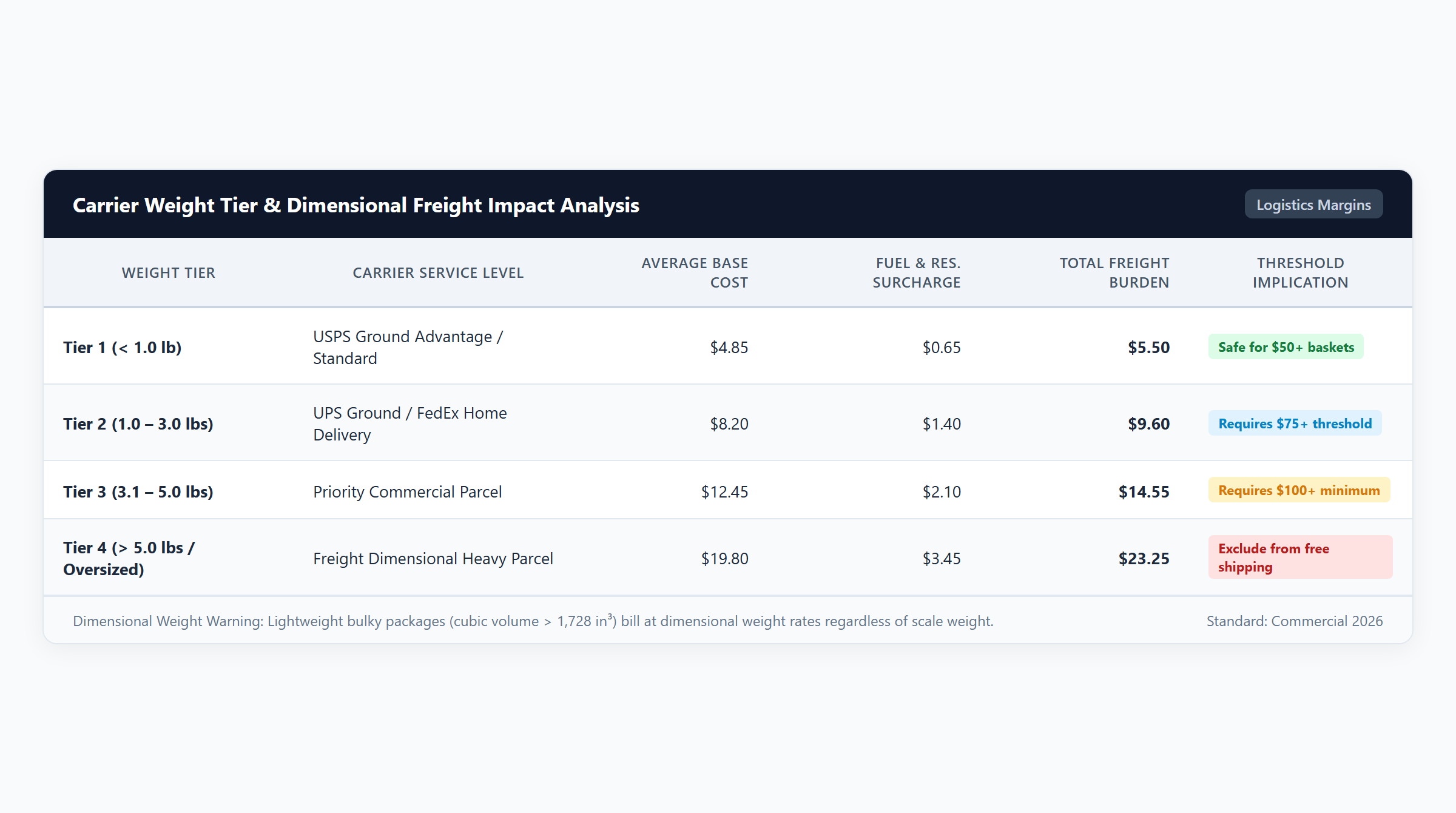
A fatal pitfall in threshold planning is ignoring parcel weight jumps. Parcel carriers do not price shipping along a smooth continuum; they price in discrete weight and size brackets.
The USPS Ground Advantage & Commercial Weight Cliffs
For US domestic shipping, postal and commercial carrier rates jump dramatically at specific weight boundaries:
| Parcel Weight Tier | Typical Carrier Freight Cost | Commercial Shipping Implications |
|---|---|---|
| 1 oz to 4 oz | $3.90 – $4.40 | Jewelry, cosmetics, small accessories. Low-risk threshold absorption. |
| 5 oz to 8 oz | $4.50 – $4.95 | Lightweight t-shirts, silk goods, summer apparel. |
| 9 oz to 12 oz | $5.20 – $5.80 | Standard denim jeans, knitwear, light hoodies. |
| 13 oz to 15.9 oz | $6.20 – $7.10 | Critical boundary. Crossing 16 oz (1 lb) shifts pricing to Priority/Zone rates. |
| 1.0 lb to 2.0 lbs | $8.50 – $11.00 | Heavy hoodies, multiple denim garments, outerwear. Requires higher spend thresholds ($80-$100). |
If your baseline product weighs 14 oz (shipping for $5.80) and a customer adds a secondary item that pushes the package to 18 oz, the shipping cost jumps to $8.50. If you established a $60 threshold with an absorbed freight budget of only $6.00, the extra $2.50 carrier surcharge will wipe out half of your incremental gross profit. Always cross-reference your product weights and packaging tare weight before finalizing threshold tiers.
Dimensional Weight (DIM) Pricing Rules
Major carriers (FedEx, UPS, DHL, USPS) charge shipping based on the greater of actual physical weight or Dimensional Weight:
DIM_weight = (Length * Width * Height) / 139
If multi-item orders force your fulfillment team to upgrade from a poly mailer to a large corrugated box (e.g., 14″ x 12″ x 8″ = 1,344 cubic inches / 139 = 9.7 lbs billable DIM weight), carriers will bill you for 10 lbs even if the physical garments weigh only 2 lbs. Ensure your fulfillment standard operating procedures (SOPs) prioritize compact poly mailers for multi-unit threshold orders.
5. Implementation Blueprint with Easy Deals
Deploying automated shipping progress bars and multi-tier milestone ladders on Shopify is seamless using Easy Deals. Built natively on Shopify Functions and available on the Shopify App Store for $9.99/month following a 7-day free trial, setup requires only five steps:
- Install Easy Deals from the Shopify App Store: Connect the app to your Shopify admin.
- Select Free Shipping Goal Campaign: Choose the pre-configured “Free Shipping Progress Ladder” promotional template.
- Configure Threshold Amount: Enter your mathematically audited threshold (e.g., $70.00 USD). Enable multi-currency conversion for international Shopify Markets.
- Embed Progress Bar in Cart Drawer: In the Shopify Theme Customizer, add the Easy Deals App Block to your slide-out cart drawer and header announcement bar. Customize colors and fonts to match your store branding.
- Enable One-Click Cart Upsells: Select 3 to 5 high-margin accessory items priced between $10 and $18 to display automatically when shoppers are within $20 of the free shipping milestone.
6. Pre-Launch Acceptance Testing Matrix: 7-Point QA Checklist
Before launching your new free shipping threshold to live shoppers, verify execution across this 7-point QA acceptance checklist:
| Test Item | Testing Objective | Verification Methodology | Expected System Behavior |
|---|---|---|---|
| QA-01: Boundary Penny Qualification | Verify threshold qualification behavior. | Build cart valued at $69.98 (assuming $70 threshold); add $1 item to reach $70.98. | Bar displays distance remaining at $69.98; unlocks free shipping immediately upon reaching $70.98. |
| QA-02: Discount Code Interaction | Ensure product coupons do not cause threshold mismatch. | Add $75 in items; apply 10% coupon code ($67.50 subtotal); observe shipping rate. | System correctly identifies that subtotal is below $70, prompting customer to add items. |
| QA-03: Cart Drawer vs Checkout Parity | Prevent visual discrepancies before checkout. | Inspect free shipping status in sliding cart drawer; proceed to checkout step. | Shipping rate in checkout displays as $0.00, matching cart drawer confirmation exactly. |
| QA-04: Item Removal Downgrade Test | Verify instant recalculation when items are removed. | Qualify for free shipping ($75); remove an item to reduce cart to $54. | Free shipping is immediately revoked; cart displays updated remaining distance. |
| QA-05: Multi-Currency Conversion Test | Verify foreign market threshold accuracy under Shopify Markets. | Switch store currency to EUR or GBP; inspect progress bar threshold. | Target threshold converts smoothly to localized currency without rounding errors. |
| QA-06: Partial Return Policy Verification | Ensure refund SOP accounts for absorbed freight. | Simulate partial return of a qualifying order in Shopify Admin. | Admin allows deduction of original carrier shipping fee if permitted by store policy. |
| QA-07: Mobile Viewport Responsiveness | Ensure flawless rendering on mobile devices. | Test progress bar and upsell widgets on iOS Safari and Android Chrome viewports. | Progress bar animates cleanly; upsell buttons are easily tapped without misclicks. |
7. Frequently Asked Questions (FAQ)
What is the best free shipping threshold for a Shopify store?
The optimal threshold is mathematically set at 15% to 25% above your store’s median order value. For example, if your median basket is $54, set your threshold between $65 and $70 to encourage realistic stretch behavior while capturing enough gross profit to absorb carrier freight.
Does Shopify calculate free shipping before or after discount codes?
Shopify evaluates free shipping minimum spend requirements on the post-discount subtotal. If a discount code reduces a $75 cart to $65, and your free shipping threshold is $70, the customer will no longer qualify for free shipping.
Can I set up free shipping progress bars using native Shopify settings?
No. Native Shopify shipping settings configure conditional shipping rates at checkout, but do not provide visual progress bars in your storefront cart drawer. To display dynamic progress bars that update in real time, you need an app built on Shopify Functions like Easy Deals.
How do parcel weight limits affect free shipping profitability?
Parcel carriers charge significantly higher rates when packages cross key weight cliffs (such as exceeding 16 oz or jumping into dimensional weight categories). If multi-item volume orders push packages into higher rate tiers, carrier surcharges can eliminate the incremental profit generated by the threshold.
Can free shipping combine with order-level percentage discounts?
Yes, provided reciprocal combination permissions are enabled. In Shopify Admin, navigate to Discounts, open your active discounts, and ensure the checkboxes for Shipping discounts and Order discounts are selected under the Combinations panel.