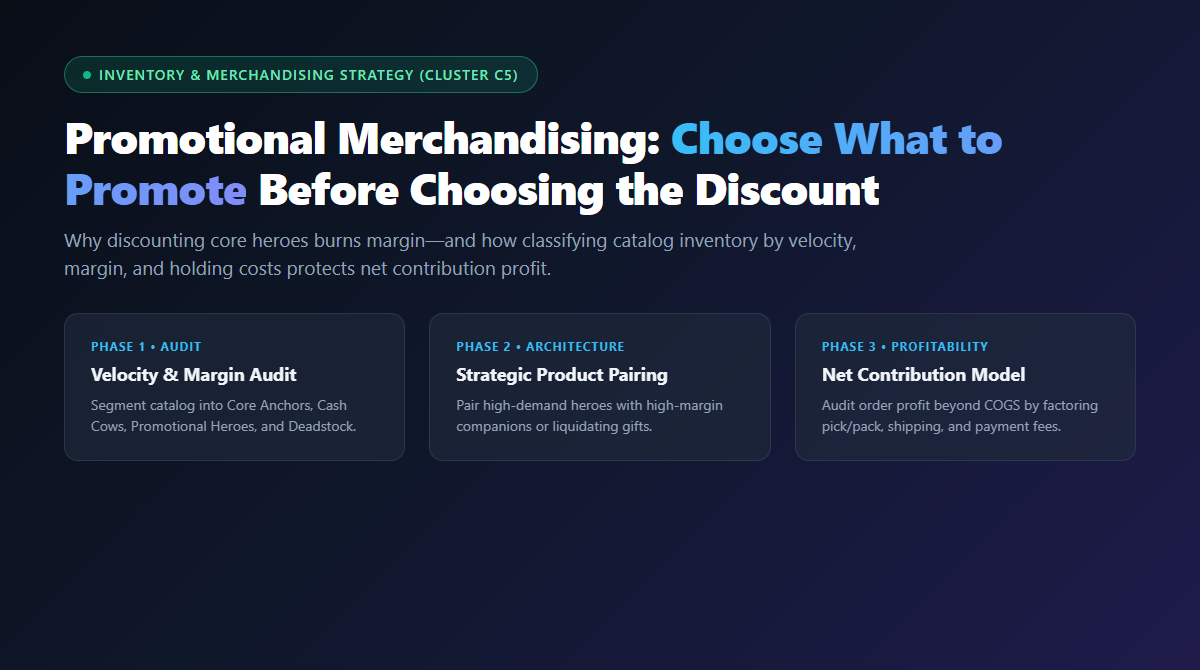
Promotional merchandising is the strategic discipline of deciding which specific products in your catalog to promote, in what combination, and for what business objective before selecting a discount mechanic. Most Shopify merchants approach sales in reverse: they choose a headline discount—such as 20% off sitewide or a storewide coupon code—before evaluating catalog inventory health. This unmerchandised approach damages profitability by discounting high-demand core items that shoppers would have purchased at full price, while stagnant deadstock continues to accumulate warehouse holding fees. By segmenting your catalog across a 4-Quadrant Velocity and Margin Matrix (Core Anchors, Cash Cows, Promotional Heroes, and Aging Deadstock), you can structure targeted product pairings, non-dilutive gifts with purchase (GWP), and stepped spend milestones. This strategy protects baseline gross margins, prevents margin cannibalization, and maximizes net contribution profit across every order.
The Discount-First Trap: Why Unmerchandised Sales Destroy Net Profit
When sales volume plateaus or cash flow tightens, the most common operational impulse is to launch an unconstrained promotional code or a storewide percentage sale. A prominent storefront banner announcing “20% Off Sitewide” produces an immediate bump in top-line transaction volume. However, evaluating promotional success solely through gross revenue ignores the severe margin cannibalization occurring beneath the surface.
When an offer applies uniformly across an entire catalog, customer purchasing behavior concentrates heavily on the products with the highest organic demand: your best-selling flagship items. Shoppers who arrived at your store with high purchase intent for your core heroes receive an unearned price reduction. The merchant surrenders 20% of gross revenue without altering customer basket composition, introducing companion products, or accelerating the turnover of slower-moving SKUs.
At the same time, aging inventory remains untouched. Discounting a broad catalog does not solve the fundamental visibility problem of slow-moving items: if an overstocked SKU suffers from low product page traffic or weak category placement, a sitewide discount will not magically surface it to relevant shoppers. Consequently, the merchant suffers a double loss: high-margin revenue on core items is permanently forfeited, while obsolete inventory continues to occupy warehouse space.
In addition to margin erosion, blanket price promotions trigger long-term psychological and regulatory complications. In foundational consumer research published in the Journal of Marketing Research, Raghubir and Corfman (1999) demonstrated that repeated direct price cuts lead consumers to make unfavorable inferences regarding product quality and systematically depress internal reference pricing. When regular prices are restored, returning shoppers perceive full retail prices as an unfair surcharge. Furthermore, under Federal Trade Commission guides against deceptive pricing (16 CFR Part 233.1), advertising ongoing promotional discounts against inflated or artificial regular prices creates serious regulatory exposure unless the former price was genuinely offered in good faith on a regular basis for a substantial preceding period.
The Inventory Carrying Cost Reality: The Hidden Math of Holding Stock
Merchants often hesitate to liquidate aging inventory because they view discounts as “losing money.” A merchant who manufactured an accessory for $10 and listed it for $35 may refuse to offer it as a complimentary gift with purchase, hoping an organic buyer will eventually pay full price. This psychological reluctance stems from ignoring the compounding economic reality of inventory carrying costs.
In supply chain management accounting (Ballou; Coyle et al.), annual inventory carrying costs consistently benchmark between 20% and 30% of total inventory value. This cost is not merely warehouse storage fees; it comprises four distinct financial drains:
- Capital Cost (WACC & Opportunity Cost): Capital tied up in stagnant inventory cannot be reinvested into reordering high-velocity best-sellers, funding paid customer acquisition, or improving cash reserves.
- Storage & 3PL Warehousing Fees: Pallet fees, shelf fees, cubic-foot storage rates, and long-term storage surcharges assessed by third-party logistics (3PL) providers continually erode unit margin.
- Service & Risk Costs: Inventory insurance premiums, local personal property inventory taxes, and administrative warehouse management software fees scale directly with stock volume.
- Shrinkage, Damage & Obsolescence: The longer a physical SKU sits in a fulfillment center, the higher the cumulative probability of package degradation, customer return damage, seasonality expiration, or technological obsolescence.
On a monthly basis, carrying costs represent roughly 1.5% to 2.5% of an item’s landed cost. If an overstocked SKU with a $10.00 cost basis sits in your warehouse for 12 months, you have incurred $2.00 to $3.00 in cumulative carrying costs. Holding stagnant inventory in pursuit of an elusive full-price sale is an active financial loss. Deploying that item as a strategic promotional incentive—such as a gift-with-purchase threshold reward or a companion bundle add-on—instantly halts carrying cost accumulation, reclaims working capital, and elevates the perceived value of your core offerings.
The 4-Quadrant Catalog Velocity & Margin Matrix: Classifying What to Promote
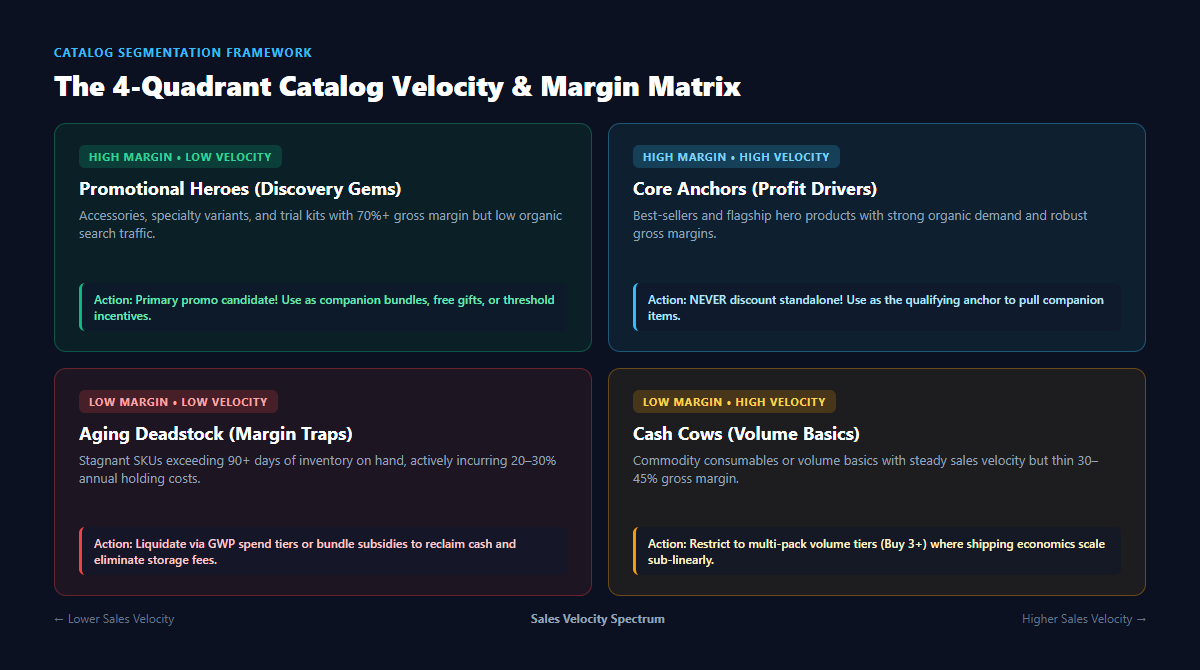
Before deciding whether to run a Buy X Get Y (BOGO) offer, a volume bundle, or a tiered order milestone, you must map your catalog across two objective dimensions: Sales Velocity (turnover rate and unit sales per month) and Gross Margin Percentage. This segmentation yields four distinct product roles:
Quadrant 1: Core Anchors (High Velocity, High Margin)
Core Anchors are your brand’s flagship products. They generate substantial search traffic, command high customer review volume, and deliver gross margins of 65% to 80%. Examples include a signature waxed canvas weekender bag, a proprietary skincare serum, or an ergonomic desk frame.
Promotional Rule: Never discount Core Anchors directly. Slashing prices on products that already convert reliably trains your core demographic to wait for sales and resets reference pricing downward. Instead, position Core Anchors as the qualifying trigger in promotional architectures: customers must purchase the Core Anchor at full retail price to unlock a discounted accessory or a free companion gift.
Quadrant 2: Promotional Heroes (Low Velocity, High Margin)
Promotional Heroes are high-potential catalog items that suffer from low organic discoverability. They possess exceptional gross margins (70% to 85%) and high customer satisfaction ratings among buyers who discover them, but they lack the standalone search volume of flagship items. Examples include specialty leather conditioner kits, high-end travel pouches, or concentrated facial mist refills.
Promotional Rule: This quadrant is your primary promotion vehicle. Because their cost of goods sold (COGS) is low relative to perceived retail value, Promotional Heroes provide the margin buffer required to absorb promotional incentives without eroding net profit. Deploy them as pre-selected companion bundle items, high-tier cart threshold rewards, or post-purchase one-click upsells.
Quadrant 3: Cash Cows (High Velocity, Low Margin)
Cash Cows are everyday volume drivers characterized by competitive pricing and modest gross margins (30% to 45%). Examples include staple t-shirts, basic charging cables, or replacement filters. They turn over rapidly but leave minimal margin cushion.
Promotional Rule: Restrict Cash Cows to multi-pack volume tiers (Buy 3, Save 15%). Because single-unit margins are thin, flat discounts destroy gross dollar profit. However, bundling multiple units into a single shipment scales fulfillment and postage costs sub-linearly, enabling merchants to share logistical savings with the customer while preserving total contribution dollars.
Quadrant 4: Aging Deadstock (Low Velocity, Low Margin)
Aging Deadstock comprises discontinued product variants, seasonal overruns, or unpopular colorways that have exceeded 90 to 120 days of inventory on hand (DOH). They tie up working capital and actively incur warehouse holding surcharges.
Promotional Rule: Liquidate through subsidization rather than clearance banners. Dumping deadstock into a public “Sale” collection devalues your storefront aesthetic and attracts low-LTV bargain hunters. Instead, leverage deadstock as an “unlocked complimentary gift” when shoppers cross a high basket threshold (e.g., “Spend $140, get a complimentary brass key fob”). Customers perceive $25 of retail value, while you eliminate holding costs and reclaim your initial manufacturing investment.
Three Strategic Merchandising Offer Architectures
Once your catalog is segmented, you can construct targeted promotional architectures that pair products strategically to drive basket growth without eroding price anchors:
Architecture 1: Anchor + High-Margin Companion Bundling
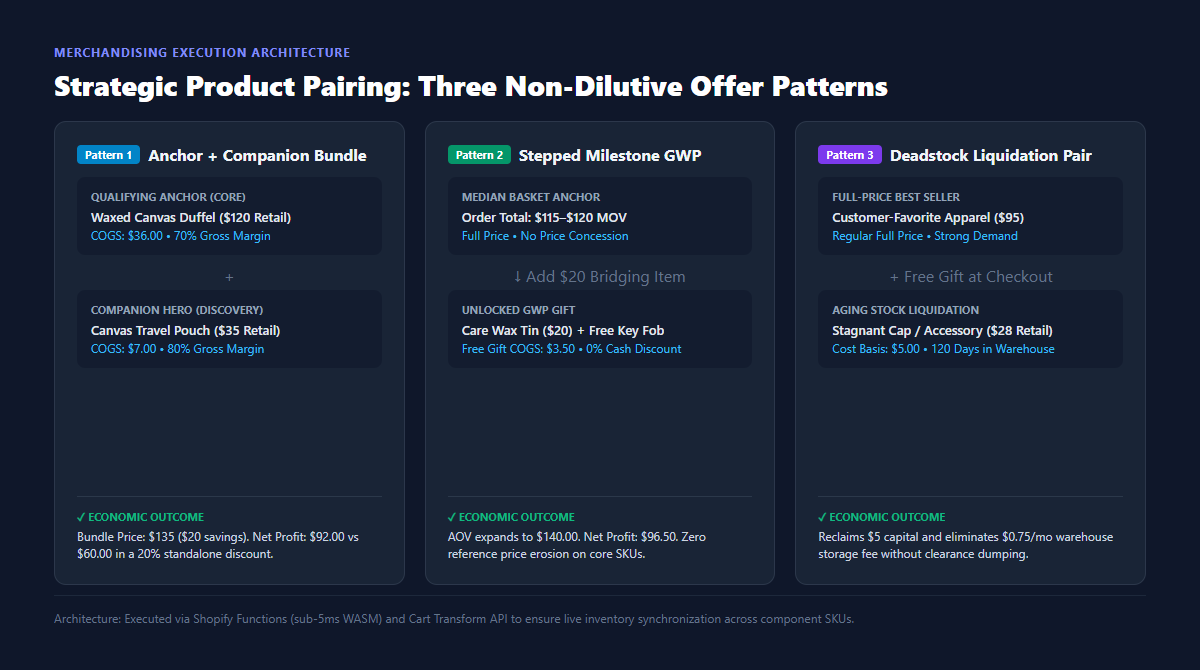
Rather than discounting a flagship item, bundle it with an essential high-margin companion item from Quadrant 2. For example, pair a $120.00 Waxed Canvas Duffel Bag ($36.00 COGS) with a $35.00 Canvas Travel Pouch ($7.00 COGS) at a combined bundle price of $135.00 ($20.00 total savings off $155.00 combined retail). The customer experiences an attractive bundle discount, while you generate $92.00 in gross dollar profit—surpassing both the full-price single bag sale ($84.00 profit) and crushing a standard 20% sitewide discount ($60.00 profit).
Architecture 2: Stepped Milestone GWP (Median Order Value Expansion)
A critical merchandising safeguard is setting spend thresholds based on Median Order Value (MOV) rather than Average Order Value (AOV). In typical ecommerce stores, AOV is distorted upward by occasional bulk wholesale orders or extreme high-spenders. If your median order is $115 but your mathematical mean AOV is $145, setting a promotional reward threshold at $160 places the goal out of reach for over 70% of shoppers.
By setting your reward milestone at $140.00 (roughly 20% above the $115.00 MOV), you establish an achievable target. To fulfill this architecture, merchandisers must provide designated “bridging items”—such as a $20.00 leather care wax tin—directly within the slide-out cart drawer. When shoppers cross $140.00, they unlock a complimentary overstocked gift. The customer pays full retail for both main items, basket size expands, and stagnant stock is cleanly liquidated.
Architecture 3: Tiered Volume Packs for Cash Cows
For consumable or staple goods in Quadrant 3, structure volume discount tables (e.g., Buy 2 Save 10%, Buy 3 Save 15%). The key merchandising requirement is verifying that additional unit shipping weight does not bump the parcel into a punitive freight tier. When planned correctly, incremental unit postage scales sub-linearly, protecting net contribution dollars while accelerating inventory turnover.
Audited Financial Model: Single-Order Net Contribution Profit Teardown
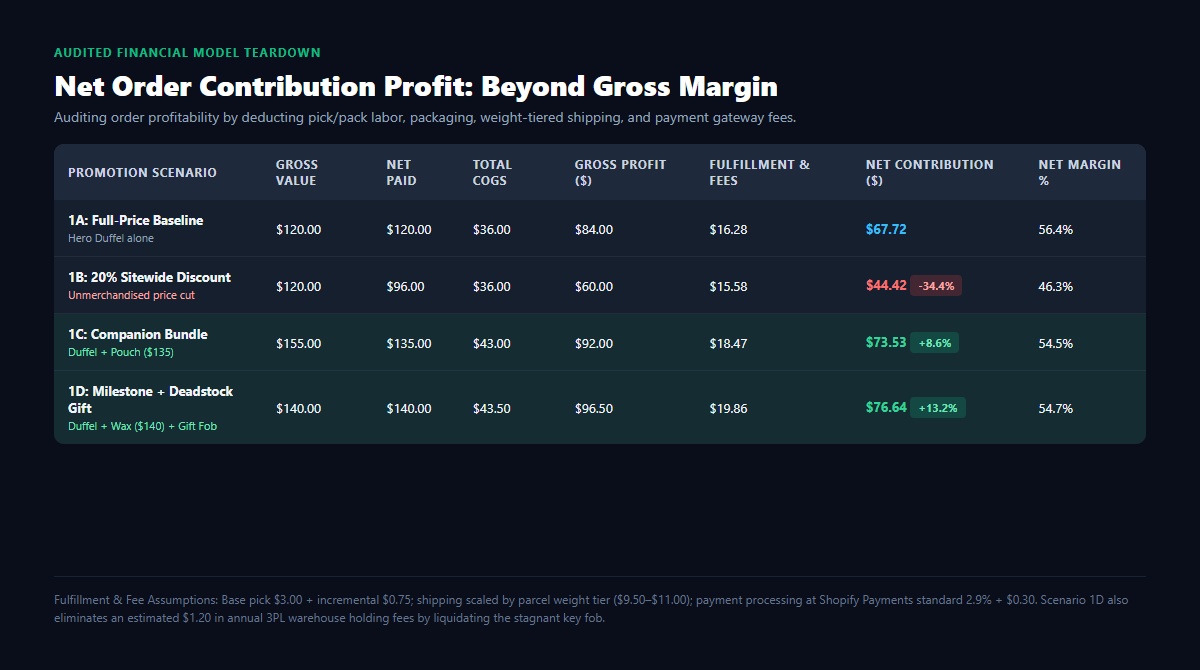
To demonstrate the profound divergence between unmerchandised discounting and strategic promotional merchandising, we examine four modeled single-order scenarios. This model evaluates Order Net Contribution Profit under controlled simulation assumptions by deducting manufacturing COGS, 3PL warehouse handling fees, parcel postage, and payment gateway processing fees.
Note: This teardown represents a modeled single-order scenario under controlled assumptions to isolate unit economics; it does not represent an empirical audit of private store accounts or guarantee storewide campaign elasticity.
Teardown Parameters & Operational Cost Assumptions
- Anchor Item: Heritage Waxed Canvas Duffel Bag ($120.00 retail, $36.00 manufacturing COGS).
- High-Margin Companion: Waxed Canvas Travel Pouch ($35.00 retail, $7.00 manufacturing COGS).
- Bridging Accessory: Leather & Canvas Care Wax Tin ($20.00 retail, $4.00 manufacturing COGS).
- Complimentary Gift (Overstocked): Solid Brass Key Fob ($25.00 retail, $3.50 manufacturing COGS, 120 days in storage).
- 3PL Fulfillment Fees: $3.00 base pick and pack for initial item; $0.75 for each additional item.
- Carrier Postage: Commercial parcel rates scaling by weight tier ($9.50 single item; $10.50 two items; $11.00 three items).
- Payment Processing: Shopify Payments domestic rate of 2.9% + $0.30 per completed transaction.
Comparative Financial Performance Table
| Metric | Scenario 1A: Baseline Full Price | Scenario 1B: 20% Sitewide Discount | Scenario 1C: Companion Bundle | Scenario 1D: Milestone GWP |
|---|---|---|---|---|
| Cart Contents | Duffel Bag alone | Duffel Bag (20% off) | Duffel + Pouch ($135) | Duffel + Wax + Gift Fob |
| Gross Catalog Value | $120.00 | $120.00 | $155.00 | $140.00 |
| Discount Deducted ($) | $0.00 | $24.00 | $20.00 | $0.00 |
| Net Paid by Customer | $120.00 | $96.00 | $135.00 | $140.00 |
| Total COGS (Products + Gifts) | $36.00 | $36.00 | $43.00 | $43.50 |
| Product Gross Dollar Profit | $84.00 | $60.00 | $92.00 | $96.50 |
| Product Gross Margin % | 70.0% | 62.5% | 68.1% | 68.9% |
| 3PL Pick & Pack Labor | $3.00 | $3.00 | $3.75 | $4.50 |
| Carrier Parcel Shipping | $9.50 | $9.50 | $10.50 | $11.00 |
| Payment Gateway Fee (2.9% + $0.30) | $3.78 | $3.08 | $4.22 | $4.36 |
| Total Fulfillment Execution Costs | $16.28 | $15.58 | $18.47 | $19.86 |
| Net Order Contribution Profit ($) | $67.72 | $44.42 | $73.53 | $76.64 |
| Net Contribution Margin % | 56.4% | 46.3% | 54.5% | 54.7% |
| Contribution Variance vs Baseline | Reference Baseline | -$23.30 (-34.4%) | +$5.81 (+8.6%) | +$8.92 (+13.2%) |
Strategic Takeaways from the Math:
- The Catastrophic Cost of Unmerchandised Discounts: In Scenario 1B, discounting the core duffel bag by 20% slashed net contribution dollars by -34.4% ($44.42 vs $67.72). To generate the same net dollar profit as a single full-price sale, the merchant must generate 1.52x more order volume—a hurdle that standard price elasticity rarely satisfies on core hero products.
- The Power of High-Margin Bundling: In Scenario 1C, introducing the high-margin travel pouch absorbs a $20.00 customer discount while lifting net contribution profit by +$5.81 (+8.6%) above baseline full price, and beating the 20% discount by +$29.11 (+65.5%).
- Deadstock Liquidation Arbitrage: In Scenario 1D, using the overstocked brass key fob as a threshold reward generates $76.64 in net contribution profit (a +13.2% gain over baseline). Furthermore, this transaction liquidates the stagnant key fob, immediately reclaiming $3.50 in working capital and avoiding an estimated $1.20 in annual 3PL warehouse holding surcharges.
Behavioral Economics Storefront Safeguards: Where Promotions Break
While academic behavioral economics demonstrates that non-dilutive offers outperform direct price cuts, psychological mechanisms fail when merchants introduce storefront UX friction. To preserve offer efficacy on Shopify, merchants must observe three operational safeguards:
1. Mental Accounting (Thaler 1985) & The Line-Item Trapping Error
Richard Thaler’s theory of mental accounting establishes that consumers separate transaction utility from acquisition utility. When an accessory is framed as a “complimentary gift,” the customer places it into an “unexpected gain” psychological account. However, if your cart drawer displays the free gift as a regular $25.00 product with a -$25.00 discount line item below it, the customer is reminded of its monetary cost, re-sensitizing them to price. To maintain transaction utility, present promotional gifts with explicit “$0.00 / FREE” labeling and prominent celebratory badges.
2. The Pain of Paying (Prelec & Loewenstein 1998) & Configuration Friction
Prelec and Loewenstein established that the psychological “pain of paying” intensifies when payments are tightly coupled to explicit consumption decisions. When merchants force shoppers to navigate complex multi-step modal configurators, select between 12 distinct gift variants, or enter manual coupon codes, friction spikes and cart abandonment increases. Mitigate this by pre-selecting default best-selling variants for companion gifts and leveraging automatic discounts that apply seamlessly without manual code entry.
3. Goal Gradient Acceleration (Kivetz et al. 2006) & The Threshold Gap Trap
Kivetz, Urminsky, and Zheng demonstrated that purchasing effort accelerates as consumers perceive proximity to a reward goal. A dynamic progress bar in the slide-out cart (e.g., “You are $20 away from a Free Travel Pouch”) significantly accelerates basket additions. However, the mechanism collapses if your catalog lacks “bridging items”: if a customer is $20 away from a threshold, but the cheapest available add-on in your store is $65, the customer experiences cognitive dissonance and abandons the goal. Merchandisers must curate dedicated $15–$25 impulse items directly beside the cart progress bar.
Shopify Platform Execution Architecture: Functions & Cart Transform
Executing sophisticated promotional merchandising requires modern Shopify platform architecture. Legacy Shopify discount scripts and draft-order hacks introduced checkout latency and broke automated fulfillment tracking. Today, merchants leverage two native platform primitives:
Shopify Functions (WebAssembly Execution)
Shopify Functions execute discount logic server-side on Shopify’s global infrastructure. Compiled to WebAssembly (WASM), Functions run in under 5 milliseconds and adhere to strict resource constraints: an 11 million instruction execution limit for carts up to 200 line items, a 256 kB binary size ceiling, and a 10 MB linear memory ceiling. This guarantees that complex promotional merchandising rules—such as evaluating customer purchase history or restricting BOGO eligibility to specific collections—execute without introducing checkout latency.
Cart Transform API & Component Inventory Tracking
When pairing companion bundles or gift items, inventory tracking is essential. Under Shopify’s Cart Transform API, a promotional bundle presented as a single merchandise item on the storefront is dynamically expanded into its underlying component SKUs at checkout. This ensures your warehouse management system (WMS) decrements inventory for both the duffel bag and the travel pouch accurately in real time, preventing overselling.
The 25 Automatic Discount Ceiling & Combinations
Shopify natively limits merchants to a maximum of 25 active automatic discounts per shop. If you run multiple automated merchandising rules, you must audit your discount combinations carefully. Shopify permits combining Product discounts, Order discounts, and Shipping discounts; however, multiple product-level automatic discounts will not stack on the same line item unless explicitly configured. Ensure your companion bundles do not conflict with sitewide free shipping thresholds.
Executing Promotional Merchandising: Implementation Options
Merchants can implement promotional merchandising through native Shopify admin features or specialized promotion apps built on Shopify Functions. The optimal choice depends on catalog size and campaign complexity:
| Solution / App | Primary Focus | BOGO & Bundles | Volume Tiers | Free Gift (GWP) | Spend Goals | Architecture | Verified Pricing |
|---|---|---|---|---|---|---|---|
| Shopify Native Automatic Discounts | Basic catalog discounting within platform limits | Supported (Standard Buy X Get Y) | Partial (Requires separate tiers) | Not Supported natively | Not Supported (No progress UI) | Shopify Native Checkout Engine | $0/mo (Included in Shopify) |
| Shopify Native Promo Codes | Manual coupon codes and customer segment rules | Supported (Code entry required) | Partial (Single tier per code) | Not Supported natively | Partial (Minimum order amount) | Shopify Native Checkout Engine | $0/mo (Included in Shopify) |
| Easy Deals (EasyAppsLab) | Stepped spend milestones, GWP, and companion pairing | Supported (Automated) | Supported (Tiered tables) | Supported (Automated $0 gift add) | Supported (Interactive slide cart bar) | Shopify Functions (WASM) | Free tier / $9.90/mo |
Editorial Disclosure: Easy Deals is developed by EasyAppsLab. While native Shopify discounts provide excellent no-cost functionality for simple Buy X Get Y rules, stores seeking automated cart progress bars, dynamic companion gift insertion, and multi-tier spend milestones benefit from dedicated Shopify Functions apps. Merchants should evaluate apps based on sub-5ms WASM performance and clean theme integration.
The 5-Metric Merchandising Audit: Actionable Pre-Launch Checklist
Before activating any promotional campaign on your Shopify store, evaluate your proposal against the 5-Metric Contribution Matrix to prevent “AOV Tunnel Vision”:
- Units Per Transaction (UPT): Does the offer structure actively encourage adding a complementary SKU, or does it merely discount a single item the customer was already buying?
- Median Order Value (MOV) Alignment: Is your promotional spend milestone set 15% to 20% above your true Median Order Value (not your mean AOV), and have you merchandised accessible bridging items in the cart drawer?
- Conversion Rate Elasticity: Have you modeled the break-even conversion volume required to offset any price concessions, ensuring that volume assumptions are grounded in historical store data?
- Product Gross Dollar Profit: Does the combined basket generate more absolute gross margin dollars than a full-price hero sale?
- Net Contribution Dollar Profit: Have you audited unit-level fulfillment realities—including pick/pack labor, weight-tiered parcel postage, and payment gateway processing fees—to confirm net dollar profitability?
By prioritizing product selection over discount percentages, you transform promotions from a dangerous margin drain into an engine for inventory health, customer discovery, and sustainable ecommerce profitability. For further strategic exploration, consult our companion guides on Brand Promotion Strategy, Ecommerce Promotion Strategy, and Basket Growth Beyond Bigger Discounts.