To set up a Buy 2 Get 1 Free (B2G1) promotion on Shopify, merchants can either use native Buy X Get Y discounts or deploy a dedicated promotion app powered by modern Shopify Functions. While Shopify includes built-in discount settings for basic Buy X Get Y rules at checkout, native discounts enforce two major operational hurdles: shoppers must manually search your store and add all three items to their cart before any discount evaluates, and native rules struggle to dynamically identify and discount the cheapest item across multi-product collections. To maximize conversion, high-growth brands deploy dedicated apps like Easy Deals that automatically detect qualifying items, discount the lowest-priced eligible unit to $0.00, and display real-time milestone progress bars in AJAX cart drawers via sub-5ms WebAssembly execution without slowing down checkout.
However, running Buy 2 Get 1 Free promotions across a diverse product catalog introduces serious financial risks if price spreads are not controlled. Offering “Buy 2 Get 1 Free” across a collection containing both $20 accessories and $80 jackets can lead to severe profit collapse if shoppers purchase two inexpensive items to claim the expensive jacket for free. This comprehensive guide covers the technical architecture of Shopify B2G1 offers, analyzes the unit economics of cheapest-item price targeting, provides a break-even volume elasticity formula, and outlines a 7-point acceptance test matrix for zero-defect peak season execution.
1. Architecture: How Buy 2 Get 1 Free Evaluates on Shopify (Native vs. Shopify Functions)
Before launching a campaign, merchants must evaluate the underlying architectural execution engine powering their discounts.
Native Shopify BXGY Configuration & Limitations
Within the Shopify Admin (under Discounts > Create discount > Buy X Get Y), merchants can configure a native automatic discount with the following parameters:
- Customer buys: Minimum quantity of 2 items from a designated collection.
- Customer gets: Quantity of 1 item from the same collection at 100% discount.
- Discount value: Free (100% off).
While straightforward, this native setup introduces critical storefront friction: per official Shopify documentation, all 3 items must be manually placed in the cart by the customer. If a shopper adds two items expecting the third to be automatically inserted at checkout, the discount does not trigger. Furthermore, native Shopify automatic discounts apply only at the final checkout step, leaving the cart drawer without visual confirmation, milestone progress bars, or dynamic prompts.
The Evolution: Legacy Draft Orders & Scripts vs. Shopify Functions
Historically, merchants turned to third-party apps that utilized fragile workarounds to deliver B2G1 functionality:
- Draft Orders Workaround (Deprecated): Early apps redirected shoppers through the Draft Order API to force line-item price overrides. This broken architecture disabled accelerated checkouts (Shop Pay, Apple Pay), erased marketing attribution tags, bypassed automated tax calculation engines, and caused inventory sync conflicts.
- Shopify Scripts (Sunset / Deprecated): Ruby-based Scripts ran only on enterprise Shopify Plus plans and required ongoing developer maintenance. Shopify has officially deprecated the Script Editor, mandating migration to Shopify Functions.
- Shopify Functions (Modern Standard): Introduced via Shopify Checkout Extensibility, Functions compile custom promotional logic into WebAssembly (WASM). Functions execute server-side directly within Shopify’s checkout infrastructure under a strict 5 millisecond runtime budget. Functions maintain 100% compatibility with Shop Pay, introduce zero client-side JavaScript delay, and support clean discount allocations across line items.
| Architectural Metric | Native Shopify BXGY | Legacy Draft Orders / Scripts | Modern Shopify Functions App |
|---|---|---|---|
| Cart Feedback & Steppers | No (Applies only at checkout) | Variable | Yes (Real-time cart drawer bar) |
| Cheapest Item Targeting | Basic Line Matching | Custom Script Logic | Dynamic Multi-Item Sorting |
| Execution Latency | Native Checkout Core | External API latency / Ruby Script | Sub-5ms WebAssembly (WASM) |
| Accelerated Wallets (Shop Pay) | Fully Compatible | Broken / Disabled | 100% Accelerated Checkout Parity |
| Platform Limit Pool | Up to 25 Auto-Discounts | Variable | Within Platform 25-Rule Pool |
For an architectural teardown of checkout engines, read our guide on Shopify native discounts vs. discount apps.
2. Price Targeting & Margin Protection: The “Cheapest Item” Rule
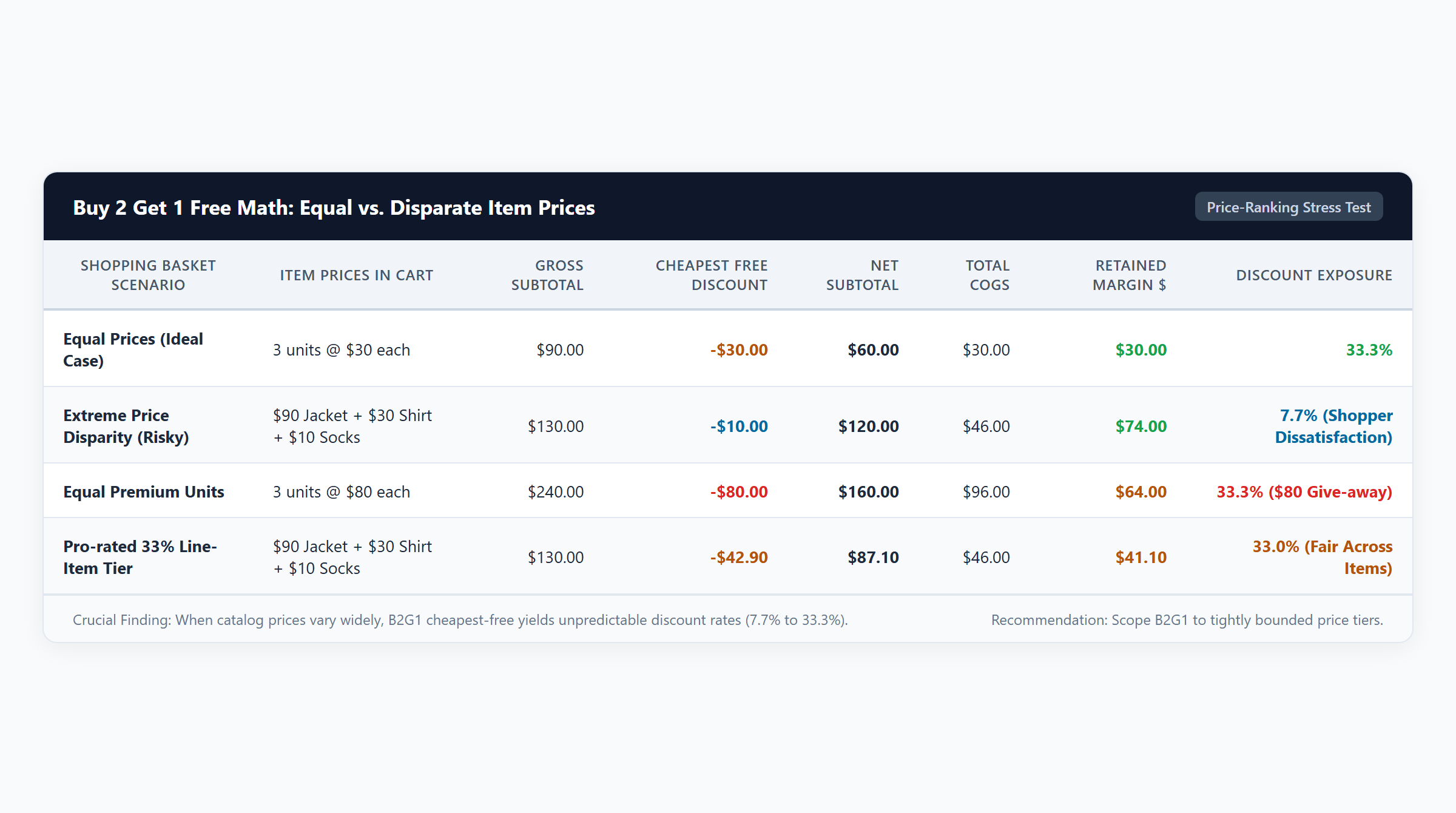
The primary commercial hazard of Buy 2 Get 1 Free campaigns is price spread variance. When a collection includes products across multiple price tiers, your discount allocation logic dictates your store’s profitability.
The Mathematical Proof: Cheapest Item vs. Most Expensive Discounting
Consider a shopper building a three-item cart from an eligible apparel collection with unequal prices: a $50 Denim Jacket, a $40 Button-Down Shirt, and a $20 Canvas Tote Bag (Gross Catalog Value: $110.00; Total Landed COGS: $33.00).
- Model A (Cheapest Item Discounted – Easy Deals Standard): The app sorts eligible cart items by price and discounts the lowest-priced unit ($20 Tote Bag) to $0.00. The customer pays $90.00. Subtracting $33.00 in COGS leaves the merchant with $57.00 in gross profit (63.3% gross margin).
- Model B (Flawed / Most Expensive Item Discounted): If an app improperly discounts the highest-priced unit ($50 Jacket) to $0.00, the customer pays only $60.00. Subtracting the identical $33.00 in COGS leaves the merchant with only $27.00 in gross profit (45.0% gross margin).
Discounting the most expensive item results in a 52.6% collapse in net profit dollars ($27.00 vs. $57.00) on the exact same inventory shipment! Ensuring that your promotional engine strictly targets the cheapest eligible item is the single most important margin guardrail in multi-product B2G1 promotions. Explore dedicated setup workflows in our Shopify cheapest item discount guide.
Behavioral Economics: Why B2G1 Outperforms Percentage Markdowns
From a pure arithmetic perspective, a Buy 2 Get 1 Free offer on three equal-priced items represents an effective 33.33% discount. However, behavioral research proves that framing the offer as “Buy 2 Get 1 Free” dramatically outperforms a “Get 33% Off” banner:
- The Zero-Price Effect (Shampanier, Mazar & Ariely, 2007): Groundbreaking research published in Marketing Science demonstrates that items priced at exactly zero trigger an affective emotional surge. Consumers do not evaluate a “Free” third item as a marginal 33% calculation; they perceive it as an unearned gift with zero downside risk, driving substantially higher cart completions.
- Reference Price Preservation (Raghubir & Corfman, 1999): Directly slashing catalog prices by 33% lowers the consumer’s internal reference price, training them to refuse to buy at full retail in the future. In contrast, B2G1 framing preserves the individual unit’s retail price point while rewarding basket volume expansion.
- The Rule of 100 (Berger, 2013): Wharton professor Jonah Berger’s research shows that for items priced under $100, numerical framing that emphasizes free units or percentage savings generates greater psychological deal satisfaction than dollar-off amounts.
3. Profitability Economics, COGS & Break-Even Volume Elasticity
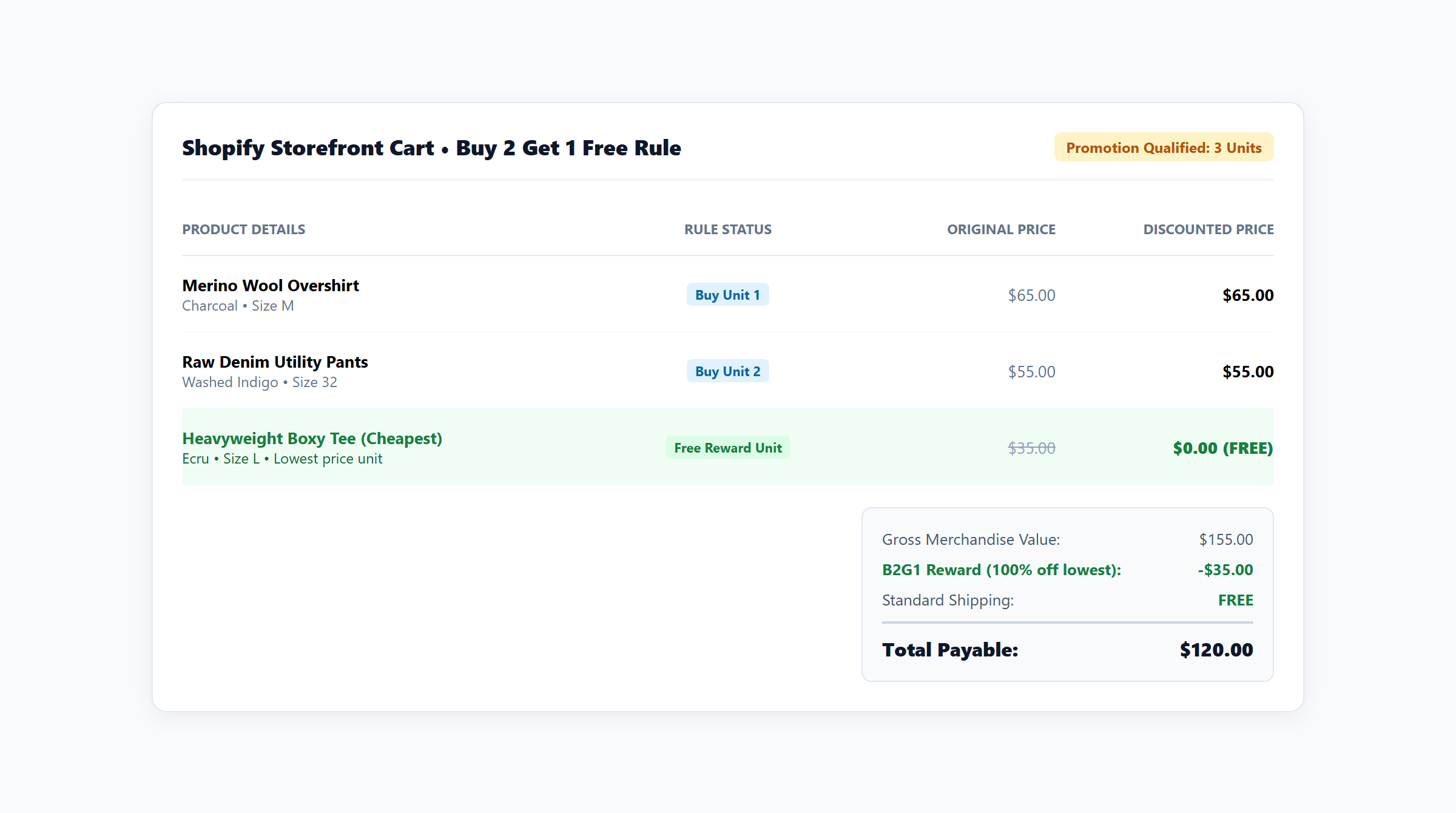
Every promotional campaign must be evaluated based on Net Dollar Profit Contribution rather than top-line gross merchandise value (GMV). Below are four fully audited merchant scenarios evaluating Cost of Goods Sold (COGS), net paid revenue, and gross profit margins:
| Campaign Scenario | Gross Retail | Discount ($) | Net Paid | Total COGS | Gross Profit ($) | Gross Margin (%) |
|---|---|---|---|---|---|---|
| 1. Equal Price Items (3x $30 Shirts) 3x $30 Shirts ($10 unit COGS) | $90.00 | $30.00 | $60.00 | $30.00 | $30.00 | 50.0% |
| 2. Unequal Prices: Cheapest Free $50 Jacket + $40 Shirt + $20 Tote ($15+$12+$6 COGS) | $110.00 | $20.00 | $90.00 | $33.00 | $57.00 | 63.3% |
| 3. Flawed Discount: Most Expensive Free $50 Jacket ($15 COGS) free + $40 Shirt + $20 Tote | $110.00 | $50.00 | $60.00 | $33.00 | $27.00 | 45.0% |
| 4. High-Volume Consumables Bundle 3x $20 Protein Powder ($6 unit COGS) | $60.00 | $20.00 | $40.00 | $18.00 | $22.00 | 55.0% |
The B2G1 Break-Even Volume Elasticity Formula
When you offer a Buy 2 Get 1 Free promotion on equal-priced items, you reduce effective revenue per unit by 33.33%. To calculate the exact sales volume expansion required to maintain your baseline gross profit dollars, use the break-even volume elasticity formula:
$$\text{Required Sales Volume Lift (\%)} = \left( \frac{\text{Discount \%}}{\text{Gross Margin \%} – \text{Discount \%}} \right) \times 100$$
Worked Merchant Example: If your store operates at a baseline gross profit margin of 60% and launches a Buy 2 Get 1 Free promotion (effective 33.33% discount), the required volume lift is:
$$\text{Volume Lift} = \left( \frac{33.33\%}{60\% – 33.33\%} \right) \times 100 = \left( \frac{33.33}{26.67} \right) \times 100 \approx 124.97\%$$
Your store must achieve a 125% increase in total units sold to generate the exact same dollar gross margin as selling at full price. If your catalog cannot generate that volume elasticity, deploy B2G1 as a limited-time flash event rather than an evergreen storewide offer. For deeper pricing analysis, review our guide on volume discounts vs. price-based discounts.
4. Operational Safeguards: Return Economics, Combinations & Stacking Limits
Fulfillment, shipping logistics, and return policies dictate whether high-volume B2G1 campaigns generate healthy cash flow or operational headaches.

Pro-Rated Line Item Discount Allocation on Returns
A major operational vulnerability in B2G1 promotions is customer return abuse: a shopper purchases three $30 items (paying $60 total), receives one item free, and subsequently returns one item demanding a full $30 refund. Under official Shopify return logic, order and bundle discounts are prorated across all qualifying line items. In this order, each $30 item carries a prorated net value of $20.00 ($60 paid / 3 items). When processing a partial return, Shopify’s refund engine returns exactly $20.00, protecting the merchant from giving away free merchandise.
Two-Way Discount Combinations and the 25-Rule Limit
Every discount on Shopify belongs to one of three classes: Product, Order, or Shipping. Under Shopify platform rules:
- Two-Way Configuration: For a B2G1 product discount to combine with a free shipping coupon, both discount rules must have combination checkboxes explicitly enabled in Shopify Admin. If either discount forbids combinations, Shopify checkout prioritizes the single discount offering the greatest monetary savings.
- The 25 Automatic Discounts Platform Ceiling: Shopify limits every store to a maximum of 25 active automatic discounts concurrently. Merchants running multiple tiered BOGO and volume rules must audit their active rule counts. Master combination strategy in our Shopify discount combinations guide.
Dimensional Weight (DIM) and Shipping Freight Impact
Moving from single-item orders to three-item orders increases package volume and weight. Carriers (USPS, FedEx, UPS, DHL) charge based on dimensional weight (DIM). If fulfilling three bulky items pushes a shipment into a larger box tier, shipping costs can jump by $4.00 to $8.00 per package, eroding your net profit. Audit your packaging options before launching storewide B2G1 campaigns.
Shopify Markets Multi-Currency and Tax Calculations
In international Shopify Markets, automatic price rounding rules can alter converted spend thresholds across foreign currencies. Additionally, sales taxes (such as US State Sales Tax or UK/EU VAT) are calculated on the net post-discount value per line item, ensuring statutory tax compliance.
5. Step-by-Step Configuration in Easy Deals & Storefront Acceptance Test Matrix
Deploying a Buy 2 Get 1 Free campaign using Easy Deals on the Shopify App Store follows a disciplined 3-step sequence:
- Campaign Logic Definition: Inside the Easy Deals dashboard, click Create Campaign and select Buy X Get Y / Tiered Volume. Set the qualifying buy quantity to 2, the reward quantity to 1 at 100% discount, and set price targeting to Discount the cheapest eligible item.
- Storefront Stepper & Cart Embed Activation: Enable the Easy Deals App Embed block inside your Shopify Theme Editor (Online Store 2.0). Customize the cart drawer progress bar text (e.g., “Add 1 more item from Summer Essentials to get your 3rd item FREE!”) to match your store typography and branding.
- Shopify Combination Authorization: Navigate to Shopify Admin > Discounts, select the generated B2G1 rule, and verify that combination permissions are toggled for Shipping Discounts or Order Discounts as commercially intended.
7-Point Storefront Acceptance Test Matrix
Before announcing any promotional campaign to your email list or ad channels, execute this 7-point acceptance test matrix across both mobile and desktop viewports:
| Test ID | Cart Scenario | Expected Cart Drawer Feedback | Expected Checkout Calculation |
|---|---|---|---|
| TC-01 | 1 qualifying item added (below threshold). | Progress bar displays prompt (e.g., “Add 2 more items to unlock free item”); zero discounts applied. | Full catalog price charged; zero discount applied. |
| TC-02 | 2 qualifying items added (below threshold). | Progress bar updates (e.g., “Add 1 more item to unlock your 3rd item FREE!”). | Full catalog price charged for both items. |
| TC-03 | 3rd qualifying item added (threshold met). | Progress bar congratulates shopper; lowest-priced eligible unit highlighted. | Cheapest item marked down to $0.00; line discount reflected at checkout. |
| TC-04 | 1 qualifying item removed (cart drops to 2 units). | Cart drawer recalculates immediately; discount removed; progress prompt returns. | Full price charged for remaining 2 items without orphan discount. |
| TC-05 | Unequal prices: $50, $40, and $20 items added. | App correctly sorts items and applies discount to the $20 item only. | Checkout charges $90.00 ($50 + $40), ensuring margin protection. |
| TC-06 | Valid Free Shipping coupon code applied. | B2G1 reward and free shipping rate coexist simultaneously. | Shipping rate zeroed out and cheapest item remains $0.00 if combinations enabled. |
| TC-07 | International currency switch (Shopify Markets). | Item prices and discount values convert dynamically per foreign exchange rates. | Accurate converted currency charged at checkout. |
If a discount fails to apply during testing, follow our step-by-step diagnostic guide: Shopify discount not applying? Diagnostic troubleshooting checklist.
6. Frequently Asked Questions (FAQ)
How do I make the cheapest item free in a Shopify Buy 2 Get 1 Free offer?
While native Shopify discounts lack advanced sorting rules across broad multi-product collections, dedicated apps like Easy Deals built on Shopify Functions automatically evaluate all eligible items in the cart, identify the lowest-priced unit, and apply a 100% discount to that specific line item at checkout.
Does Shopify automatically add the 3rd item to the cart in B2G1?
No. Under native Shopify discounts, customers must manually locate and add all three items to their cart. With a modern app like Easy Deals, the cart drawer displays an interactive progress bar showing shoppers exactly how many more items they need to unlock their free third item.
How are refunds calculated if a customer returns 1 item from a B2G1 order?
Shopify automatically prorates discounts across all qualifying items in an order based on relative price ratios. In an equal-price B2G1 order of three $30 items ($60 total paid), each item carries a prorated value of $20.00. If the customer returns one item, Shopify issues a $20.00 refund, preventing the customer from returning full-price items while keeping the free product.
Can Buy 2 Get 1 Free combine with Free Shipping or coupon codes?
Yes, provided that two-way combination permissions are configured. In Shopify Admin, both the B2G1 discount and the Free Shipping discount must have combination checkboxes explicitly enabled. If either rule disables combinations, Shopify checkout prioritizes the single discount offering the greatest monetary savings.
Can customers claim multiple free items in a single order (Buy 4 Get 2 Free)?
Yes. In Easy Deals, you can configure recurring discount rules (e.g., Buy 4 Get 2, Buy 6 Get 3) or set a maximum discount cap per transaction to prevent excessive inventory depletion.
Editorial Disclosure: Easy Deals is developed by EasyAppsLab. We evaluate all ecommerce promotion software using identical technical criteria, transparent Cost of Goods Sold accounting, and verified platform documentation. Merchants are encouraged to test all promotional rules in staging environments before public launch.