
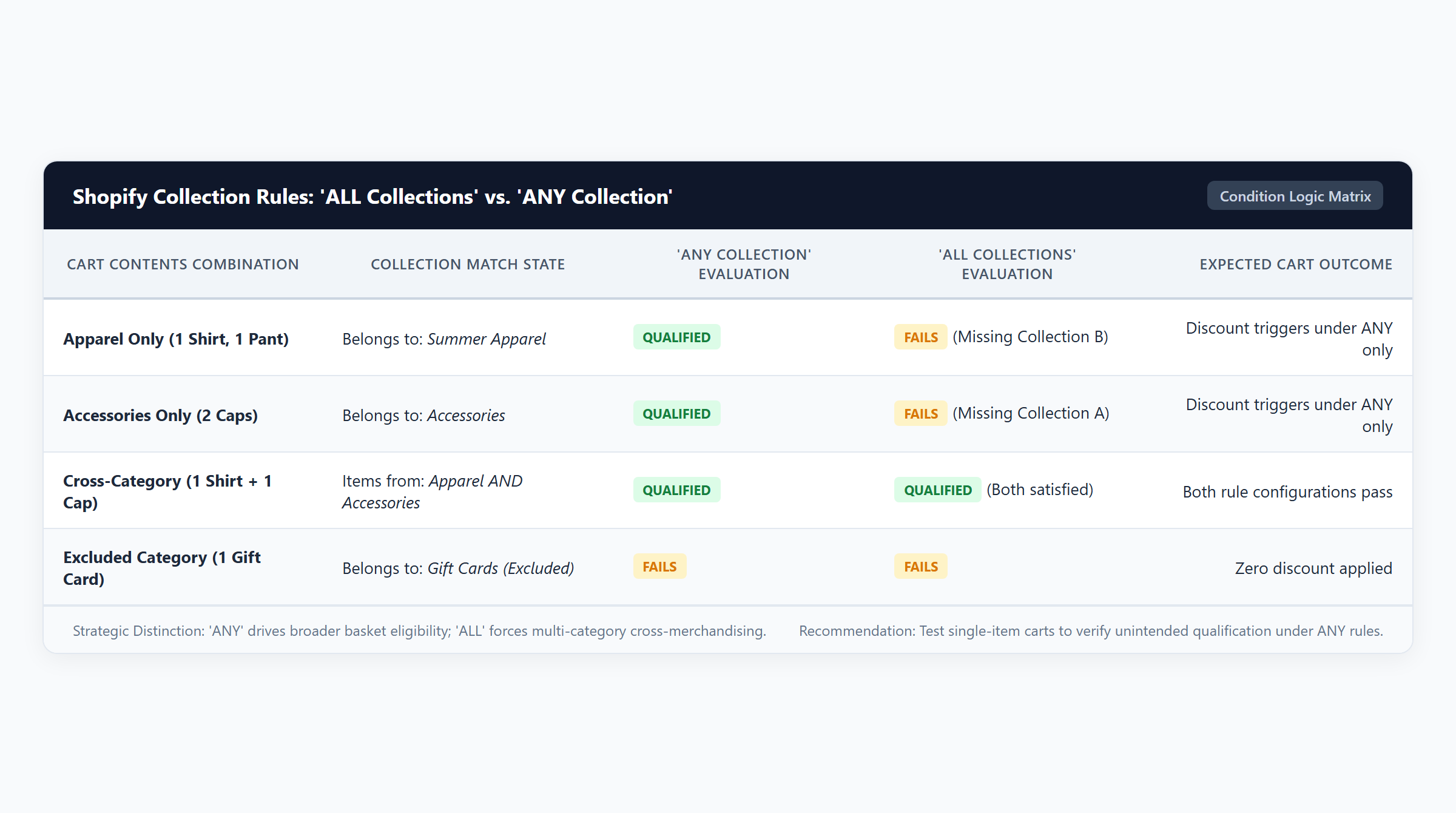
Shopify collection discounts allow merchants to restrict promotional savings to curated catalog segments, but choosing between ALL (logical AND) and ANY (logical OR) rules dictates whether your campaign functions as an exclusive cross-category bundle or an open departmental sale. In Shopify checkout, an ALL rule requires a shopper’s cart to satisfy every specified collection threshold simultaneously before granting savings, protecting profit margins by forcing complementary purchases. Conversely, an ANY rule grants discounts as soon as items from any single specified collection enter the cart. Leveraging server-side Shopify Functions ensures sub-5ms rule calculation, eliminates code-injection loopholes, and preserves baseline margins across complex collections.
1. Core Mechanics: How ALL vs ANY Logic Evaluates Cart Contents
Modern promotional engines evaluate customer carts against collection rules using boolean qualification trees. In native Shopify discount configurations and advanced discount engines alike, the distinction between conjunction (ALL) and disjunction (ANY) establishes the baseline eligibility gatekeeper:
- ALL Rules (Logical Conjunction / AND): Every configured collection condition must be satisfied concurrently. If a merchant builds a promotion requiring 2 items from Collection A (Apparel Tops) AND 1 item from Collection B (Accessories), a cart holding 4 Apparel Tops and 0 Accessories receives $0.00 in promotional savings. The checkout engine evaluates the conjunction as
falseuntil the complementary accessory is added. - ANY Rules (Logical Disjunction / OR): Meeting at least one defined collection condition satisfies qualification for the matching line items. If a promotion targets Collection A (Apparel Tops) OR Collection B (Accessories), any qualifying unit from either collection immediately receives promotional pricing, accelerating clearance velocity across multiple product lines.
Under modern Shopify architecture, collection validation runs directly inside Shopify Functions compiled to WebAssembly (Wasm). When a customer initiates checkout, Shopify executes the discount function within an 11 million instruction limit (targeting sub-5ms execution time) and strict 256 kB binary size boundaries. The function receives the cart payload via a GraphQL input query containing line items, quantities, prices, and parent collection IDs. Because this execution occurs server-side in checkout rather than client-side in the browser DOM, customers cannot manipulate JavaScript variables to bypass collection restrictions.
Selecting between these logical operators requires balancing margin defense against conversion friction. Academic research in consumer bundling demonstrates that requiring complementary items across distinct product categories protects gross margin dollars while delivering perceived utility to the shopper (Journal of Marketing Research). For comprehensive rules on combining collection promotions with storewide incentives, review our architectural guide on Shopify discount combinations.
2. Cart Scenarios, Collection Combinations & Mathematical Allocation
To examine the financial and operational mechanics of collection rules, consider a merchant selling two product categories: Collection A (Apparel Tops: $30.00 retail, $10.00 COGS) and Collection B (Accessories: $20.00 retail, $6.00 COGS). The merchant models four promotional configurations to verify gross profit, discount absorption, and line-item allocations.
| Scenario | Cart Line Items | Gross Value | Discount | Net Revenue | Total COGS | Gross Profit | Gross Margin |
|---|---|---|---|---|---|---|---|
| 1. ALL Rules Met (Cross-Bundle) | 2 Tops ($60.00) + 1 Accessory ($20.00) | $80.00 | $12.00 (15%) | $68.00 | $26.00 | $42.00 | 61.8% |
| 2. ALL Rules Unmet (Partial Cart) | 2 Tops ($60.00) + 0 Accessories ($0.00) | $60.00 | $0.00 (0%) | $60.00 | $20.00 | $40.00 | 66.7% |
| 3. ANY Rule Met (Category Promo) | 2 Tops ($60.00) | $60.00 | $6.00 (10%) | $54.00 | $20.00 | $34.00 | 63.0% |
| 4. Tiered Volume Ladder (4 Units) | 2 Tops ($60.00) + 2 Accessories ($40.00) | $100.00 | $20.00 (20%) | $80.00 | $32.00 | $48.00 | 60.0% |
Mathematical Breakdown of Audited Scenarios
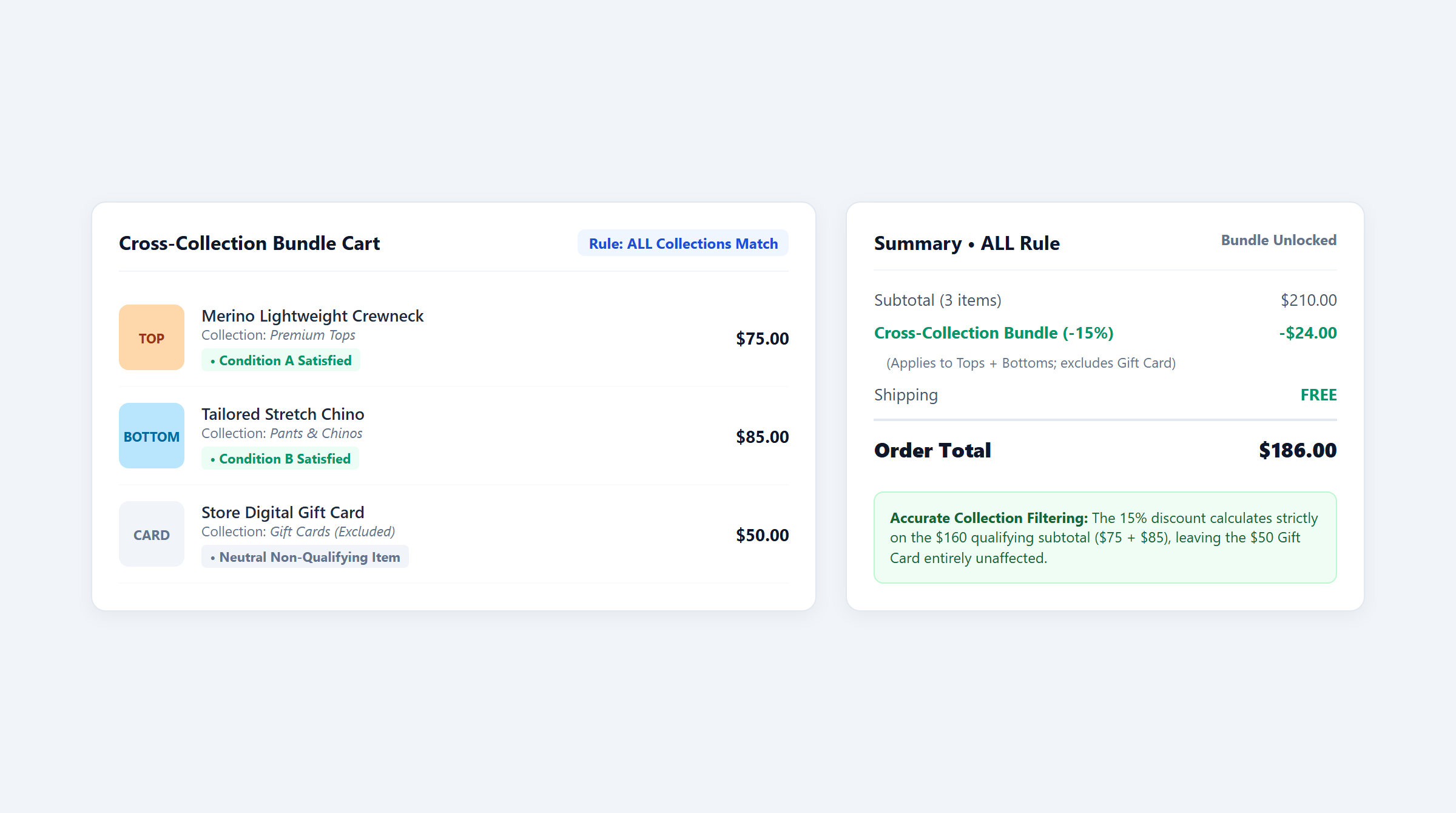
- Scenario 1: Multi-Collection Bundle with ALL Rules Satisfied: The customer adds 2 Tops ($30.00 each = $60.00) and 1 Accessory ($20.00), reaching a gross subtotal of $80.00. Because both collection prerequisites are met, the engine applies a 15% bundle discount amounting to $12.00. Net customer payment is $68.00. With combined inventory COGS of $26.00 ($20.00 for tops + $6.00 for accessory), the merchant captures $42.00 in gross profit, retaining a healthy 61.8% gross margin.
- Scenario 2: Partial Bundle Fails ALL Rule Evaluation: The shopper places 2 Tops ($30.00 each = $60.00) in their cart but omits the accessory. Because the rule requires ALL conditions, eligibility evaluates to false. The discount applied is $0.00. The customer pays full gross price of $60.00. Subtracting $20.00 in COGS yields $40.00 in gross profit (66.7% margin). Crucially, the merchant avoids giving away margin without securing the intended higher basket size.
- Scenario 3: Category Promo with ANY Rule Satisfied: A standalone promotion offers 10% off items from Tops OR Accessories. The customer purchases 2 Tops ($60.00 gross value). The ANY logic evaluates to true, applying a $6.00 discount. Net payment is $54.00, COGS is $20.00, and gross profit settles at $34.00 (63.0% margin).
- Scenario 4: Multi-Collection Tiered Volume Ladder: The merchant establishes a multi-collection volume incentive: purchasing 4 or more combined units from Tops and Accessories yields 20% off. The cart contains 2 Tops ($60.00) and 2 Accessories ($40.00), totaling $100.00 gross value. The 20% discount deducts $20.00, producing $80.00 in net revenue. At $32.00 combined COGS ($20.00 + $12.00), the transaction generates $48.00 in gross profit (60.0% margin), maximizing absolute gross profit dollars.
Pro-Rated Line-Item Discount Distribution
When Shopify applies a collection discount across multiple cart items, the platform does not deduct the entire savings from a single line item. Instead, Shopify Functions allocate the discount pro-rata across eligible line items based on each item’s pre-discount proportion of the eligible subtotal. In Scenario 1, the $12.00 bundle discount is apportioned across the $60.00 Tops and $20.00 Accessory:
- Apparel Tops Proportion: $60.00 / $80.00 = 75% of discount → $12.00 × 0.75 = $9.00 total ($4.50 per top, reducing net price from $30.00 to $25.50 each).
- Accessory Proportion: $20.00 / $80.00 = 25% of discount → $12.00 × 0.25 = $3.00 total (reducing net price from $20.00 to $17.00).
Pro-rated distribution is legally required for accurate tax reporting, automated duty calculation, and clean partial returns. If the customer subsequently returns one Top, Shopify automatically refunds the net paid amount ($25.50) rather than the original gross retail price ($30.00), safeguarding merchant revenue against post-purchase return arbitrage. To see how pro-rated allocations interact with tiered pricing, explore our analysis of volume vs price-based discounts.
3. Storefront Messaging, PDP Badging & Cart Drawer Feedback
Technical discount logic fails if shoppers do not understand how to unlock the promotion. The primary reason ALL-rule promotions suffer abandoned carts is customer confusion when a partial bundle fails to trigger the expected discount. Implementing clear storefront visual cues bridges this gap:
- PDP Collection Badges: Display dynamic pill badges on product cards and product detail pages (e.g., “Eligible for 15% Apparel + Accessory Bundle”). Setting consumer expectations prior to cart addition eliminates surprises.
- Cart Drawer Progress Feedback: When a shopper adds an item from Collection A, the cart drawer should instantly display contextual completion guidance: “Add any accessory from Collection B to activate 15% off your entire bundle!”
- Framing Psychology (The Rule of 100): Behavioral research indicates that for price points under $100, consumers perceive percentage-based discounts (e.g., 15% off) as significantly more attractive than dollar-off amounts ($12.00 off), whereas for baskets exceeding $100, absolute dollar discounts drive greater conversion velocity (Journal of Consumer Psychology). Match your collection promo badge wording to these empirical thresholds.
4. Stacking Permissions, Tag Integrity & Exclusion Guardrails
Maintaining profitable collection promotions requires configuring rigorous backend controls around automated collections, tagging rules, and combination stacking permissions:
Automated (Smart) Collection Conditions and Tag Synchronization Latency
Automated collections populate dynamically based on conditions such as product tags (e.g., promo-eligible), product types, or vendor names. While automated collections streamline catalog management, merchants must account for indexing latency. When product tags or collection conditions are modified in the Shopify Admin, propagation across Shopify’s edge cache and checkout functions can take up to several minutes during high-traffic periods. Never launch a flash sale immediately after tagging hundreds of SKUs; always verify collection membership in advance.
Managing Multi-Collection Overlap
A single product often resides in multiple collections (e.g., a leather jacket belonging to both “Autumn Outerwear” and “Clearance Sale”). If an ANY rule applies to both collections, the discount engine must ensure the line item receives the discount once, rather than compounding recursively. Shopify Functions resolve this natively by applying the highest single eligible discount allocation per line item unless explicit stacking is programmed.
Discount Stacking and the 25-Discount Boundary
Shopify enforces a platform limit of 25 active automatic discounts concurrently per store. Within this framework, merchants can permit product-level collection discounts to combine with order-level discounts or free shipping discounts by checking combination checkboxes in the discount settings. However, stacking a 15% collection discount on top of an existing 10% order-level promotion quickly erodes margins. Restrict combination permissions exclusively to free shipping or non-overlapping discount classes. For step-by-step guidance on structuring native vs app promotions, see our comparative review of Shopify native discounts vs discount apps.
5. Technical Architecture & App Solution Comparison
While native Shopify discounts handle single-collection percentage or Buy X Get Y promotions reliably, merchants requiring multi-collection cross-bundling, strict ALL conjunction rules, or tiered collection volume ladders require specialized Shopify Function apps:
| Platform / Application | Primary Focus | BOGO Support | Volume Support | Free Gift Support | Spend Goals | Technical Architecture | Pricing |
|---|---|---|---|---|---|---|---|
| Easy Deals (EasyAppsLab) | Multi-collection bundle rules, ALL vs ANY logic, and quantity ladders via Shopify Functions | Yes (Native Functions BOGO & bundle logic) | Yes (Tiered breaks & collection bundles) | Yes (Auto-add & customer-selected gifts) | Yes (Multi-tier cart milestone progress bars) | Shopify Functions (WebAssembly sub-5ms runtime) | $9.99/mo (7-day free trial) |
| Shopify Native Discounts | Basic single-collection percentage or fixed amount discounts without cross-collection AND rules | Limited (Fixed ratio Buy X Get Y only) | No (Requires individual coupon workarounds) | Limited (Manual customer add-to-cart required) | No (Requires theme Liquid modifications or app) | Shopify Core Admin Engine | Free (Included with all Shopify plans) |
| Automated Discounts & Gifts | Cart-level rule automation, gift triggers, and multi-condition checkout promotions | Yes (Functions & API automation) | Yes (Tiered cart rules) | Yes (Automated gift injection) | Yes (Cart value milestones) | Shopify Functions & Storefront API | $29.99/mo |
| Volume & Tiered Discounts | Grid-based wholesale quantity tiers and volume discount tables | No (Volume tables focus only) | Yes (Product & collection quantity breaks) | No (Not supported in core tiers) | No (Not supported in core tiers) | Theme App Extension & Functions | $19.99/mo |
Deploying Easy Deals allows merchants to configure sophisticated ALL-condition multi-collection bundles at an accessible entry price of $9.99/mo with a 7-day free trial. Because Easy Deals executes entirely within Shopify Functions WebAssembly, promotions calculate instantaneously at checkout without theme code bloat or script injection vulnerabilities. For step-by-step guidance on complementary buy-one-get-one promotions, review our guide to Shopify BOGO apps and Buy X Get Y discount setup.
6. Implementation QA Matrix & Merchant Frequently Asked Questions
Before launching an ALL or ANY collection discount campaign, run your store through this 7-point QA verification checklist:
- Logical Operator Verification: Confirm whether the promotion requires ALL specified collections or ANY collection. Audit rule prerequisites against target basket objectives.
- Unmet Rule Fallback Test: Add items fulfilling only one branch of an ALL-rule bundle (e.g., 2 Tops without an Accessory). Verify that discount applied equals exactly $0.00 and cart copy prompts the shopper to complete the set.
- Met Rule Trigger Test: Add the missing complementary item. Confirm the bundle discount triggers automatically without requiring manual coupon entry.
- Pro-Rated Allocation Audit: Inspect the checkout summary to confirm the discount distributes proportionally across qualifying lines rather than lumping onto a single SKU.
- Collection Overlap Test: Add an item belonging to multiple overlapping sale collections to verify that the discount applies exactly once and does not double-discount.
- Combination Stacking Review: Attempt to apply a sitewide coupon or free shipping promotion alongside the collection discount to ensure combinations match intended merchant policies.
- Mobile & Edge Device Speed: Test checkout progression on mobile devices to confirm Shopify Functions respond in sub-5ms without layout shifting or cart freezing.
Frequently Asked Questions
Can I create an ALL-rule collection bundle using Shopify native discounts without apps?
Native Shopify automatic discounts allow targeting specific collections, but native functionality evaluates collection targets using ANY logic (qualifying items from any listed collection). Building strict multi-collection cross-bundle dependencies (requiring items from Collection A AND Collection B simultaneously) requires a Shopify Functions discount application such as Easy Deals.
What happens if a product belongs to two collections in an ANY-rule promotion?
Shopify’s discount engine matches the line item to its parent collections. In an ANY promotion, matching either collection qualifies the item. However, the system evaluates the item as a single eligible line, applying the configured percentage or dollar amount once rather than compounding the discount twice.
How do refunds work when a customer returns one item from a collection bundle?
Because Shopify allocates multi-item collection discounts pro-rata across eligible lines based on pre-discount retail value, each item records an exact net paid value. When processing a return in Shopify Admin, the refund default reflects the pro-rated net paid amount ($25.50 for a $30.00 top in a 15% bundle), preventing the customer from pocketing unearned promotional value.
Does Shopify limit the number of collection discount rules I can run?
Shopify permits a maximum of 25 active automatic discounts concurrently across an entire store. However, a single Shopify Function app can consolidate multiple collection tiers, bundles, and volume rules inside a single active discount instance, effectively bypassing the 25-rule ceiling.