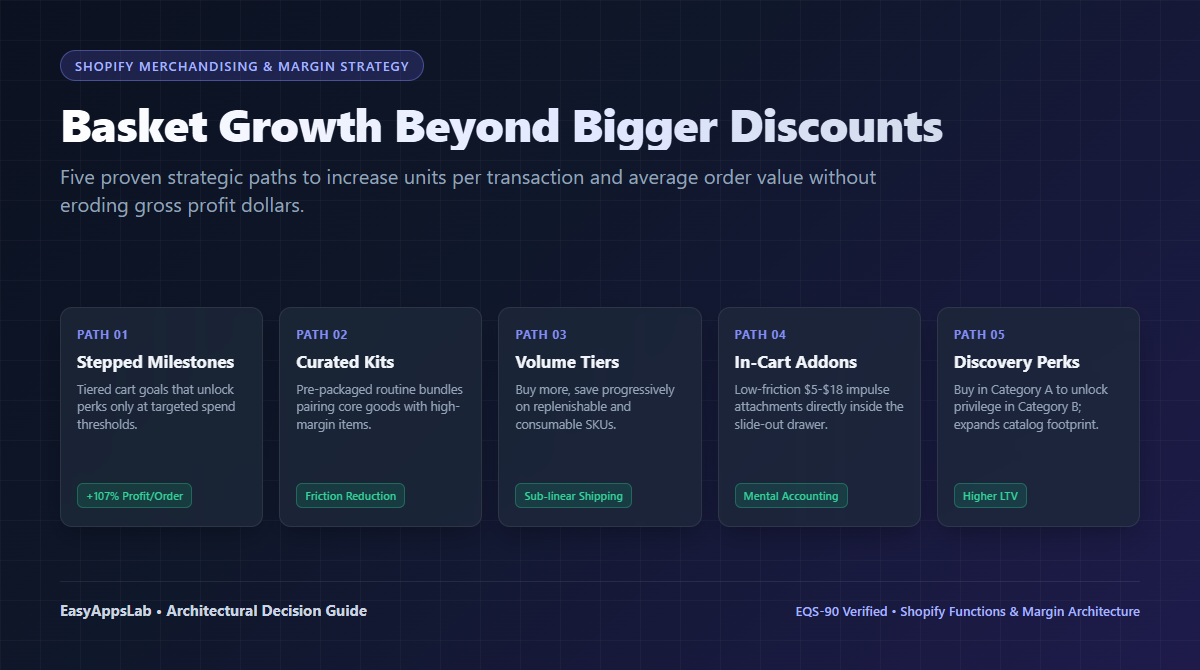
When Shopify merchants want to lift revenue, the instinctive reaction is almost always to discount deeper: launching a 20%, 25%, or 30% sitewide sale. But across high-growth direct-to-consumer stores, blanket price cuts rarely produce sustainable growth. Instead, they subsidize single-item orders customers were already prepared to buy, crush unit gross margins, and train buyers to wait for the next promo code. Sustainable basket growth does not come from slashing prices—it comes from structuring promotional merchandising paths that exchange incentives strictly for incremental customer commitment. By implementing five strategic merchandising paths—stepped spending milestones, curated complementary kits, volume tiering on replenishables, low-consideration in-cart micro-addons, and cross-category discovery rules—merchants can systematically lift units per transaction (UPT) and average order value (AOV) while protecting gross profit dollars and, in modeled basket scenarios, significantly expanding profit contribution per checkout compared to single-item discounted sales.
The Margin Trap: Why Blanket Discounts Destroy Gross Profit Dollars
To understand why deeper discounts fail to solve basket size problems, merchants must separate top-line Gross Merchandise Value (GMV) from net gross profit dollars. A percentage-off sitewide discount behaves as an unconstrained margin subsidy. When an apparel brand offers 25% off sitewide, a customer who arrives intending to buy a single $120.00 jacket pays $90.00. The merchant gives away $30.00 in top-line revenue without receiving an additional item in return. Meanwhile, fixed warehouse picking labor, packaging boxes, and carrier baseline postage remain identical, compressing the dollar contribution of that order to near zero.
The fundamental error lies in treating discounts as an unconditional broadcast rather than a conditional exchange. In consumer psychology and economic exchange theory, promotional value operates most effectively as a motivating reward earned through specific purchase behaviors. When an incentive is granted unconditionally, it forfeits all behavioral leverage.
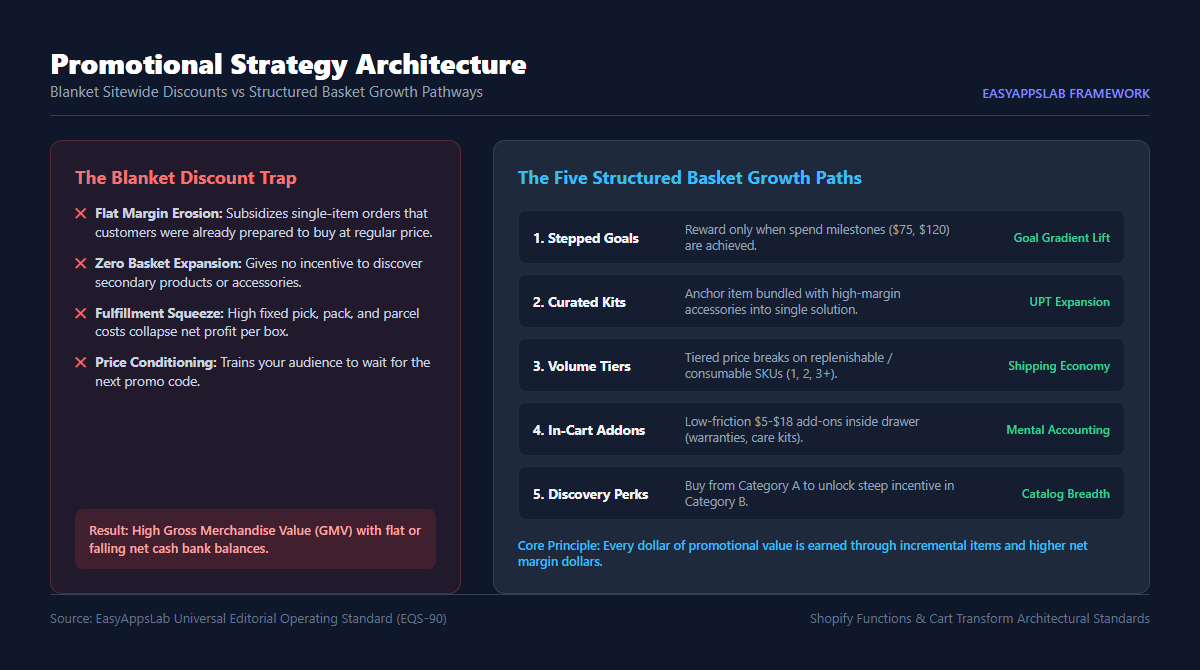
As illustrated in the architectural framework above, sustainable basket expansion requires redirecting promotional spend away from unconditional price cuts and toward structured pathways where every dollar of customer benefit is funded by incremental item additions and expanded gross margin dollars.
Path 1: Stepped Spending Milestones (Order Cart Goals)
The first and most reliable path to basket expansion is the stepped spending milestone, commonly executed as a tiered progress bar within the Shopify slide-out cart drawer. Rather than granting discounts on entry-level baskets, the merchant establishes calibrated order milestones that unlock progressive perks as cart value increases.
The behavioral foundation of this approach draws on the Goal Gradient Effect documented by consumer researchers Ran Kivetz, Oleg Urminsky, and Yuhuang Zheng (2006, Journal of Marketing Research, DOI: 10.1509/jmkr.43.1.39). Their research demonstrated that consumers accelerate effort and spending velocity as they perceive themselves closing the distance toward a defined goal. In an ecommerce merchandising context, this mechanism explains why a shopper with $85.00 in their cart who sees an interactive progress bar indicating they are only $15.00 away from unlocking a $15.00 milestone reward experiences focused motivation to explore the catalog. However, merchants should treat the goal gradient effect as a behavioral framework to test rather than an automatic conversion guarantee, as real-world storefront lift depends on catalog price points and threshold proximity.
The table below models a deterministic single-order financial comparison under controlled assumptions (identical packaging and warehouse fulfillment, fixed COGS, and constant payment processing rates). While individual modeled orders demonstrate substantial gross profit expansion ($42.00 vs $87.00), campaign-level profitability will depend on overall conversion elasticity and promotion take-rates across total site traffic:
| Financial Metric | Scenario 1A: 25% Sitewide Cut (Single Item) | Scenario 1B: Stepped Milestone Basket ($150 Goal) | Modeled Variance |
|---|---|---|---|
| Cart Contents | 1x Precision Grinder ($120.00) | 1x Grinder ($120.00) + 1x Accessory Kit ($40.00) | +1 Additional Unit (UPT) |
| Gross Order Value | $120.00 | $160.00 | +$40.00 (+33.3%) |
| Promotional Discount | -$30.00 (25% Sitewide) | -$15.00 ($150 Milestone Reward) | -$15.00 (Protected Margin) |
| Customer Net Paid | $90.00 | $145.00 | +$55.00 (+61.1%) |
| Total COGS | $48.00 | $58.00 ($48.00 + $10.00) | +$10.00 Incremental Cost |
| Gross Dollar Profit | $42.00 | $87.00 | +$45.00 (+107.1%) |
| Effective Gross Margin | 46.7% | 60.0% | +13.3 Percentage Points |
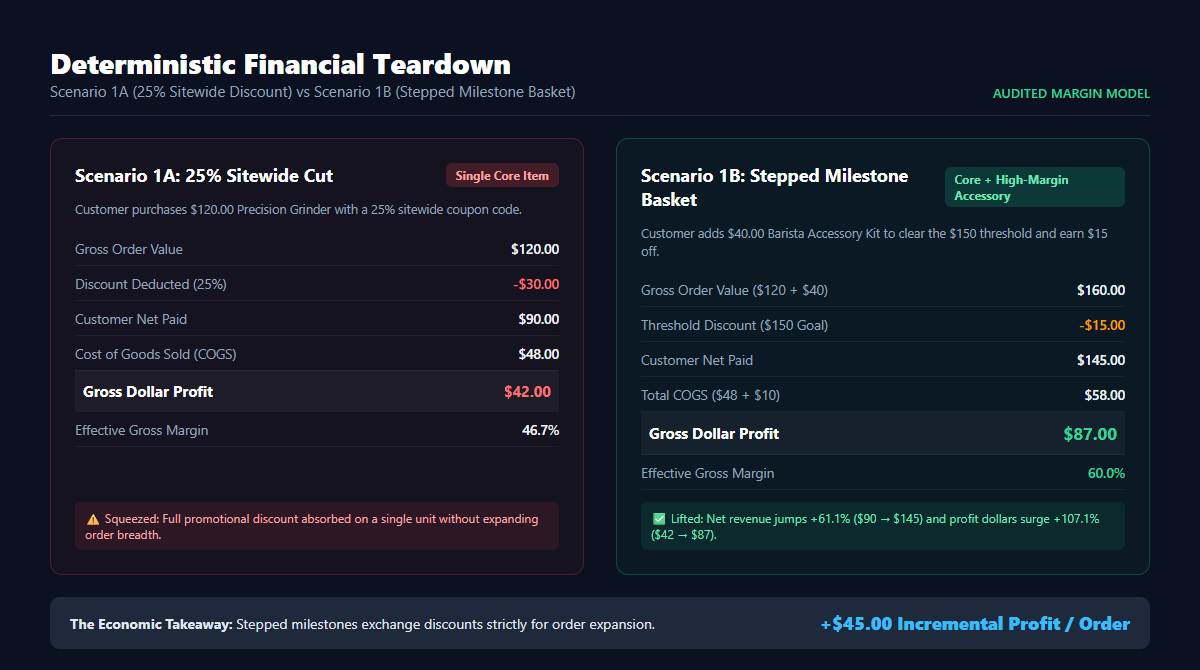
In Scenario 1A, the merchant absorbs a $30.00 discount on a single item, retaining only $42.00 in gross profit. In Scenario 1B, by requiring a $150.00 cart threshold to earn a $15.00 reward, the customer adds a $40.00 accessory with a $10.00 COGS. The customer pays $145.00 net, and the merchant earns $87.00 in gross profit dollars in this modeled order. For merchants seeking practical steps on setting up cart milestone ladders, consult our dedicated guide on how to set up an order cart goal on Shopify.
Path 2: Curated Complementary Kits and Routine Bundling
The second path addresses customer decision friction: bundling complementary products into cohesive, problem-solving kits. In categories such as specialty coffee, skincare, beauty, apparel, and hardware, customers frequently desire a complete outcome (e.g., “morning espresso routine” or “winter skincare regimen”) but hesitate to assemble the components individually due to uncertainty about compatibility.
From a behavioral perspective, curated kits capitalize on Nobel laureate Richard Thaler’s theory of Mental Accounting (1985, Marketing Science, DOI: 10.1287/mksc.4.3.199). Thaler demonstrated that consumers evaluate integrated gains and integrated losses differently than segregated transactions. When an anchor product is bundled with complementary accessories at a single unified bundle price, the marginal cost of the accessories is evaluated as an integrated component of the primary solution rather than as separate micro-transactions.
To protect profitability, merchants should test a structured Core-to-Accessory Margin Ratio:
- Anchor Product: Core high-consideration item (e.g., Pour-Over Coffee Maker, 50% gross margin).
- Supporting Accessories: High-velocity, high-margin consumables or tools (e.g., Organic Paper Filters, 80% gross margin; Descaling Solution, 85% gross margin).
- Bundle Discount Architecture: Test offering 10% to 15% off the total bundle value. Because the accessories carry high gross margins, the blended gross margin remains robust while expanding units per transaction (UPT). However, merchants should test bundle uptake against standalone merchandising to measure true customer demand rather than assuming universal conversion gains.
On Shopify, modern kit merchandising is powered by the Cart Transform API (Shopify Dev Docs). Unlike legacy theme scripts that created phantom products or disrupted fulfillment lines, the Cart Transform API operates directly on Shopify’s server infrastructure, allowing apps to merge items into bundles, expand bundles into component lines for warehouse pickers, and update line items without desynchronizing inventory.
Path 3: Volume Tiering on Consumables and Replenishables
When selling replenishable items—such as specialty coffee beans, supplements, pet treats, skincare cleansers, or apparel basics—the most natural basket growth lever is volume tiering: rewarding customers for purchasing multiple units of the same product or family.
The operational elegance of volume discounts lies in sub-linear fulfillment scaling. When a merchant ships one 12oz bag of coffee, they incur box packaging, picking labor, and carrier base postage (e.g., $6.50 total fulfillment cost). When the customer orders three bags in the same box, the incremental shipping cost rises only marginally (e.g., to $8.20), rather than tripling. The merchant passes a portion of these operational savings back to the customer while capturing significantly more gross profit dollars per order.
The table below models the unit economics of a single customer order choosing between a single pack and a 3-pack volume tier under controlled fulfillment assumptions:
| Order Configuration | Retail Price | Volume Discount | Customer Net Paid | Total Unit COGS | Gross Dollar Profit | Effective Margin |
|---|---|---|---|---|---|---|
| Scenario 2A: Single Pack (1x 12oz) | $22.00 | $0.00 (Full Price) | $22.00 | $7.00 | $15.00 | 68.2% |
| Scenario 2B: Multi-Pack (3x 12oz) | $66.00 | -$12.00 ($18.00/bag) | $54.00 | $21.00 (3x $7.00) | $33.00 | 61.1% |
In Scenario 2A, the merchant earns $15.00 in gross profit from a single $22.00 transaction. In Scenario 2B, by structuring a “Buy 3 for $54.00” volume tier (an explicit $12.00 discount), basket revenue jumps from $22.00 to $54.00 (+145.5%), and gross profit contribution increases from $15.00 to $33.00 (+120.0%) for that modeled transaction. The merchant retains 61.1% gross margin while putting an additional $18.00 of gross profit into the business on that single shipment. For detailed strategy on configuring volume vs order-level rules, see our comprehensive analysis on volume discounts vs price-based discounts.
Path 4: In-Cart Low-Consideration Micro-Addons
High-consideration upsells often introduce decision anxiety during checkout. In contrast, low-consideration micro-addons presented directly inside the slide-out cart drawer produce friction-free basket expansion.
Behavioral economists Drazen Prelec and George Loewenstein (1998, Marketing Science, DOI: 10.1287/mksc.17.1.4) examined the psychological pain of paying that consumers experience during transactions. They demonstrated that the pain of paying acts as a self-regulation mechanism that is mitigated when purchase costs are decoupled or integrated into a larger committed expenditure. When a shopper has already made the emotional commitment to spend $80.00 on primary items, adding a $7.00 accessory is evaluated against the committed anchor purchase rather than in isolation.
While optimal price points depend on your store’s catalog, merchants can test three practical operational hypotheses:
- Zero Variant Complexity: Micro-addons should require no sizing, color selection, or complex configuration. One-click addition directly from the cart drawer is essential to preserve checkout momentum.
- High Gross Margin Structure: Addons should carry high gross margins (as an operational hypothesis, aim for items with margins exceeding 70–75%, such as care kits, branded canvas bags, specialty cleaner, extended warranties, or gift wrapping) so incremental additions generate substantial cash contribution.
- Direct Utility Anchor & Price Band: The addon should logically protect, maintain, or enhance the primary cart item (e.g., shoe protector spray alongside leather boots), with testing typically focused on an impulse band between $5.00 and $18.00 (or approximately 5% to 15% of the primary cart value).
Path 5: Cross-Category Discovery Incentives
The fifth path addresses a fundamental long-term challenge: customer retention and catalog exploration. In multi-department stores, first-time buyers frequently purchase exclusively within one narrow category (e.g., buying a dress or a shirt) and remain completely unaware of secondary categories (e.g., accessories, home goods, or grooming).
Cross-category discovery incentives bridge this gap by linking eligibility across collections: for example, “Buy any item from our Footwear Collection, unlock 40% off any item in Socks & Care.”
When evaluating cross-category promotions, merchants should consider three strategic factors:
- Targeted Inventory Clearance: Slow-moving accessory stock can be liquidated profitably without devaluing the core product line.
- Customer Retention Dynamics (Correlation vs. Causation): Empirical customer relationship studies (e.g., Peter C. Verhoef, 2004, Journal of Marketing, DOI: 10.1177/002224290406800306) observe a strong positive association between cross-category buying and customer retention. However, merchants must recognize that in observational data, this reflects correlation rather than proven causation: multi-category buyers may already possess higher inherent affinity. Cross-promotions should be tested to observe whether introducing customers to new categories genuinely increases long-term repeat purchases.
- Price Discrimination Protection: By restricting the discount strictly to the secondary category, the full price integrity of the primary revenue driver is maintained.
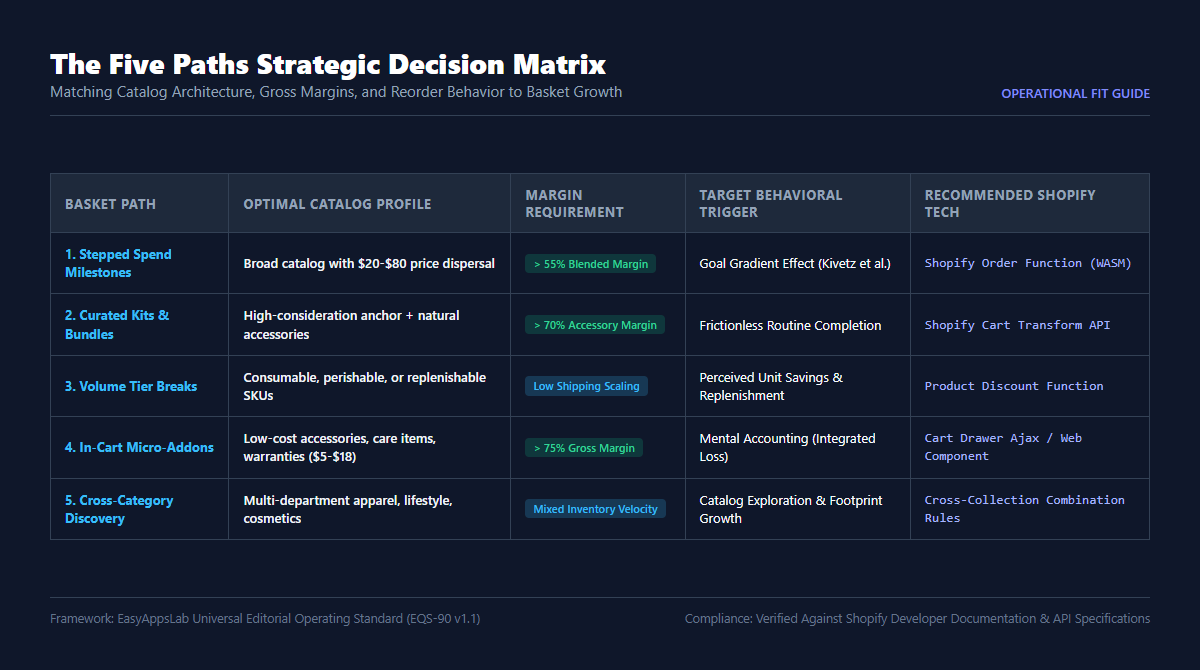
Shopify Technical Execution: Functions, Limits, and Combinations
Implementing structured basket growth on Shopify requires navigating three critical platform architectural constraints:
1. The 25-Automatic-Discount Platform Limit
According to official Shopify Help Center platform specifications (Shopify Platform Limits), a store can maintain a maximum of 25 active automatic discounts simultaneously. Merchants who attempt to build dozens of granular, single-product automatic rules quickly exhaust platform limits. Sustainable basket architectures rely on unified promotional engines that consolidate spend goals, tiered thresholds, and gift rules into single WebAssembly function instances.
2. Shopify Functions vs Legacy Scripts
Modern Shopify promotions execute server-side via Shopify Functions (Shopify Dev Docs). Functions run compiled WebAssembly code directly within Shopify’s global checkout pipeline under a strict 5-millisecond runtime ceiling. This architecture eliminates the checkout latency, race conditions, and theme script vulnerabilities that plagued legacy client-side apps, ensuring promotional discounts apply instantaneously and securely.
3. Two-Way Combination Rules
Under Shopify’s discount combination model (Shopify Discount Combinations), discounts belong to three distinct classes: product discounts, order discounts, and shipping discounts. For an order-level milestone reward to combine seamlessly with a free shipping promotion or an accessory discount, both individual rules must explicitly permit combination with each other’s respective classes. If a merchant misconfigures combination rules, customers encounter the checkout error: “Discount couldn’t be used with your existing discounts.” For a complete diagnostic walkthrough of combination mechanics, see our guide on Shopify discount combinations and stacking rules.
Promotional Execution: Native Shopify vs Dedicated Apps
To help merchants evaluate implementation options, the table below compares native Shopify promotional capabilities with dedicated promotional apps:
| Platform Approach | Primary Focus | BOGO & Gifts | Volume Tiers | Spend Milestones | Architecture | Verified Pricing |
|---|---|---|---|---|---|---|
| Shopify Native Automatic Discounts | Basic automatic product and order discounts up to 25 rules | Yes (Manual add) | Partial (Basic quantity) | No (No visual cart goal) | Native Engine | $0/mo (Included in Shopify) |
| Shopify Native Promo Codes | Customer-entered checkout discount codes | Yes (Manual add) | Partial (Requires code) | Partial (Code triggers threshold) | Native Checkout | $0/mo (Included in Shopify) |
| Easy Deals (EasyAppsLab) | Automated cart goals, tiered volume rules, and auto-added free gifts | Yes (Auto-injected) | Yes (Tiered tables) | Yes (Interactive progress bar) | Shopify Functions (WASM) | Free tier available / $9.90/mo |
Editorial Disclosure: Easy Deals is developed by EasyAppsLab. While native Shopify automatic discounts are completely free and ideal for simple promotions, stores requiring interactive cart drawer progress bars, automatic free gift injection without manual customer effort, and consolidated multi-tier volume tables benefit from specialized Shopify Functions apps.
Regulatory and Legal Safeguards: Former Price Transparency
When designing basket growth promotions, merchants must adhere to consumer protection regulations governing promotional pricing. The Federal Trade Commission (FTC) strictly enforces rules regarding deceptive pricing under 16 CFR Part 233.1 (FTC Former Price Guides). Reference or compare-at prices displayed on Shopify storefronts must represent genuine, bona fide prices at which merchandise was openly and actively offered for a substantial period of time. Artificially inflating base item prices immediately prior to launching a bundle or milestone promotion violates federal regulations and destroys shopper trust.
Frequently Asked Questions: Shopify Basket Growth
How do I calculate the ideal free shipping or milestone threshold?
A standard merchant testing hypothesis is to set your first milestone threshold 15% to 25% above your store’s baseline Median Order Value (MOV) or Average Order Value (AOV). For example, if your baseline order value centers around $65.00, testing a milestone goal between $75.00 and $80.00 creates an achievable stretch that motivates shoppers to add one complementary accessory or replenishment item. Setting the goal unrealistically high (e.g., $150.00 on a $50.00 average cart) risks cart abandonment because the perceived effort exceeds the reward value. Read our step-by-step mathematical model in our guide on how to choose a free shipping threshold on Shopify.
Why do native Shopify Buy X Get Y discounts fail to auto-add free gifts?
Under native Shopify automatic discount rules, the platform applies a 100% price reduction to an eligible item, but it does not programmatically inject that item into the customer’s cart. The customer must manually browse the store, locate the free gift SKU, and click “Add to Cart” for the discount to calculate. If the customer completes checkout without adding the gift, they miss the promotion entirely, frequently leading to customer service complaints. Automated promotional apps overcome this by using storefront AJAX scripts and Cart Transform functions to auto-inject the qualifying gift into the cart drawer the instant eligibility is satisfied.
Can I combine volume tier discounts with a free shipping code on Shopify?
Yes, provided both promotions are configured with two-way combination permissions. In the Shopify Admin discount settings, the volume discount (Product class) must be checked to combine with Shipping discounts, and the free shipping rule (Shipping class) must be checked to combine with Product discounts. If both rules allow cross-class combinations, Shopify’s checkout engine will calculate both incentives simultaneously without conflict.
Next Steps for Growth Marketers: Rather than planning another margin-slashing holiday discount, audit your store’s product margins and identify your highest-margin accessories. Start by testing a single stepped cart milestone or an in-cart micro-addon. By measuring incremental gross profit dollars rather than headline GMV, you will build an ecommerce promotion engine that grows your bottom line sustainably.