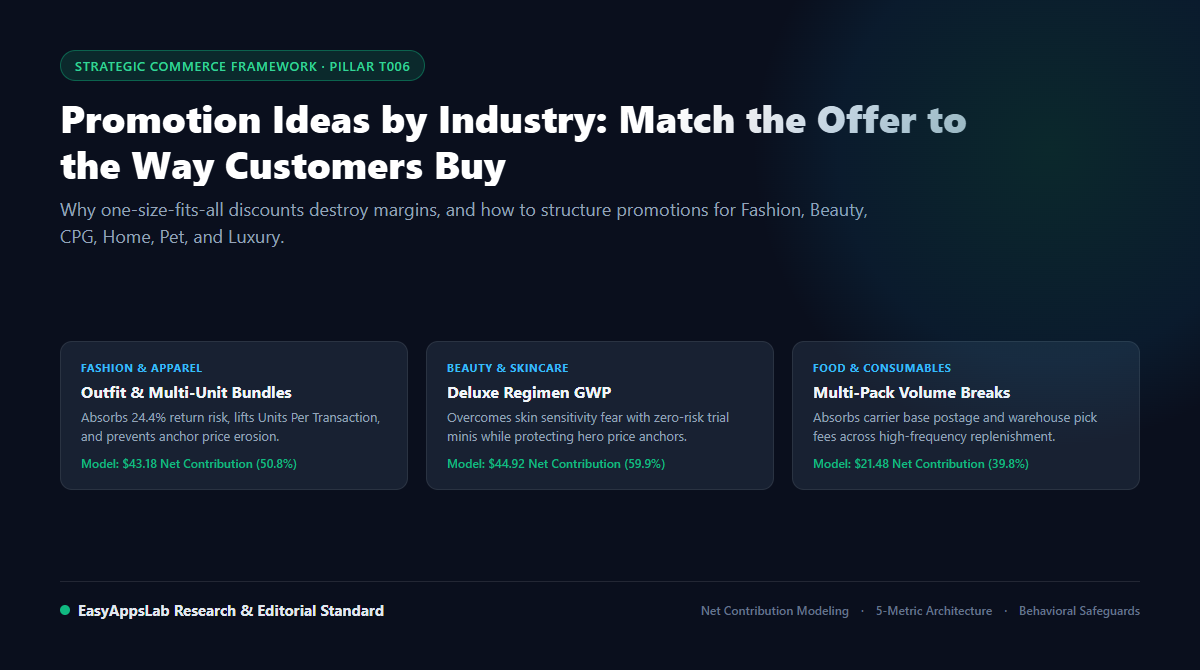
A promotion succeeds only when its discount mechanic matches the structural buying rhythm, gross margin profile, and fulfillment realities of your specific industry. Applying a blanket sitewide 20% discount across different verticals fails predictably: in fashion, it inflates return liabilities on single garments; in beauty, it fails to resolve customer hesitation around skin sensitivity; in food and beverage (CPG), carrier postage erodes low-ticket margins; and in home goods, freight shipping wipes out unconstrained percentage sales. To build enduring profitability, Shopify merchants must replace generic discounting with vertical-specific offer architectures—such as coordinated outfit bundles in apparel, deluxe regimen Gifts with Purchase (GWP) in skincare, multi-pack volume breaks in CPG, and stepped spend milestones in home decor. Every promotional campaign must be governed by a 5-metric contribution matrix—balancing Units Per Transaction (UPT), Average Order Value (AOV), Conversion Rate (CVR), Gross Profit Dollars, and Net Contribution Profit after pick/pack labor, packaging, weight-tiered shipping, and credit card processing fees.
The Fatal Flaw of One-Size-Fits-All Discounts
Most ecommerce promotional calendars are built around seasonal dates rather than structural customer behavior. When revenue dips or a holiday approaches, merchants reflexively blast out generic 15% or 20% coupon codes across their entire catalog. While this tactic may generate a temporary spike in top-line revenue, it routinely depresses net dollar contribution and trains shoppers to defer purchases until the next scheduled sale.
The failure of generic discounting stems from ignoring the fundamental differences in how consumers purchase across verticals. A customer purchasing a $60.00 button-down shirt is navigating sizing and fit anxiety; a customer evaluating a $75.00 anti-aging serum is balancing ingredient efficacy against the fear of adverse dermatological reactions; a customer buying specialty coffee concentrate is evaluating unit replenishment convenience against parcel delivery fees; and an interior decor buyer is coordinating aesthetic compatibility while bracing for bulky freight charges.
When a merchant deploys an unconditional percentage discount, they surrender gross margin without addressing the specific psychological barrier that prevents the customer from completing checkout. Furthermore, as established in our foundational guide on promotional merchandising, discounting without inventory velocity segmentation leads stores to cannibalize full-price sales on high-demand anchor products while failing to clear aging warehouse inventory.
The 6-Industry Promotional Architecture Matrix
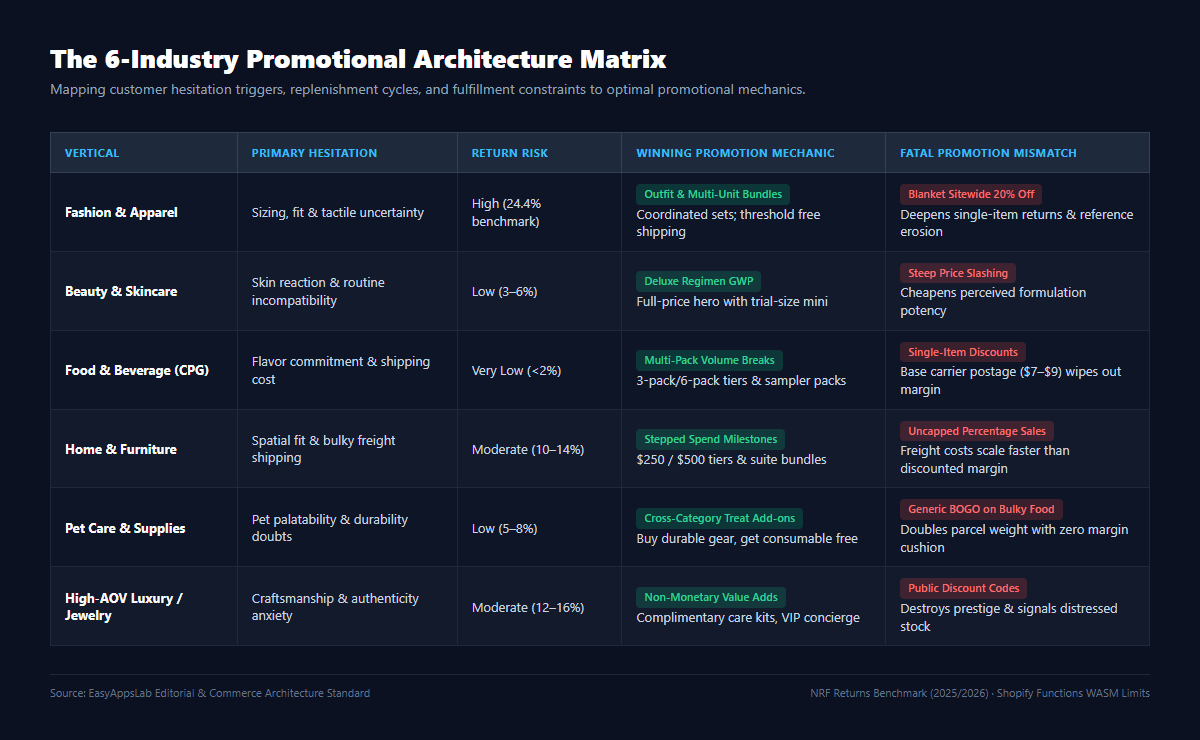
To select the right promotion, merchants must categorize their business model across four core operating variables: customer hesitation triggers, return rate vulnerability, replenishment frequency, and fulfillment scaling economics. The following matrix outlines the strategic alignment across six dominant direct-to-consumer (DTC) verticals.
| Vertical | Primary Buyer Hesitation | Return Vulnerability | Winning Promotion Mechanic | Fatal Promotion Mismatch |
|---|---|---|---|---|
| Fashion & Apparel | Sizing, fit & styling uncertainty | High (24.4% industry benchmark) | Coordinated Outfit Bundles & Tiered Free Shipping | Blanket Sitewide 20% Off single items |
| Health, Beauty & Skincare | Adverse skin reaction & routine fit | Low (3%–6%) | Deluxe Trial-Size Regimen Gift with Purchase (GWP) | Deep Price Slashing (cheapens formulation efficacy) |
| Food, Beverage & CPG | Flavor commitment & parcel shipping fees | Very Low (<2%) | Multi-Pack Volume Breaks & Discovery Samplers | Single-Item Discounts (carrier postage erodes margin) |
| Home Goods & Furniture | Spatial dimensions & heavy freight costs | Moderate (10%–14%) | Stepped Spend Milestones ($250 / $500) & Room Sets | Uncapped Percentage Sales on freight items |
| Pet Care & Supplies | Pet palatability & chew durability | Low (5%–8%) | Cross-Category Add-ons (Durable Gear + Treat Gift) | Generic BOGOs on heavy, bulky kibble bags |
| Luxury & Artisanal Goods | Craftsmanship authenticity & exclusivity | Moderate (12%–16%) | Non-Monetary Value Adds & Bespoke Care Kits | Public Promo Codes (destroys prestige positioning) |
Industry Playbook: Deep Dives by DTC Vertical
1. Fashion & Apparel: Outfits Over Single-Item Markdowns
Apparel ecommerce operates under a unique structural headwind: return rates. According to data published by the National Retail Federation (NRF) and Appriss Retail, online apparel returns average 24.4%, compared to the general retail benchmark of 14.5%. Much of this return volume is driven by “bracketing”—shoppers purchasing multiple sizes or colors of a single garment with the explicit intention of returning what does not fit.
When an apparel brand runs an unconstrained 20% sitewide sale, it subsidizes single-garment purchases that carry maximum return risk. The merchant absorbs reverse logistics shipping, inspection labor, and markdown losses when returned items miss their peak seasonal window. Instead, apparel promotions must incentivize wardrobe completion and outfit assembly. Pairing a primary $60.00 button-down shirt with $40.00 tailored shorts for a bundled price of $85.00 ($15.00 bundle savings) lifts Units Per Transaction (UPT) and raises order value to absorb fixed fulfillment costs while anchoring garment value.
2. Health, Beauty & Skincare: Routine Regimen GWPs Over Price Cuts
In beauty and skincare, gross margins are typically robust (70%–85%), but customer acquisition friction is exceptionally high. Consumers hesitate to commit to a new facial serum or moisturizer due to the physical risk of allergic breakout or dermatological mismatch. Slashing the price of a $75.00 serum to $60.00 does not eliminate this fear; in fact, heavy discounting can trigger skepticism regarding ingredient concentration and brand efficacy, violating the brand positioning principles detailed in our analysis of brand promotion strategy.
The winning promotional architecture in skincare is the Deluxe Regimen Gift with Purchase (GWP). By maintaining the core serum at its full retail price of $75.00 and granting a complimentary travel-size purifying cleanser ($18.00 retail value, $3.00 manufacturing COGS), the merchant protects the anchor price while eliminating product risk. The customer tests the cleanser inside their daily regimen, paving the path for high-margin replenishment orders.
3. Food, Beverage & Consumables (CPG): Multi-Pack Volume Breaks
Consumer Packaged Goods (CPG) feature low individual item price points ($15.00 to $25.00), high repurchasing frequency, and low return rates (<2%). However, CPG brands face an unforgiving fulfillment constraint: parcel shipping weight. Because liquid concentrates, beverages, and pantry items are heavy, carrier base postage represents a massive proportion of single-item order value.
If a merchant discounts a single $22.00 bottle of cold brew concentrate by 20% to $17.60, outbound postage ($7.50) and 3PL pick/pack fees ($2.50) completely consume the remaining gross profit. CPG merchants must deploy volume-break tiered pricing. By structuring an offer as “Buy 3 Canisters for $54.00” ($18.00 per unit instead of $22.00, representing a $12.00 discount on a $66.00 catalog value), the merchant amortizes the base shipping postage across three units, turning an otherwise unprofitable parcel into a high-contribution transaction.
4. Home Goods, Decor & Furniture: Stepped Spend Milestones
Home furnishings and decor are characterized by long consideration windows, low repurchase frequency, and significant spatial anxiety. Furthermore, oversized parcel and freight shipping costs escalate drastically with physical dimensions. An unconstrained percentage discount on single low-margin furniture items leaves merchants vulnerable to freight margin collapse.
The optimal mechanic for home furnishings is the Stepped Order Spend Milestone (e.g., Spend $250.00, Save $30.00; Spend $500.00, Save $75.00). Because customers frequently furnish entire rooms or redecorate living spaces in batches, stepped spend milestones motivate shoppers to add complementary textiles, lighting, or wall decor to clear the threshold, driving basket expansion while safeguarding freight margins.
5. Pet Care & Supplies: Cross-Category Consumable Add-ons
Pet stores maintain a dual catalog structure: bulky, low-margin staple consumables (kibble bags, canned food) and high-margin durable accessories (orthopedic beds, harnesses, grooming tools). A common fatal error in pet ecommerce is running Buy One, Get One (BOGO) promotions on 30-pound dog food bags, which doubles package weight and carrier surcharges while yielding negligible margin.
The superior promotional play is cross-category pairing. When a customer purchases a high-margin durable hero item (such as an $80.00 orthopedic dog bed), the merchant awards a complimentary bag of organic training treats ($15.00 retail, $3.00 COGS). The treats add negligible shipping weight, resolve palatability doubts, and initiate recurring consumable replenishment.
6. High-AOV Luxury & Artisanal Jewelry: Non-Monetary Value Adds
In fine jewelry and luxury goods, price is an explicit signal of craftsmanship, authenticity, and prestige. Slashing prices by 25% via a public checkout promo code signals distress or low intrinsic value, eroding brand equity. Luxury buyers are not price-sensitive in the traditional sense; they seek reassurance, white-glove treatment, and exclusivity.
Instead of monetary discounts, luxury brands should offer elevated non-monetary value-adds: complimentary bespoke leather travel rolls, professional cleaning care kits, or private pre-launch viewing access. These incentives reward high-value patronage without resetting price expectations or violating Federal Trade Commission (16 CFR Part 233.1) comparative pricing guidelines.
Unit Economics & Net Contribution Margin Waterfall
Merchants frequently evaluate promotions on Product Gross Profit (Revenue minus Cost of Goods Sold), suffering from severe operational blind spots. True order profitability must be measured on Net Contribution Profit, which accounts for warehouse pick and pack labor, carton packaging, weight-tiered carrier shipping postage, and payment processing fees.
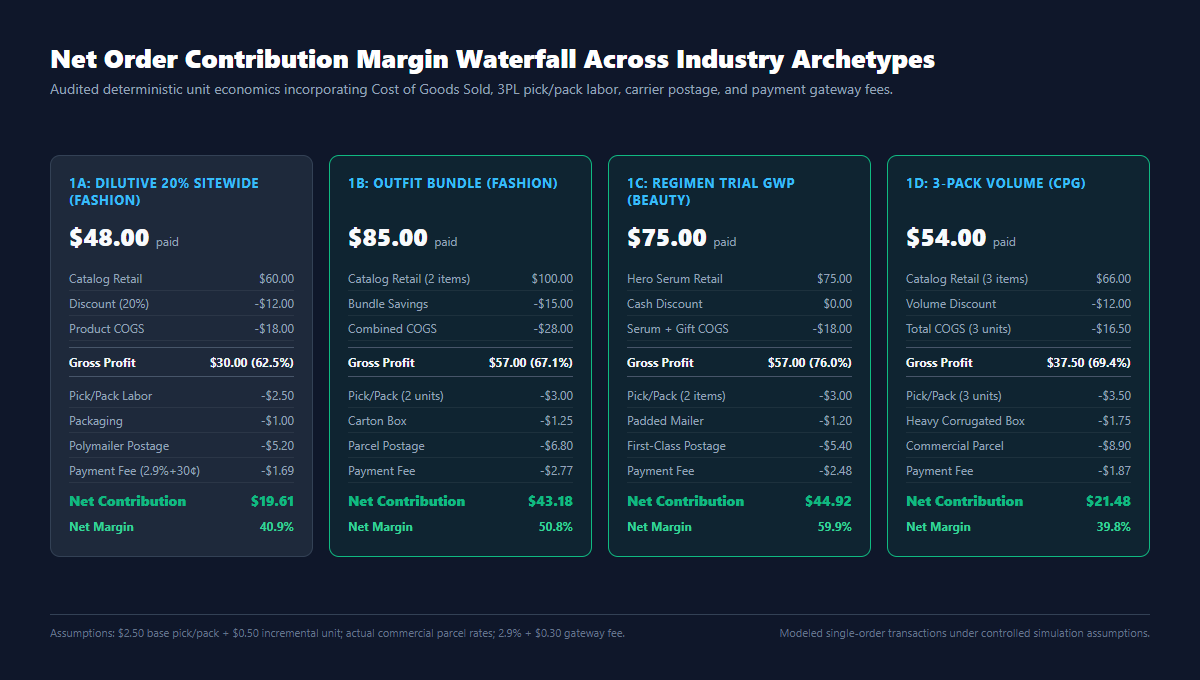
Note: The following worked examples represent modeled single-order scenarios under controlled simulation assumptions ($2.50 base pick/pack labor + $0.50 per incremental unit; audited packaging materials; actual commercial parcel postage; and standard Shopify Payments 2.9% + $0.30 processing fees). They do not represent storewide campaign elasticity or empirical merchant accounting.
| Scenario & Industry Archetype | Gross Catalog Value | Discount Applied | Customer Net Paid | Total COGS | Product Gross Profit | Fulfillment Costs | Net Contribution Profit | Net Margin % |
|---|---|---|---|---|---|---|---|---|
| 1A: Dilutive 20% Sitewide (Fashion) 1 Shirt ($60.00 retail) |
$60.00 | $12.00 | $48.00 | $18.00 | $30.00 (62.5%) | $10.39 | $19.61 | 40.9% |
| 1B: Outfit Bundle (Fashion) Shirt ($60.00) + Shorts ($40.00) |
$100.00 | $15.00 | $85.00 | $28.00 | $57.00 (67.1%) | $13.82 | $43.18 | 50.8% |
| 1C: Regimen Trial GWP (Beauty) Serum ($75.00) + Gift Cleanser ($18.00) |
$75.00 | $0.00 | $75.00 | $18.00 | $57.00 (76.0%) | $12.08 | $44.92 | 59.9% |
| 1D: 3-Pack Volume Break (CPG) 3 Coffee Concentrates ($22.00 ea) |
$66.00 | $12.00 | $54.00 | $16.50 | $37.50 (69.4%) | $16.02 | $21.48 | 39.8% |
Examining the waterfall reveals critical operational truths. In Scenario 1A, a single fashion item discounted by 20% leaves the merchant with only $19.61 in net contribution dollars (40.9% net margin) because fixed pick/pack ($2.50), packaging ($1.00), polymailer postage ($5.20), and transaction fees ($1.69) consume over 34% of net paid revenue. By contrast, in Scenario 1B, bundling the shirt with tailored shorts raises net paid revenue to $85.00. While fulfillment costs rise slightly to $13.82 due to package weight, Net Contribution Profit surges to $43.18—more than doubling retained cash flow per order.
In Scenario 1C (Beauty GWP), the customer pays full retail ($75.00) while receiving a trial cleanser ($18.00 retail value, $3.00 COGS). The merchant achieves $44.92 in net contribution profit (59.9% net margin), providing $0.00 in cash discounts while generating powerful product sampling. In Scenario 1D (CPG), selling 3 units for $54.00 yields $21.48 in net contribution dollars, whereas selling a single bottle at $22.00 would yield barely $4.31 after parcel postage.
Behavioral Economics Storefront Safeguards: Theory vs. Checkout Reality
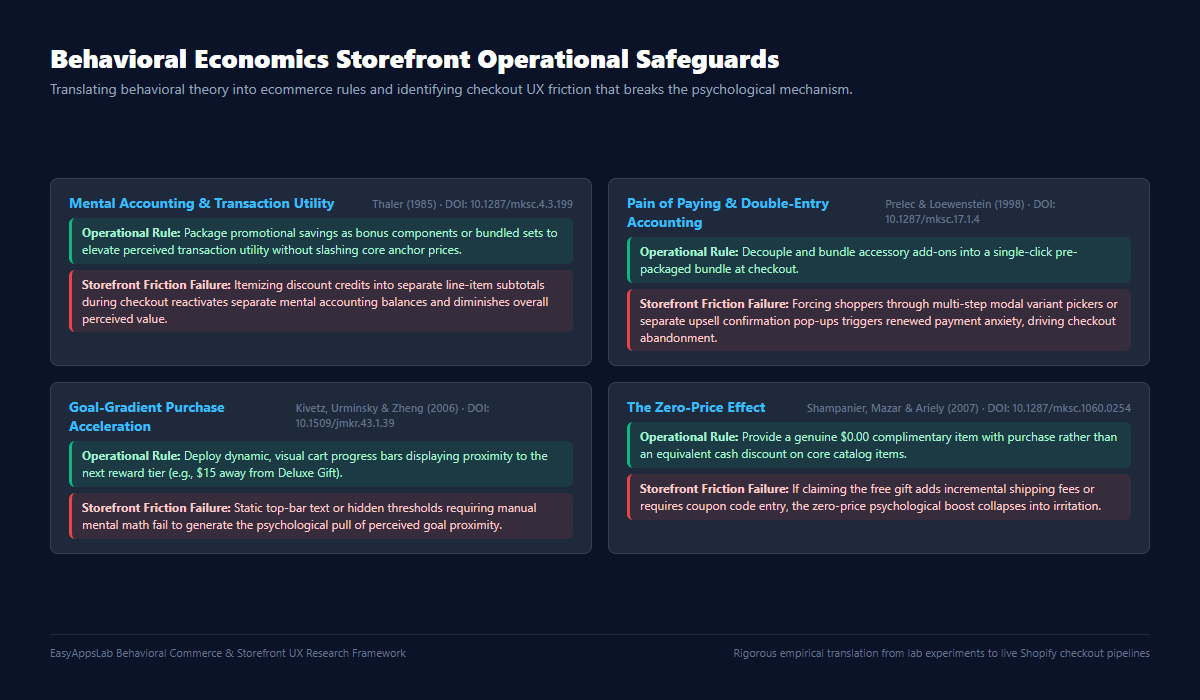
Ecommerce literature frequently cites behavioral economics to justify discounting tactics. However, academic findings conducted in controlled lab settings often break down inside real-world Shopify checkout funnels due to user experience friction. To succeed, merchants must translate psychological principles into operational storefront rules and systematically eliminate friction points.
Consider the following operational translations and their associated storefront failure conditions:
- Mental Accounting & Transaction Utility (Thaler 1985; DOI: 10.1287/mksc.4.3.199): Richard Thaler established that consumer purchases are governed by both acquisition utility (perceived product value vs price) and transaction utility (perceived deal quality vs reference price). Packaging savings into bundled sets or gift add-ons preserves transaction utility without eroding the core reference anchor. Storefront Friction Failure: If the checkout drawer itemizes bundled discounts into separate subtracted line items, it fragments the customer’s mental ledger and reactivates price comparison scrutiny.
- Pain of Paying & Double-Entry Mental Accounting (Prelec & Loewenstein 1998; DOI: 10.1287/mksc.17.1.4): Drazen Prelec and George Loewenstein proved that the psychological pain of paying is exacerbated by multiple segregated payment decisions. Storefront Friction Failure: Forcing shoppers through multi-step pop-up upsells or separate variant dropdowns at checkout reactivates payment pain, driving cart abandonment. Bundled solutions must be selectable in a single click.
- Goal-Gradient Hypothesis (Kivetz, Urminsky & Zheng 2006; DOI: 10.1509/jmkr.43.1.39): Ran Kivetz and colleagues demonstrated that purchasing velocity accelerates as consumers perceive they are nearing a goal. Storefront Friction Failure: Announcing spend thresholds through static announcement bars without real-time, interactive cart progress meters fails to trigger goal acceleration because shoppers cannot visually perceive their proximity.
- Reference Price Erosion (Raghubir & Corfman 1999; DOI: 10.1509/jmkr.36.2.211): Priya Raghubir and Kim Corfman proved that frequent, predictable percentage promotions permanently downgrade consumer reference price anchors. Storefront Friction Failure: Running rolling sitewide weekend sales trains shoppers to never purchase at full retail, forcing perpetual discounting to maintain conversion velocity.
- The Zero-Price Effect (Shampanier, Mazar & Ariely 2007; DOI: 10.1287/mksc.1060.0254): Kristina Shampanier, Nina Mazar, and Dan Ariely showed that a price of zero ($0.00) induces an emotional surge that outperforms mathematically equivalent discounts. Storefront Friction Failure: If claiming a “free gift” triggers an unexpected shipping surcharge or requires manually entering a discount code at checkout, the zero-price psychological advantage is instantly converted into customer resentment.
Statistical Calibration: Moving Beyond AOV Tunnel Vision with MOV
A pervasive mistake in ecommerce promotion planning is setting spend thresholds based solely on Average Order Value (AOV). AOV is an arithmetic mean calculated by dividing total revenue by total orders. Because ecommerce transaction distributions are almost universally right-skewed—distorted by high-value B2B orders or multi-item bulk purchases—the mean AOV is significantly higher than the Median Order Value (MOV).
For example, consider a Shopify store with an AOV of $82.00, but a Median Order Value (MOV) of $50.00 (representing the typical customer purchasing a single signature product). If this merchant sets a Free Shipping or Free Gift threshold at $95.00 (targeting 15% above AOV), the spend goal requires the median shopper to double their cart size. Facing an unattainable threshold, the shopper abandons the goal entirely.
Statistical hygiene requires calibrating promotion thresholds 15% to 20% above the Median Order Value (MOV). In this store, setting the milestone tier at $60.00 enables the median $50.00 buyer to cross the threshold by adding an accessible $15.00 accessory or consumable add-on. Furthermore, merchants must monitor the 5-Metric Contribution Framework to guard against “AOV Tunnel Vision”:
- 1. Units Per Transaction (UPT): Measures basket density and ensures promotions motivate multi-unit purchases rather than single-item coupon clipping.
- 2. Median & Average Order Value (MOV / AOV): Tracks structural basket growth while monitoring distribution skew.
- 3. Conversion Rate (CVR): Confirms that promotional mechanics reduce cart friction rather than introduce checkout confusion.
- 4. Product Gross Profit Dollars ($): Tracks catalog margin dollars after COGS deductions.
- 5. Net Contribution Dollars ($): The ultimate benchmark—measuring retained cash flow after accounting for pick/pack labor, packaging, carrier postage, and credit card processing fees.
Technical Execution on Shopify: Native Engine vs. Shopify Functions
Executing sophisticated industry promotions requires understanding the architectural capabilities and constraints of the Shopify platform. Shopify provides two execution models: native admin discounts and custom apps built on Shopify Functions.
Under native Shopify configuration, stores are subject to a platform ceiling of 25 active automatic discount rules at any given time. Furthermore, native automatic discounts offer limited flexibility for dynamic spend goals or cross-collection product gifting without requiring customer coupon entry. Native discount combinations (Product, Order, and Shipping) can be configured, but merchants must carefully ensure combination flags do not permit unintended stacking leakage.
For merchants scaling complex promotional logic, modern Shopify apps utilize Shopify Functions. Built with server-side compiled WebAssembly (WASM), Shopify Functions execute directly inside Shopify checkout pipeline. They operate under rigorous platform constraints: an 11 million instruction ceiling per execution (for carts up to 200 items), a 10 MB linear memory ceiling, a 512 kB stack limit, and a 256 kB binary size limit, targeting sub-5ms runtime to minimize checkout latency. Additionally, the Shopify Cart Transform API allows apps to dynamically merge or expand bundle line items while maintaining synchronized inventory tracking on underlying component SKUs.
When evaluating promotional tooling, merchants should review execution architecture alongside pricing tiers. For instance, our proprietary app Easy Deals is engineered on Shopify Functions WASM architecture to deliver automated cart goals, BOGO mechanics, and GWP reward tiers without checkout latency, offering a free tier alongside paid plans starting at $9.90/mo ($9.90). Merchants can also utilize native Shopify automatic discounts ($0/mo included with Shopify plans) for foundational percentage and order promotions.
Strategic Implementation Checklist for Shopify Merchants
Before launching your next promotional campaign, audit your offer structure against this 6-step operational checklist:
- Audit Customer Hesitation Triggers: Identify whether your vertical’s primary drop-off is driven by fit anxiety (fashion), efficacy doubts (beauty), parcel postage sensitivity (CPG), or freight charges (home goods).
- Map Unit Net Contribution Margins: Model single-order transactions beyond Gross Profit. Deduct pick/pack labor ($2.50 base + $0.50 incremental), packaging, carrier postage, and payment fees (2.9% + $0.30) to verify retained dollars.
- Calibrate Thresholds to MOV, Not AOV: Calculate your store’s Median Order Value. Set free shipping or promotional spend tiers 15% to 20% above MOV to motivate the core 50% of your customer base.
- Protect Reference Price Anchoring: Avoid calendar-recurring percentage discounts on signature hero SKUs. Use outfit bundles, deluxe trial GWPs, or volume breaks to deliver value without cheapening perceived product quality.
- Eliminate Storefront Checkout Friction: Ensure bundle add-ons can be selected in a single click, free gifts are automatically added to the cart at $0.00 without coupon codes, and spend milestones feature real-time visual progress bars.
- Verify Technical Platform Limits: Confirm that active automatic discount rules remain within Shopify 25-rule ceiling and that discount combination classes are properly configured to prevent unintended discount stacking.
Editorial Disclosure: EasyAppsLab publishes independent technical research, financial models, and strategic playbooks for ecommerce operators. While we develop Easy Deals to solve advanced discounting and spend-goal challenges on Shopify, we evaluate native platform capabilities and commercial alternatives with equal technical scrutiny.