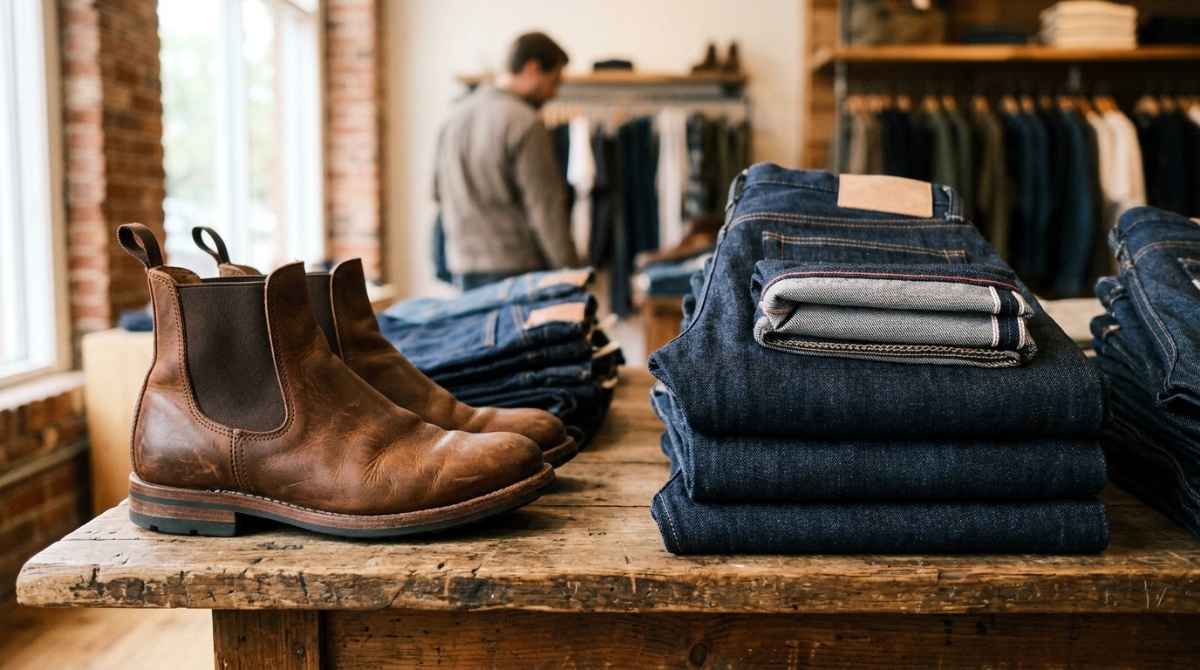
Cross-category promotions requiring shoppers to purchase items from two distinct collections before unlocking a complimentary gift represent one of e-commerce’s most potent Average Order Value (AOV) growth strategies. By enforcing a compound prerequisite (Collection A AND Collection B), merchants prevent shoppers from cherry-picking low-margin items while incentivizing discovery across complementary catalog departments. In Shopify checkout, modern Shopify Functions evaluate line items and collection taxonomy server-side in sub-5ms compiled WebAssembly, verifying both collection criteria before automatically applying the 100% discount to the designated gift SKU and protecting baseline gross profit margins.
1. Core Mechanics: Dual-Collection Condition Evaluation Logic
A multi-collection free gift offer requires a cart to satisfy separate qualification criteria across two distinct collections before the reward item is discounted to $0.00 or injected into the basket:
- Compound AND Logic: The customer must purchase at least one qualifying item from Collection A (e.g., Skincare Cleansers) AND at least one qualifying item from Collection B (e.g., Facial Moisturizers). Adding two cleansers does not satisfy the moisturizer requirement.
- Server-Side Cart Evaluation: When evaluated via modern Shopify Functions at checkout, line items are validated against their parent collection IDs. Only when both condition sets evaluate to true does the discount engine allocate the 100% price reduction to the designated gift SKU.
This structure prevents the common margin leak where shoppers add multiple low-cost items from a single category to trigger an expensive free gift. For a complete breakdown of Boolean operators in catalog promotions, review our guide to Shopify collection discount ALL vs ANY rules.
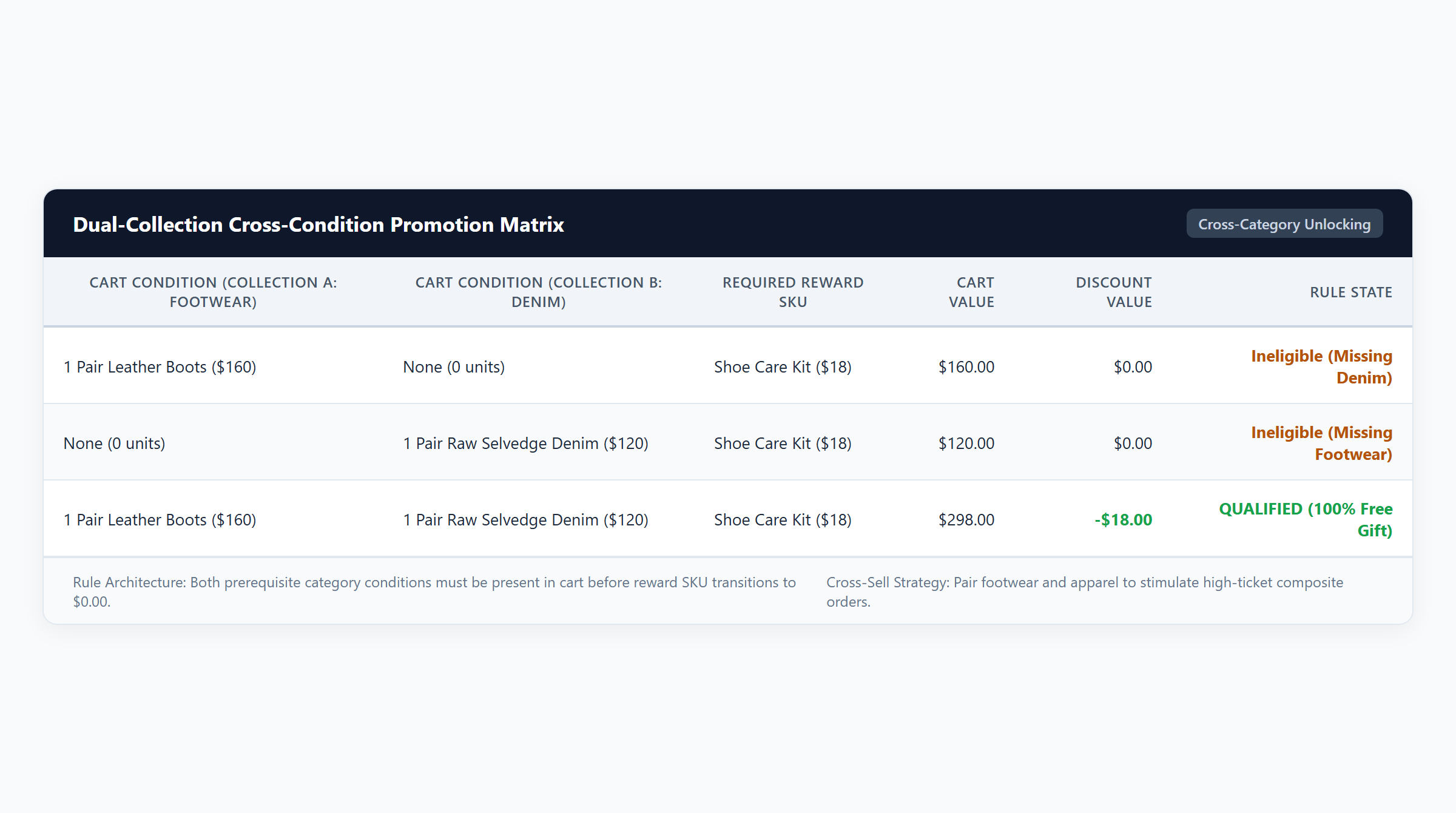
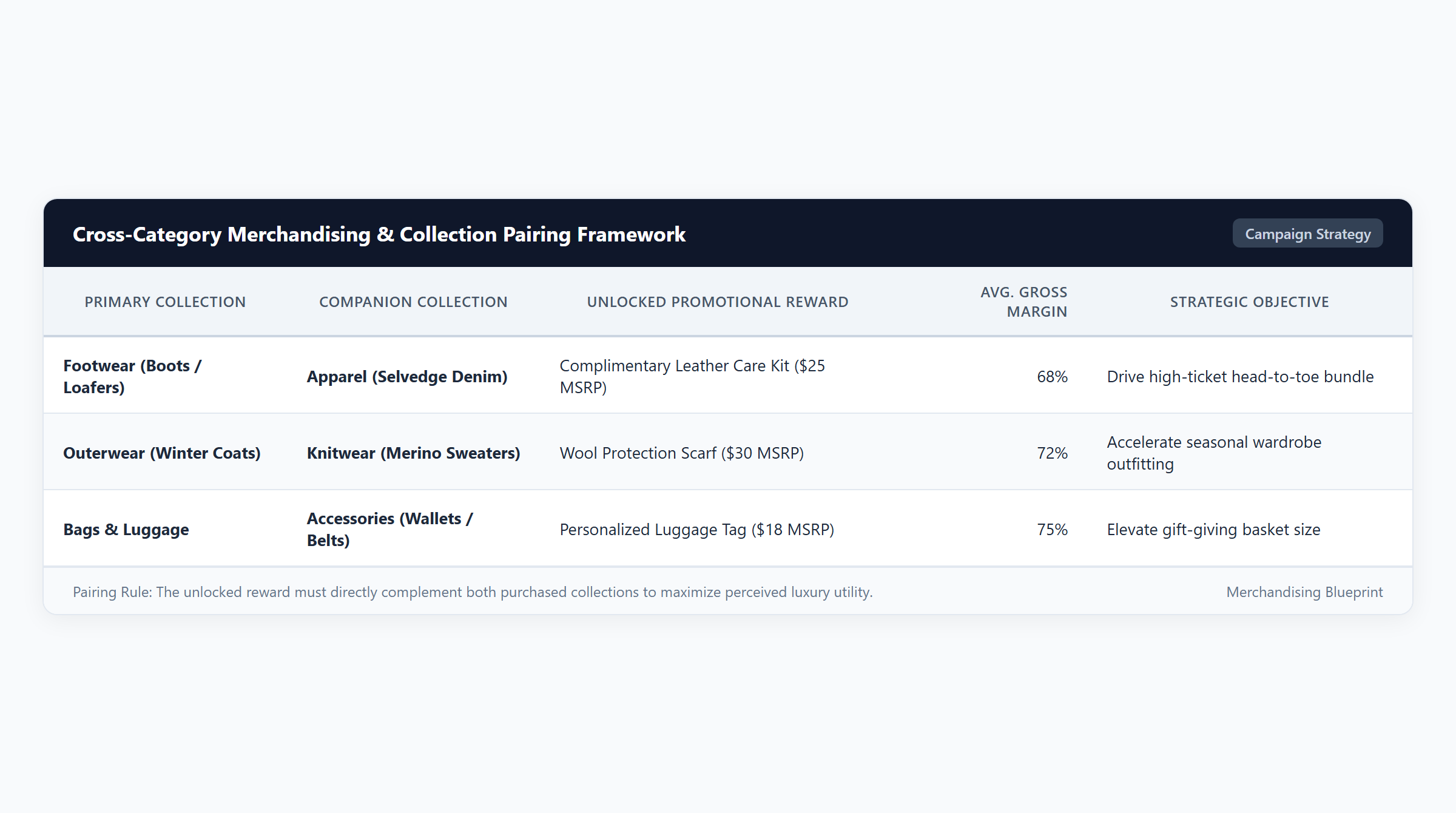
Selecting between these logical operators requires balancing margin defense against conversion friction. Academic research in consumer bundling demonstrates that requiring complementary items across distinct product categories protects gross margin dollars while delivering perceived utility to the shopper (Journal of Marketing Research). For comprehensive rules on combining collection promotions with storewide incentives, review our architectural guide on Shopify discount combinations.
2. Merchandising Strategy, Cross-Category Bundles & Unit Margins
To examine the profit dynamics of dual-collection gifting, consider a skincare brand offering a complimentary Deluxe Travel Serum Gift ($10.00 retail value, $2.00 COGS) when customers purchase both a Botanical Gentle Cleanser ($24.00 retail, $6.00 COGS) from Collection A and a Hydrating Barrier Moisturizer ($36.00 retail, $9.00 COGS) from Collection B.
| Scenario | Cart Line Items | Gross Value | Applied Discount | Net Customer Paid | Total COGS | Gross Profit | Gross Margin |
|---|---|---|---|---|---|---|---|
| 1. Dual-Collection Qualified | 1 Cleanser ($24.00) + 1 Moisturizer ($36.00) + 1 Gift ($10.00) | $70.00 | $10.00 (100% Gift) | $60.00 | $17.00 | $43.00 | 71.7% |
| 2. Single-Category Unqualified | 1 Cleanser ($24.00) + No Moisturizer | $24.00 | $0.00 (0%) | $24.00 | $6.00 | $18.00 | 75.0% |
| 3. High-Tier Basket (2 Cleansers) | 2 Cleansers ($48.00) + 1 Moisturizer ($36.00) + 1 Gift ($10.00) | $94.00 | $10.00 (100% Gift) | $84.00 | $23.00 | $61.00 | 72.6% |
| 4. Double Cross-Bundle (4 Units) | 2 Cleansers ($48.00) + 2 Moisturizers ($72.00) + 1 Gift ($10.00) | $130.00 | $10.00 (100% Gift) | $120.00 | $32.00 | $88.00 | 73.3% |
Mathematical Breakdown of Audited Scenarios
- Scenario 1: Dual-Collection Bundle Meets Cross-Category Threshold: The customer adds 1 Cleanser ($24.00) and 1 Moisturizer ($36.00) along with the Deluxe Gift ($10.00), totaling $70.00 gross value. Because both collection prerequisites are met, the engine applies a $10.00 discount, reducing the gift price to $0.00. The customer pays $60.00 net. Combined inventory COGS is $17.00 ($6.00 + $9.00 + $2.00), delivering $43.00 in gross profit (71.7% margin). Compared to a single-cleanser purchase, gross profit jumps from $18.00 to $43.00 (+139% gross margin dollars).
- Scenario 2: Single-Category Purchase Missing Second Collection: The shopper adds only 1 Cleanser ($24.00). Because the second collection condition is unmet, the discount is $0.00. Net payment is $24.00, COGS is $6.00, and profit is $18.00. The store retains 75.0% margin while avoiding accidental gift leakage.
- Scenario 3: Expanded Dual-Collection Basket (2 Cleansers + 1 Moisturizer): The shopper buys 2 Cleansers ($48.00 subtotal) and 1 Moisturizer ($36.00) plus the gift ($10.00), reaching $94.00 gross value. The $10.00 gift discount results in $84.00 net revenue. With combined COGS of $23.00 ($12.00 + $9.00 + $2.00), the transaction generates $61.00 in gross profit (72.6% margin).
- Scenario 4: Double Cross-Bundle (4 Core Items): The shopper adds 2 Cleansers ($48.00) and 2 Moisturizers ($72.00) plus the gift ($10.00), achieving $130.00 gross subtotal. Deducting the $10.00 gift discount produces $120.00 in net revenue. At $32.00 total COGS ($12.00 + $18.00 + $2.00), the sale yields $88.00 in gross profit (73.3% margin), proving how cross-category promotions expand gross margin dollars exponentially.
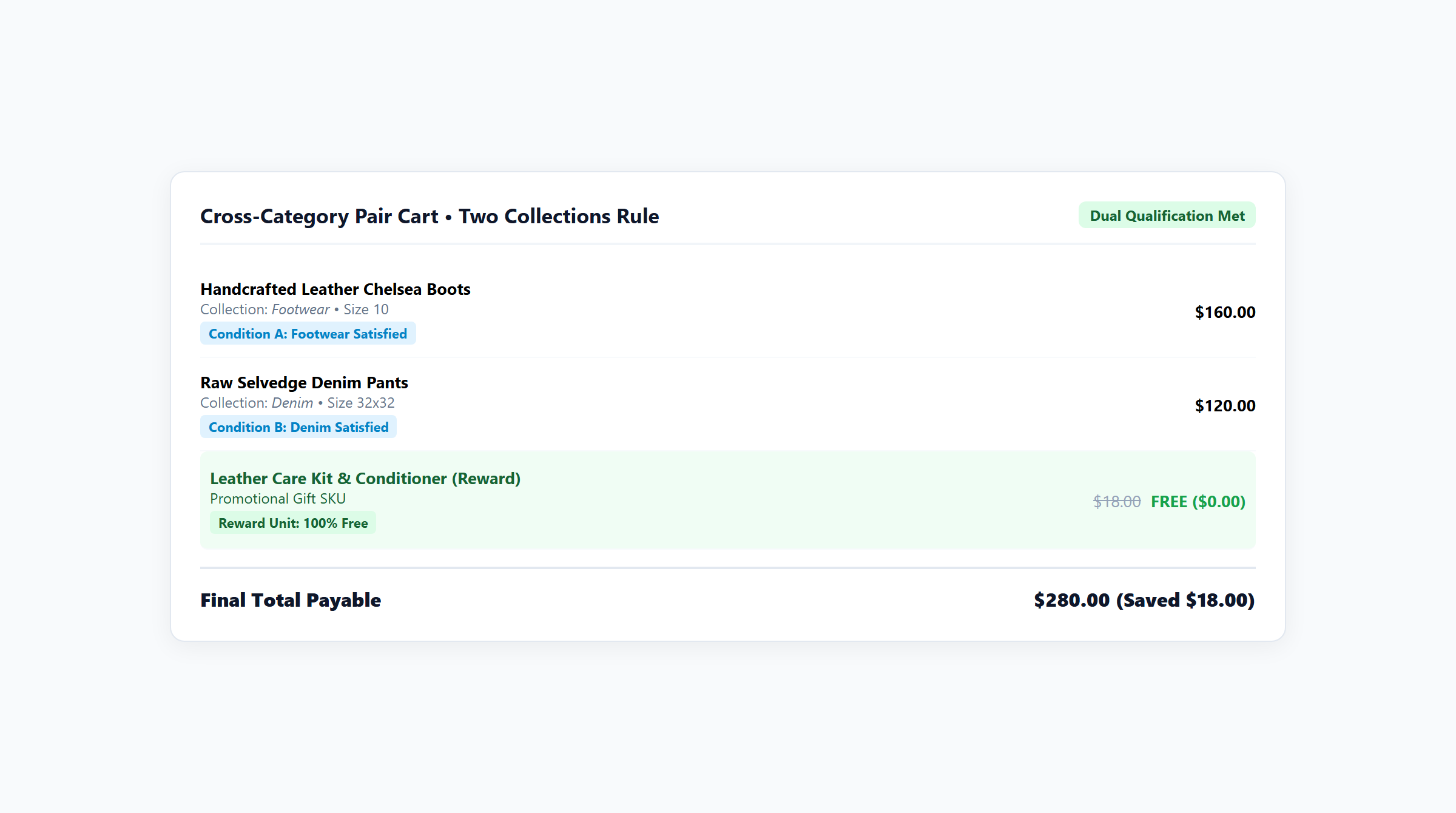
3. Storefront Experience: Collection Navigation & Cart Feedback
The biggest operational hurdle with cross-collection free gift promotions is the Native Shopify limitation: Shopify Native Buy X Get Y discounts do not automatically inject the gift into the cart. If the customer does not manually find and add the reward SKU, no discount applies at checkout, leading to missed promotions and customer frustration.
Overcoming this requires automated storefront feedback mechanisms:
- Contextual Drawer Banners: When a shopper adds a Cleanser, the cart drawer updates in real time: “You’re 1 Moisturizer away from unlocking a FREE Deluxe Travel Serum!”
- Customer-Selected Gift Modals: Rather than forcing an arbitrary free item, triggering a modal upon qualification allows the customer to choose their preferred gift variant or scent. Empirical behavioral studies confirm that consumer choice in promotional gifts significantly elevates perceived brand generosity and checkout completion (Journal of Retailing). For comparison between automated injection and customer modals, consult our guide on automatic vs customer-selected gifts.
- The Rule of 100 in Gift Value: For sub-$100 orders, tangible free gift items ($10.00 value) often outperform equivalent monetary discounts because consumers perceive tangible gifts as complete, high-value bonuses rather than slight price reductions (Journal of Consumer Psychology).
4. Inventory Reservation, Out-of-Stock Fail-safes & Stacking Rules
Merchandising dual-collection promotions introduces inventory dependencies across three distinct SKUs. Protecting operations requires addressing three key guardrails:
1. Gift Inventory Depletion and Stockouts
If your promotional gift SKU goes out of stock, native Shopify discounts will display an error or prevent the promotional reward from applying. To prevent cart abandonment, ensure your discount engine supports secondary fallback gifts or automatically hides the promotion when gift inventory drops below 10 units.
2. Automated Smart Collection Synchronisation
Automated collections rely on tags and product conditions. During high-traffic events, tagging latency can delay a product’s recognized membership in Collection A or B by several minutes across cached checkout functions. Always pre-populate collections at least 24 hours prior to launching promotional marketing.
3. Stacking Permissions and the 25-Discount Ceiling
Shopify enforces a platform ceiling of 25 active automatic discounts concurrently per store. To prevent margin erosion, do not allow multi-collection free gift promotions to combine with sitewide percentage discounts. Restrict stacking exclusively to shipping discounts. For detailed combination rules, explore our tutorials on Buy 2 Get 1 Free setup and cart spend goal tiers.
5. Technical Architecture & App Solution Comparison
While native Shopify discounts offer basic Buy X Get Y tools, executing strict dual-collection AND requirements and automated gift modals requires dedicated discount applications built on Shopify Functions:
| Platform / Application | Primary Focus | BOGO Support | Volume Support | Free Gift Support | Spend Goals | Technical Architecture | Pricing |
|---|---|---|---|---|---|---|---|
| Easy Deals (EasyAppsLab) | Multi-collection compound rules, automated free gift modals, and cart spend goals | Yes (Native Functions BOGO & bundle logic) | Yes (Tiered breaks & collection bundles) | Yes (Auto-add & customer-selected gift modals) | Yes (Multi-tier cart milestone progress bars) | Shopify Functions (WebAssembly sub-5ms runtime) | $9.99/mo (7-day free trial) |
| Shopify Native Discounts | Basic single-collection Buy X Get Y promotions without cross-collection AND rules | Limited (Fixed ratio Buy X Get Y only) | No (Requires individual coupon workarounds) | Limited (Manual customer add-to-cart required) | No (Requires theme Liquid modifications or app) | Shopify Core Admin Engine | Free (Included with all Shopify plans) |
| Automated Discounts & Gifts | Cart-level rule automation, gift triggers, and multi-condition checkout promotions | Yes (Functions & API automation) | Yes (Tiered cart rules) | Yes (Automated gift injection) | Yes (Cart value milestones) | Shopify Functions & Storefront API | $29.99/mo |
| Volume & Tiered Discounts | Grid-based wholesale quantity tiers and volume discount tables | No (Volume tables focus only) | Yes (Product & collection quantity breaks) | No (Not supported in core tiers) | No (Not supported in core tiers) | Theme App Extension & Functions | $19.99/mo |
With Easy Deals, merchants configure multi-collection compound gift rules starting at $9.99/mo with a 7-day free trial. Executed natively in compiled WebAssembly via Shopify Functions, promotions trigger without theme latency or checkout script conflicts. For related promotional mechanics, review our guides to Shopify BOGO apps and Shopify Buy X Get Y setups.
6. Launch QA Acceptance Matrix & Frequently Asked Questions
Before launching a cross-collection free gift campaign, execute this 7-point QA verification checklist:
- Dual-Condition Verification: Test adding only Collection A items; confirm gift remains locked at full price. Test adding only Collection B items; verify gift remains locked.
- Combined Basket Activation: Add qualifying items from both Collection A and Collection B; confirm the gift discount ($10.00 off) activates immediately.
- Auto-Add / Modal Test: Confirm whether the gift automatically injects into the cart or prompts an interactive selection modal.
- Quantity Ratio Testing: Test higher quantities (e.g., 2 Cleansers + 2 Moisturizers) to ensure the engine awards gifts according to your configured limits (e.g., maximum 1 free gift per transaction).
- Inventory Depletion Test: Temporarily set gift stock to 0 in a test environment; verify the store handles out-of-stock gracefully without breaking checkout.
- Partial Removal Behavior: Remove the Collection B item from the cart; verify the engine instantly revokes the gift discount or removes the gift SKU.
- Combination Stacking Review: Attempt applying an order-level coupon alongside the free gift to ensure combination permissions match merchant policy.
Frequently Asked Questions
Can I create a multi-collection free gift promotion using native Shopify discounts?
Native Shopify Buy X Get Y discounts allow you to require products from a collection to get a reward, but native rules cannot enforce a compound AND condition across two separate collections (Collection A AND Collection B). Doing so requires a Shopify Functions application like Easy Deals.
What happens if the customer removes one of the qualifying items after the gift is added?
A properly configured Shopify Functions app re-evaluates cart line items every time the basket changes. If a customer removes the required item from Collection A or B, the function immediately invalidates the discount, reverting the gift to its full retail price or removing it from the cart.
How are refunds handled if a customer returns a qualifying item from a gift bundle?
Shopify’s pro-rated discount allocation assigns net paid amounts to each line item. If the gift was discounted 100% to $0.00, returning the $36.00 moisturizer refunds the net paid amount, while the gift carries $0.00 refund value, preventing return exploitation.
Does running multi-collection gifts slow down Shopify checkout?
No. When built using modern Shopify Functions, the discount logic compiles to WebAssembly and runs directly inside Shopify’s checkout infrastructure within an 11M instruction / sub-5ms runtime limit, ensuring zero page speed penalty or checkout delay.