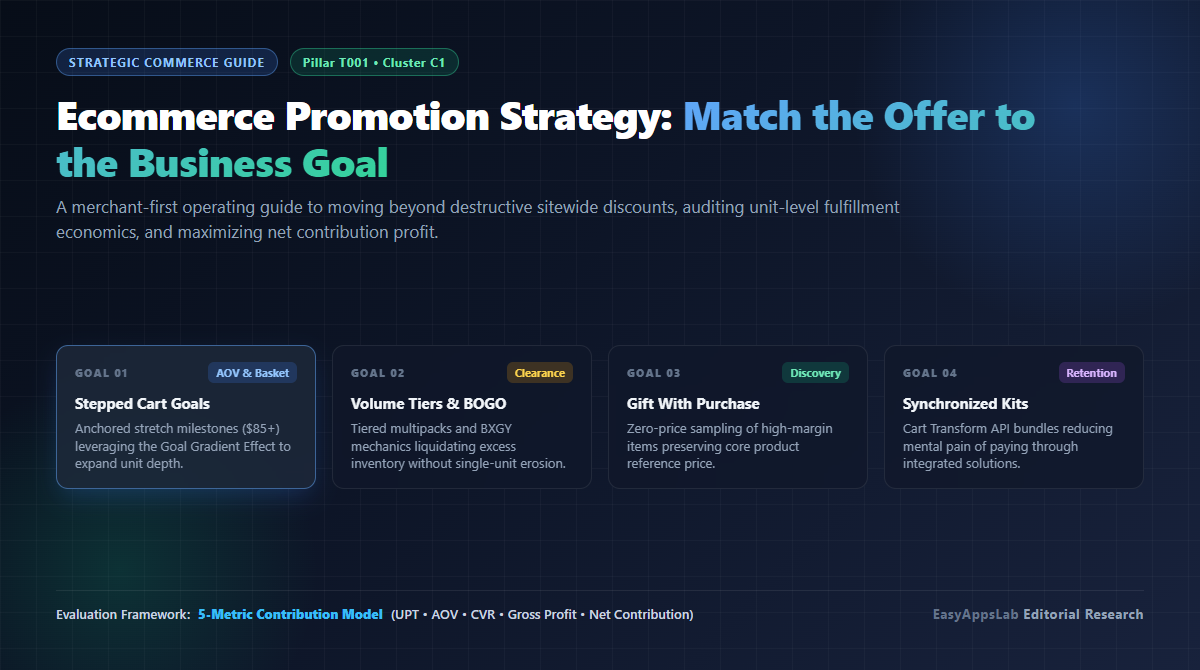
A promotion is not a blunt sales accelerator; it is a financial and behavioral mechanism designed to achieve a specific business objective. When ecommerce merchants default to blanket sitewide percentage discounts to solve every revenue lull, they subsidize customers who intended to buy at full price, erode established reference pricing, and reduce net retained profit. Achieving sustainable profitability on Shopify requires matching distinct promotional mechanics—such as stepped cart milestones, tiered volume pricing, Buy X Get Y (BXGY), and gift with purchase (GWP)—to explicit operational goals like expanding basket size, liquidating deadstock, or introducing new product lines.
To evaluate whether a promotional campaign actually creates economic value, merchants must look beyond top-line revenue and top-line gross margin. Evaluating promotional performance requires balancing five core metrics across the store: Units Per Transaction (UPT), Average Order Value (AOV), Storefront Conversion Rate, Product Gross Profit Dollars, and Net Order Contribution Profit (accounting for pick/pack warehouse labor, parcel postage, and payment gateway fees). This comprehensive guide provides an operational decision framework to map each promotional offer to your business goal, models the exact unit-level fulfillment economics, and outlines the storefront UX safeguards required to keep behavioral mechanisms intact.
1. The Blanket Discount Trap: Why Sitewide Sales Erode Margins
The most frequent promotional mistake in ecommerce is treating discounts as a universal antidote for sluggish traffic. When a merchant announces a “20% Off Everything” sale, the offer applies indiscriminately across all SKUs, regardless of individual product gross margins, inventory holding costs, or customer acquisition sources. This creates three severe structural hazards for an ecommerce business:
- Full-Price Margin Cannibalization: Customers who were already prepared to purchase high-demand, full-margin products at catalog price receive an unnecessary cash discount, transferring margin directly out of the business without driving incremental order volume.
- Reference Price Degradation: Research in consumer decision framing demonstrates that frequent, unconstrained price discounting erodes the internal reference price consumers attach to a brand. Once a merchant conditions their audience to expect periodic sitewide cuts, baseline conversion at regular catalog prices drops.
- Deal-Seeker Churn: Sitewide sales attract price-sensitive first-time buyers who exhibit substantially lower lifetime value (LTV) and higher return rates than organic customers acquired through product-market fit and brand positioning.
Instead of relying on blanket discounts, modern DTC brands treat promotions as precision instruments. Before configuring a single rule in Shopify, you must define the exact business problem you are attempting to solve. Are you trying to lift basket size among active shoppers, liquidate slow-moving inventory tied up in warehouse space, or incentivize trial for a newly launched product category? Each operational objective demands a fundamentally different promotional structure.
2. The Strategic Promotion Decision Matrix: Offer-to-Goal Alignment
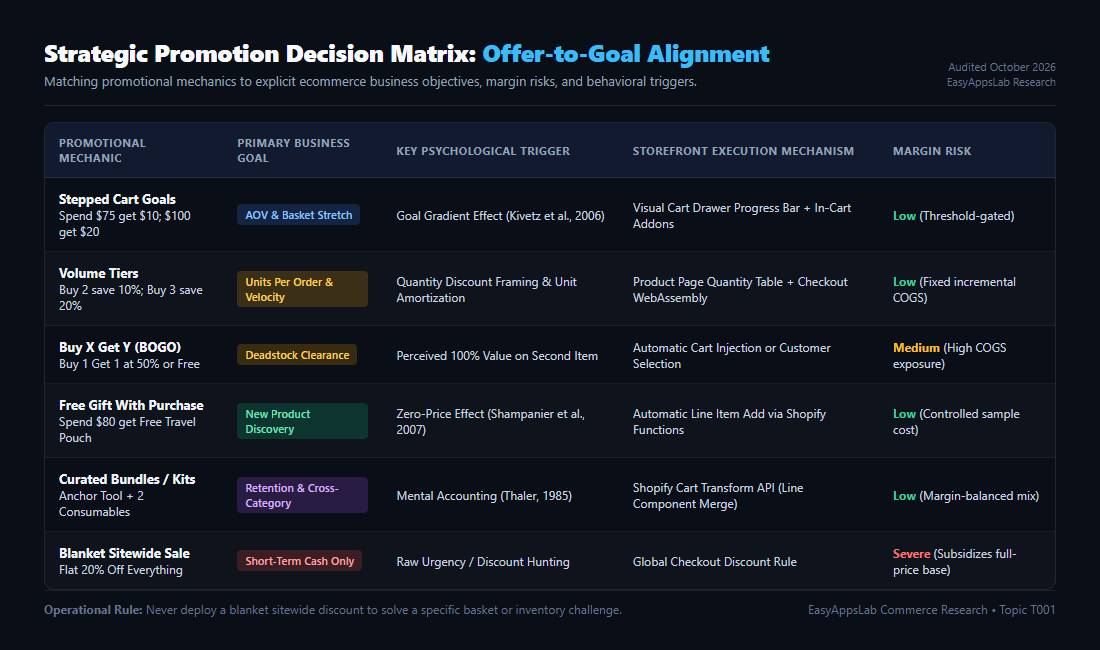
To select the right promotion, merchants can utilize the Strategic Promotion Decision Matrix below. This operational framework pairs each discount mechanic with its primary business objective, the underlying consumer behavioral mechanism, its storefront execution requirements, and its inherent gross margin risk.
| Promotional Mechanic | Primary Business Goal | Underlying Behavioral Driver | Storefront Execution Requirement | Margin Risk Rating |
|---|---|---|---|---|
| Stepped Cart Goals Spend $75 get $10; Spend $100 get $20 |
AOV Expansion & Basket Growth | Goal Gradient Effect (Kivetz et al., 2006) | Interactive cart drawer progress bar with 1-click in-cart add-on modules | Low: Discounts are strictly gated behind profitable cart thresholds |
| Tiered Volume Pricing Buy 2 save 10%; Buy 3 save 20% |
Stock Velocity & Multi-Unit Depth | Quantity Discount Framing & Unit Amortization | Product page quantity tier tables with automatic checkout calculation | Low: Incremental order volume amortizes fixed packaging overhead |
| Buy X Get Y (BXGY / BOGO) Buy 1 core item, get accessory at 50% off |
Deadstock Liquidation & Bundled Trial | Perceived 100% Value on Secondary Item | Automatic cart injection or customer-selected qualifying trigger | Medium: Requires strict control over the cost of goods sold of Item Y |
| Gift With Purchase (GWP) Spend $80 get free travel sample |
New Product Category Discovery | Zero-Price Effect (Shampanier et al., 2007) | Automatic addition of free SKU via Shopify Functions at checkout | Low: Controlled wholesale sample cost preserves primary product price |
| Synchronized Bundles / Kits Core tool + 2 consumable refills |
Long-Term Retention & Cross-Buying | Mental Accounting & Integrated Losses (Thaler, 1985) | Shopify Cart Transform API for component line-item inventory tracking | Low: Balanced product mix protects overall order contribution margin |
| Blanket Sitewide Sale Flat 20% off entire order |
Emergency Cash Generation Only | Raw Price-Drop Urgency | Sitewide announcement bar and global checkout discount code | Severe: Subsidizes purchases that would have occurred at full catalog price |
When reviewing this matrix, notice that higher-margin promotions protect profitability by requiring customer commitment before unlocking value. Stepped milestones require cart value expansion, volume tiers require inventory absorption, and free gifts require a qualifying order threshold. In contrast, flat sitewide sales offer unearned value, which is why they carry the highest risk of margin degradation.
3. Moving Beyond “AOV Tunnel Vision”: The 5-Metric Contribution Framework
A dangerous analytical trap in ecommerce management is “AOV Tunnel Vision”—the assumption that any promotion that raises Average Order Value is automatically successful. Evaluating promotional health on AOV alone ignores how threshold friction impacts conversion rates and how discounting compresses contribution dollars. A promotion that lifts AOV from $70.00 to $95.00 while causing store conversion to collapse from 2.0% to 1.3% reduces total retained earnings across the business.
To assess campaign health holistically, merchants must evaluate promotions across five balanced metrics: Units Per Transaction (UPT), Average Order Value (AOV), Storefront Conversion Rate, Product Gross Profit Dollars, and Net Order Contribution Profit. This relationship is captured by the Storewide Campaign Contribution Formula:
Campaign Net Contribution = Sessions × Storefront Conversion Rate × (Net AOV - Product COGS - Pick/Pack Labor - Parcel Postage - Payment Gateway Fees)
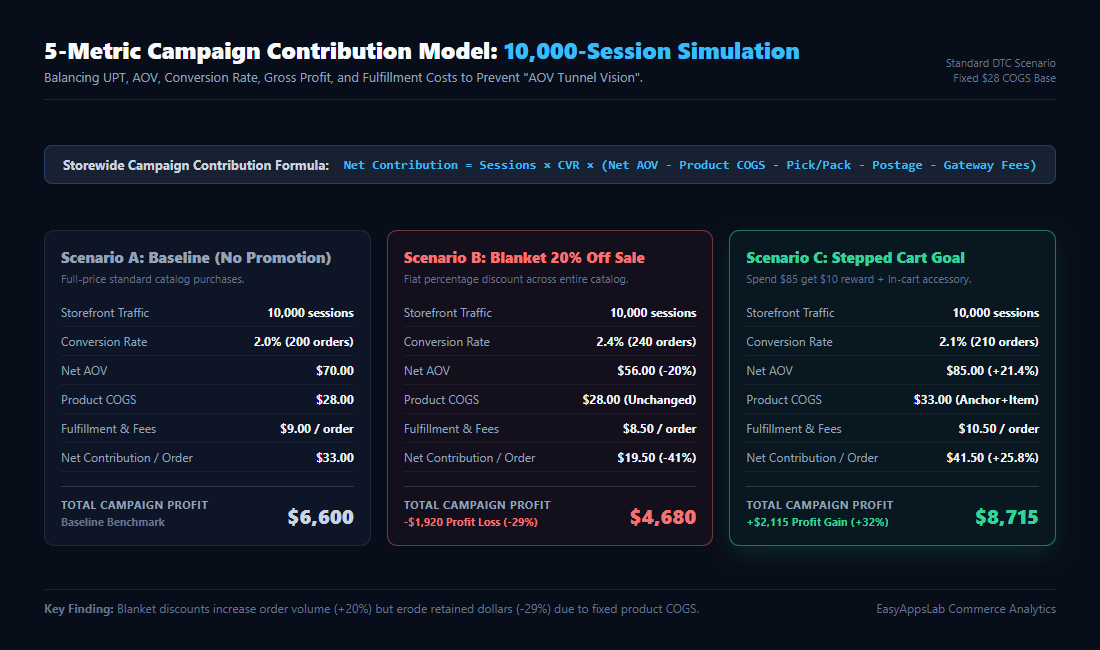
To illustrate the power of this framework, consider a controlled 10,000-session campaign simulation comparing three alternative promotional strategies for a typical DTC store with a baseline $70.00 cart and $28.00 product COGS:
| Campaign Evaluation Metric | Scenario A: Baseline (No Promo) | Scenario B: Blanket 20% Sitewide Sale | Scenario C: Stepped Cart Goal ($85 Stretch) |
|---|---|---|---|
| Storefront Traffic (Sessions) | 10,000 sessions | 10,000 sessions | 10,000 sessions |
| Storefront Conversion Rate | 2.0% (200 completed orders) | 2.4% (240 completed orders) | 2.1% (210 completed orders) |
| Average Order Value (AOV) | $70.00 | $56.00 (-20.0%) | $85.00 (+21.4%) |
| Units Per Transaction (UPT) | 1.0 units | 1.0 units | 1.6 units |
| Total Storefront Revenue | $14,000.00 | $13,440.00 | $17,850.00 |
| Average Product COGS Per Order | $28.00 | $28.00 (Unchanged unit cost) | $33.00 (Anchor item + accessory) |
| Fulfillment, Postage & Fees Per Order | $9.00 ($2.50 pick + $5.50 ship + $1.00 fees) | $8.50 ($2.50 pick + $5.50 ship + $0.50 fees) | $10.50 ($3.00 pick + $6.00 ship + $1.50 fees) |
| Net Contribution Profit Per Order | $33.00 ($70 – $28 – $9) | $19.50 ($56 – $28 – $8.50) | $41.50 ($85 – $33 – $10.50) |
| Total Retained Campaign Profit | $6,600.00 (200 × $33.00) | $4,680.00 (240 × $19.50) | $8,715.00 (210 × $41.50) |
| Net Profit Variance vs Baseline | Benchmark ($0.00) | -$1,920.00 (-29.1% profit loss) | +$2,115.00 (+32.0% profit gain) |
The financial simulation reveals a critical operational reality: Scenario B generated 40 extra orders (+20% order volume lift), yet total retained campaign profit plummeted by $1,920.00 (-29.1%). Why? Because physical product COGS and fulfillment overhead remained fixed per order while revenue per order dropped from $70.00 to $56.00. In contrast, Scenario C utilized an anchored $85.00 spend milestone. By motivating customers to add an accessory to cross the threshold, the brand lifted net contribution per order from $33.00 to $41.50, generating an additional $2,115.00 in bankable contribution profit.
4. Order Fulfillment Economics: Sub-Linear Cost Scaling and Margin Realities
A foundational reason why basket expansion promotions outperform percentage discounts is the economic principle of sub-linear fulfillment scaling. When a customer purchases multiple items in a single checkout, warehouse execution costs do not double. Instead, the fixed operational expenses of order handling are absorbed primarily by the first item in the carton.
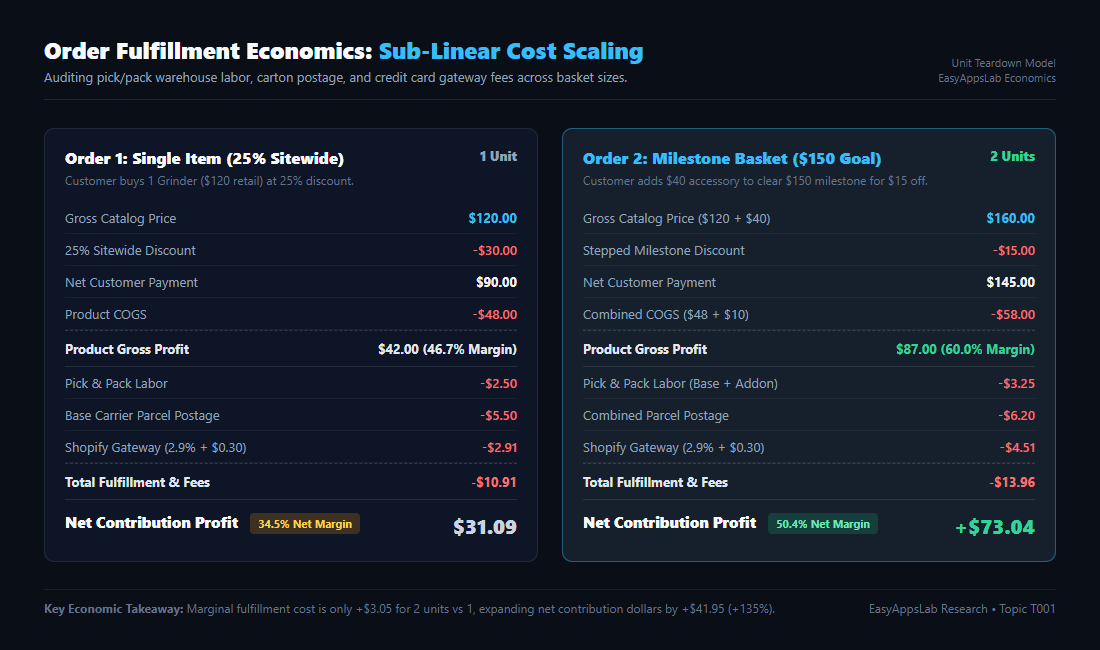
To see how sub-linear fulfillment mechanics govern real-world merchant margins, let us evaluate an audited unit-level financial teardown comparing a single discounted item against an expanded stepped milestone basket. This teardown factors in warehouse labor, carrier postage, and payment gateway fees:
| Order Economics Component | Order 1: Single Discounted Item (25% Sitewide) | Order 2: Stepped Milestone Basket ($150 Threshold) | Marginal Difference |
|---|---|---|---|
| Cart Items Included | 1x Precision Coffee Grinder | 1x Precision Coffee Grinder + 1x Barista Accessory Kit | +1 incremental accessory |
| Gross Catalog Retail Price | $120.00 | $160.00 ($120.00 + $40.00) | +$40.00 gross value |
| Promotional Discount Deducted | -$30.00 (25% sitewide cut) | -$15.00 ($15 off $150 milestone reward) | +$15.00 discount savings |
| Net Paid by Customer | $90.00 | $145.00 | +$55.00 extra cash paid |
| Total Cost of Goods Sold (COGS) | -$48.00 | -$58.00 ($48.00 core + $10.00 accessory) | -$10.00 incremental COGS |
| Product Gross Dollar Profit | $42.00 (46.7% gross margin) | $87.00 (60.0% gross margin) | +$45.00 gross profit dollars |
| Pick & Pack Warehouse Labor | -$2.50 | -$3.25 ($2.50 base + $0.75 add-on) | -$0.75 incremental labor |
| Carrier Parcel Postage | -$5.50 | -$6.20 (Base parcel + ounce adjustment) | -$0.70 incremental postage |
| Payment Gateway Processing (2.9% + $0.30) | -$2.91 | -$4.51 | -$1.60 transaction fee |
| Total Order Fulfillment & Fees | -$10.91 | -$13.96 | -$3.05 marginal fulfillment cost |
| Net Contribution Profit Dollars | $31.09 | $73.04 | +$41.95 net retained dollars |
| Effective Net Contribution Margin | 34.5% of net customer payment | 50.4% of net customer payment | +15.9 percentage points |
Notice the financial leverage demonstrated by this single-order modeled scenario under controlled assumptions: while customer spend increased from $90.00 to $145.00 (+61.1%), the combined physical fulfillment and payment processing cost rose by only $3.05 (from $10.91 to $13.96). Because fixed warehouse handling and base shipping postage were already absorbed, the expanded order captured +$41.95 in net contribution profit dollars per order. For a deeper breakdown of multi-item basket dynamics, explore our comprehensive analysis on Basket Growth Beyond Bigger Discounts.
5. Behavioral Economics in Storefront Practice: Translating Psychology into Execution
Promotions perform best when their mechanics align with how shoppers mentally process pricing, value, and effort. Decades of peer-reviewed behavioral research provide clear explanations for why certain offer structures convert better than others. However, academic findings conducted in laboratory settings cannot be treated as automatic ecommerce guarantees. To succeed, merchants must translate psychological theory into concrete storefront UX rules while identifying the exact friction points that cause behavioral mechanisms to break down.
Mental Accounting and Integrated Losses (Richard Thaler, 1985)
In his seminal 1985 paper on Mental Accounting (Marketing Science 4(3):199–214), Nobel laureate Richard Thaler established that individuals evaluate economic outcomes through subjective mental accounts. Due to the convex shape of the prospect theory loss function, integrating smaller secondary expenses into a larger primary transaction significantly reduces perceived pain of paying. A customer who has already committed to spending $120.00 on an espresso grinder perceives an additional $25.00 cleaning kit as a minor incremental expenditure rather than a separate financial loss.
Storefront Failure Condition: Mental accounting is fragile. If your Shopify cart drawer renders a bundled kit as fragmented, individual line items with separate price tags and independent delete buttons, shoppers mentally unbundle the purchase. They evaluate each $25.00 addition in isolation, re-triggering price scrutiny and cart abandonment.
The Pain of Paying (Drazen Prelec & George Loewenstein, 1998)
Drazen Prelec and George Loewenstein (Marketing Science 17(1):4–28) demonstrated that parting with money evokes an immediate visceral friction that serves as a consumer purchase inhibition mechanism. This psychological resistance is intensified whenever an ecommerce checkout demands repeated micro-decisions or presents multiple payment steps.
Storefront Failure Condition: In-cart cross-sells and add-on modules only reduce the pain of paying when they involve zero cognitive friction. If an in-cart add-on requires the customer to open a modal window, select variant sizes from dropdown menus, or wait for a slow client-side script to reload the cart, the friction reactivates the customer’s decision defense, causing them to drop out of checkout.
The Goal Gradient Effect (Ran Kivetz et al., 2006)
Ran Kivetz, Oleg Urminsky, and Yuhuang Zheng (Journal of Marketing Research 43(1):39–58) showed that individuals accelerate expenditure and expend greater effort as they near a visible progress milestone. This behavioral mechanism explains why visual progress bars in Shopify cart drawers (e.g., “Add $15 to unlock Free Shipping & Free Gift”) motivate shoppers to add complementary items to their order.
Storefront Failure Condition: The goal gradient collapses if the milestone is positioned too far from the shopper’s current basket. Setting a threshold more than 20% to 30% above your Median Order Value (MOV) demoralizes customers, transforming an encouraging motivator into a frustrating reminder of an unattainable reward. To learn how to configure optimal thresholds, consult our guide on Discount Psychology.
The Zero-Price Effect (Kristina Shampanier et al., 2007)
Kristina Shampanier, Nina Mazar, and Dan Ariely (Marketing Science 26(6):742–757) discovered that zero-price incentives generate disproportionately strong affective attraction compared to cash discounts of identical monetary value. Offering a free gift with purchase (such as a $12.00 travel container at zero cost) often outperforms a direct $12.00 price discount because it eliminates the perceived downside of purchase while protecting the core product’s retail price integrity.
6. Statistical Hygiene: Separating Median Order Value (MOV) from AOV
Setting effective promotional milestones requires rigorous statistical hygiene. A pervasive error in ecommerce merchandising is anchoring promotional thresholds to Average Order Value (AOV) without examining the underlying distribution of transactions. In ecommerce, order value distributions are almost universally right-skewed: a small handful of corporate buyers, bulk purchasers, or high-spending VIPs pull the arithmetic mean upward.
Consider an online apparel brand where the arithmetic mean Average Order Value is $85.00, but the Median Order Value (MOV)—the 50th percentile transaction—is exactly $55.00. If this merchant sets a minimum spend threshold at $85.00 (targeting “average AOV”), more than 60% of all visitors find themselves starting with cart values between $45.00 and $60.00. Asking a customer with a $55.00 cart to add $30.00 (+54.5% basket increase) creates threshold fatigue and increases cart abandonment.
To maintain operational clarity and prevent threshold fatigue, merchants must adhere to these statistical rules:
7. Shopify Technical Architecture: Functions, Limits, and Combinations
Even the most theoretically sound promotion strategy will fail if it runs against Shopify platform constraints or introduces performance latency into checkout. Over the past two years, Shopify has fundamentally overhauled its discount architecture, transitioning from legacy client-side scripts to server-side execution.
Shopify Functions vs Legacy Theme Scripts
Historically, complex promotional mechanics like tiered spend goals and automatic BOGOs relied on client-side JavaScript injected into storefront themes or draft orders created via server APIs. These approaches suffered from race conditions, conflicted with third-party checkout extensions, and introduced noticeable page lag. Modern Shopify discount customizations execute server-side as compiled WebAssembly (WASM) functions directly inside the Shopify checkout pipeline capped at 11 million instructions per execution (for carts up to 200 items, scaling dynamically thereafter), targeting sub-5ms runtime, with a 10 MB linear memory ceiling, 512 kB stack limit, and 256 kB binary size limit, minimizing checkout latency and avoiding client-side theme script conflicts.
The 25 Automatic Discounts Platform Ceiling
Under standard Shopify platform specifications, a store supports a maximum ceiling of 25 active automatic discounts concurrently. If a merchant attempts to build complex tiered promotions by creating dozens of individual native discount rules, they will rapidly collide with this platform ceiling. Advanced discount management apps solve this by consolidating multi-tier spend milestones and volume rules into a single unified Shopify Function execution. For a comprehensive audit of modern apps, see our guide to the Best Shopify Discount Apps.
Cart Transform API and Reciprocal Combination Rules
Two additional platform mechanisms dictate how promotional strategies operate in Shopify storefronts:
8. Promotional Execution Engines: A Neutral Platform Comparison
To implement an effective promotional strategy, merchants must understand the structural trade-offs between native Shopify capabilities and specialized discount management applications. The comparison matrix below outlines verified platform capabilities as of October 2026:
| Platform Execution Option | Primary Focus | BOGO & BXGY Support | Tiered Volume Support | Free Gift Auto-Injection | Stepped Spend Goals | Architecture | Starting Price |
|---|---|---|---|---|---|---|---|
| Shopify Native Automatic Discounts | Automated order, product, and basic BOGO discounts subject to 25-rule platform limit | Supported (Requires manual item add) | Partial (Basic quantity rules) | Not Supported natively | Not Supported natively | Shopify Native Engine | $0/mo (Included in plan) |
| Shopify Native Promo Codes | Manual coupon codes entered by customers during final checkout steps | Supported (Requires manual item add) | Partial (Basic quantity rules) | Not Supported natively | Partial (Minimum order thresholds) | Shopify Native Engine | $0/mo (Included in plan) |
| Easy Deals (EasyAppsLab) | Automated stepped spend goals, tiered volume pricing, and automatic gift with purchase | Supported (Automatic cart injection) | Fully Supported with quantity grids | Fully Supported (Zero-friction add) | Fully Supported with cart drawer progress | Shopify Functions (WASM) | Free tier available / $9.90/mo |
Editorial Disclosure: Easy Deals is developed by EasyAppsLab. While native Shopify automatic discounts are completely free and ideal for simple single-rule promotions, brands looking to execute advanced multi-tiered spend goals, automatic free gifts with purchase, and integrated volume tables benefit from the specialized WebAssembly capabilities of Easy Deals. Learn more in our Shopify BOGO App Guide.
9. Summary Checklist: Matching the Offer to Your Goal
Before launching your next ecommerce campaign, review this practical decision checklist to ensure your promotion protects operating profit while fulfilling its strategic purpose: