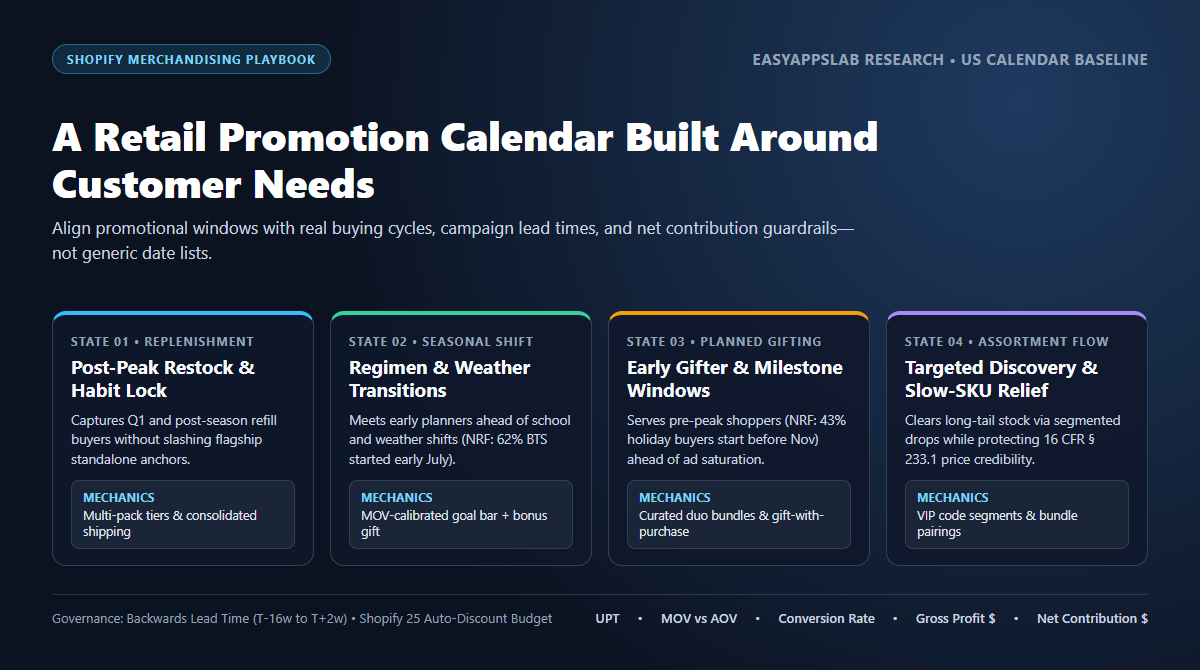
A retail promotion calendar built around customer needs schedules every bundle, threshold gift, and replenishment offer around four recurring buyer demand states—planned gifting, seasonal transitions, post-peak replenishment, and targeted catalog discovery—rather than slapping sitewide coupon codes onto statutory holidays. For Shopify merchants, effective seasonal campaign planning relies on counting backwards from when shoppers actually begin browsing: lock inventory 12 to 16 weeks ahead, model net contribution and Median Order Value (MOV) thresholds at 8 to 10 weeks, budget Shopify’s 25-automatic-discount cap at 4 to 6 weeks, launch early-shopper segments 2 to 3 weeks before peak auctions, and enforce full-price cooldowns afterward.
Scope note: Seasonal timing references in this guide follow a US / Northern Hemisphere calendar baseline and the National Retail Federation (NRF) retail reporting year in USD. Storefronts selling predominantly in the Southern Hemisphere should invert weather and school transition windows by six months while applying the same backwards lead-time logic and unit-contribution stress tests.
Why Generic Holiday Date Lists Erode Margin and Trigger Discount Fatigue
Most downloadable calendar templates hand merchants a list of minor observances—National Siblings Day, Earth Month, Memorial Day, Flash July Sales—and tell teams to invent a percentage cut for each box on the grid. Running an annual retail marketing calendar that way creates three predictable operational failures.
- Missed early-demand capture: Shoppers do not wait until promo Friday to buy. According to the National Retail Federation (NRF) Winter Holiday data, 43% of holiday shoppers plan to start before November while total November–December US retail spending is forecast at $1.013 trillion (+4.2% year over year). Similarly, NRF Back-to-School tracking reports 62% of shoppers had already started by early July and one-third planned purchases around summer sales. Launching campaign messaging in the final week forces your brand into the highest paid-media CPM window after early buyers have already converted elsewhere.
- Conditioning buyers to wait out full prices: When a storefront runs unsegmented sitewide percentage cuts every few weeks, repeat visitors stop evaluating products on fit and learn to hold carts until the next banner drops. Research by Raghubir and Corfman (1999) in the Journal of Marketing Research demonstrates that frequent, pattern-breaking price promotions can degrade pretrial brand quality evaluations, particularly among newer buyers evaluating unfamiliar brands.
- Legal exposure on perpetual “former price” anchors: Under the US Federal Trade Commission’s Guides Against Deceptive Pricing (16 CFR § 233.1), a crossed-out comparison price is only legitimate if the item was actively offered to the public at that actual, bona fide regular price for a reasonably substantial period of time. Rotating endless back-to-back flash events undermines your ability to run compliant comparison pricing when major seasonal moments arrive.
Avoiding generic holiday discount fatigue in your promo calendar starts by stripping unaligned dates off the whiteboard and rebuilding from why customers buy your catalog across the year, complementing your macro ecommerce promotion strategy.
How to Build a Retail Promotion Calendar Around Customer Buying Cycles
Every commercial promotion solves either an internal inventory objective or an external customer job. High-converting Shopify calendars intersect the two: pairing the right product assortment with the shopper’s psychological and practical buying cycle—the trigger that initiates their search—while preserving unit contribution margin.
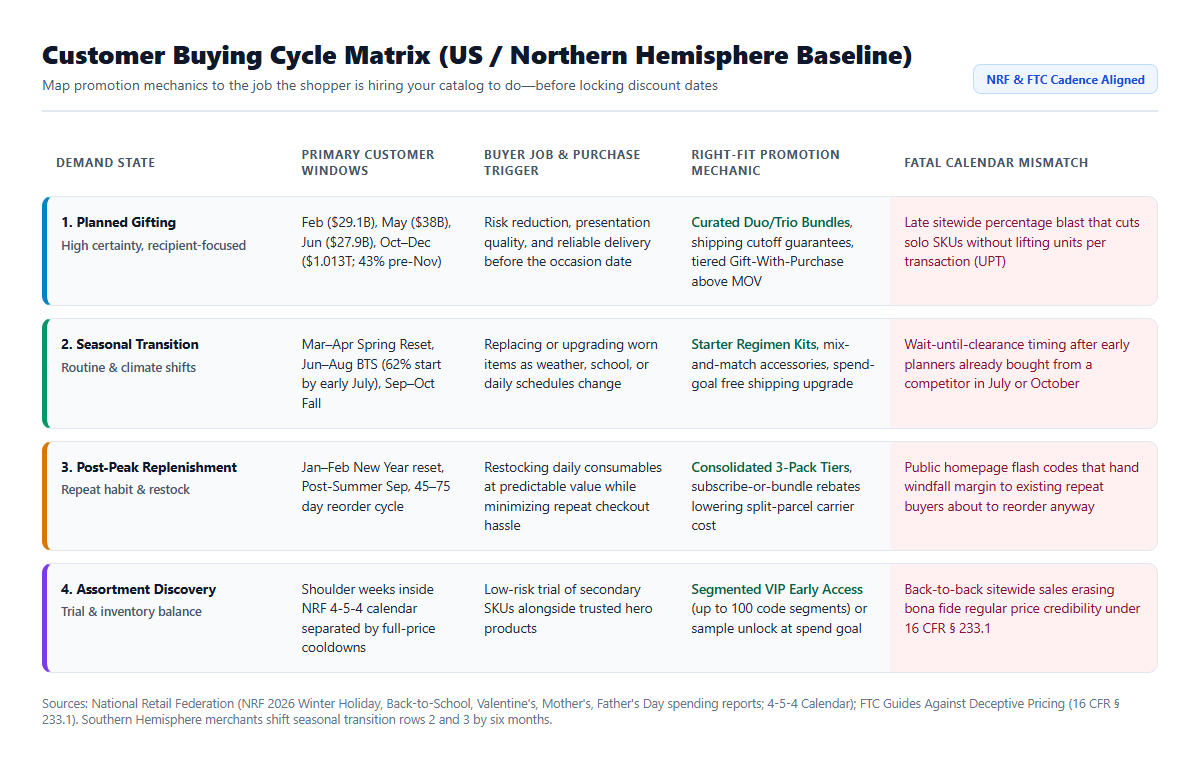
1. Planned Gifting and Milestone Windows
When a shopper purchases a gift for Valentine’s Day ($29.1 billion forecast), Mother’s Day ($38 billion expected), Father’s Day ($27.9 billion expected across 77% of consumers at an average spend of $226.58), graduation, or winter holidays, their dominant anxiety is recipient fit and on-time arrival—not squeezing another 5% off a single loose item.
NRF notes that 56% of holiday shoppers say the state of the economy affects their spending plans, with requested gift categories led by gift cards (47%), clothing (44%), books and media (25%), and personal care or beauty items (24%). Merchants win this window not by cutting solo hero prices at the eleventh hour, but by assembling presentation-ready duo/trio bundles, clear carrier cutoff banners, and spend-threshold bonus gifts that add recipient value while protecting standalone SKU pricing.
2. Seasonal Transition and Regimen Shifts
Weather changes, back-to-campus routines, spring cleaning, and fall wardrobe switches force customers to replace worn gear or add new use-case steps (for instance, shifting skincare from heavy winter barrier creams to lighter SPF hydration). Here, customers actively evaluate curated starter kits and companion accessories. Launching starter bundles six weeks before the meteorological or academic turn serves deliberate planners before clearance markdowns become necessary.
3. Post-Peak Replenishment and Habit Consolidation
After gifting peaks in December, May, or August, consumable and recurring-use catalogs enter a replenishment cycle (typically 45 to 75 days after initial trial, concentrated heavily in January–February and September). Throwing a public sitewide 20% off banner onto your homepage during January hands windfall margin to loyal buyers who already intended to restock. Instead, build multi-pack refill tiers (Buy 2 or Buy 3 units for a fixed multi-pack rate) or threshold free-shipping consolidations that encourage shoppers to load multiple refills into one parcel rather than three expensive single-unit shipments.
4. Assortment Discovery and Shoulder-Week Inventory Balance
Between major seasonal crests, Shopify operators still need mechanisms to stimulate cross-category trial and rotate slow-moving secondary variants without running nonstop sale banners. Anchor shoulder-week campaigns inside the NRF 4-5-4 retail calendar (which standardizes four-week, five-week, and four-week fiscal months so Saturdays, Sundays, and major holidays align cleanly for year-over-year comparison). Use segmented VIP discount codes or cart-goal sample unlocks tied to full-price core purchases, surrounded by strict full-price cooldown periods.
Your Year-Round Ecommerce Promotional Calendar Strategy by Quarter
Putting customer needs promotion planning into practice means giving every quarter a distinct commercial role in your DTC retail promo schedule. Rather than repeating “20% off everything” twelve times a year, use distinct promotional cadence themes that solve different customer problems and keep year-round vertical ideas from industry promotion playbooks strictly prioritized by season.
| 4-5-4 Fiscal Quarter | Primary Customer Demand States | Recommended Promotion Mechanics | Catalog Protection & Cadence Rule |
|---|---|---|---|
| Q1 (Feb–Apr) | Post-Holiday Replenishment, Valentine’s Gifting ($29.1B US), Spring Weather Reset | 3-pack consumable refill tiers; curated gift sets for Valentine’s; full-price spring hero launch paired with a sample gift goal | Hold flagship hero SKUs at regular bona fide price for cooldown compliance; consolidate small reorders to save parcel postage |
| Q2 (May–Jul) | Mother’s Day ($38B US), Father’s Day ($27.9B US), Early Back-to-School (62% start by early July) | Early-access VIP gift kits with reliable delivery windows; summer travel starter bundles; July back-to-school multi-item mix-and-match | Target VIP and gifter segments separately using segment-gated codes instead of blanket banners on core evergreen pages |
| Q3 (Aug–Oct) | Peak Back-to-School, Fall Climate Shift, Pre-November Early Gifters (43% holiday start) | Starter kit bundles for fall regimens; late-October “Early Gifter” curated bundles and gift-with-purchase tiers ahead of Nov 1 | Lock November–December automatic discount architecture early and audit your 25-rule slot budget before BFCM creative freezes |
| Q4 (Nov–Jan) | Peak Holiday Gifting ($1.013T Nov–Dec forecast), Late Self-Gifting, January Reset | Mainstream BFCM structured tiered baskets / GWP goals (avoiding flat sitewide race-to-the-bottom cuts); December digital gift card + bounce-back incentives | Enforce strict end dates in Shopify Admin timezone so Q4 promos never bleed into Q1 full-price baselines |
How Far in Advance to Plan Seasonal Ecommerce Promotions: The Campaign Preparation Window
A promotion calendar only works if inventory arrival, margin modeling, landing-page merchandising, and checkout QA happen on schedule before buyers start searching. Counting backwards from campaign launch day gives Shopify teams a repeatable campaign preparation window across six stages.
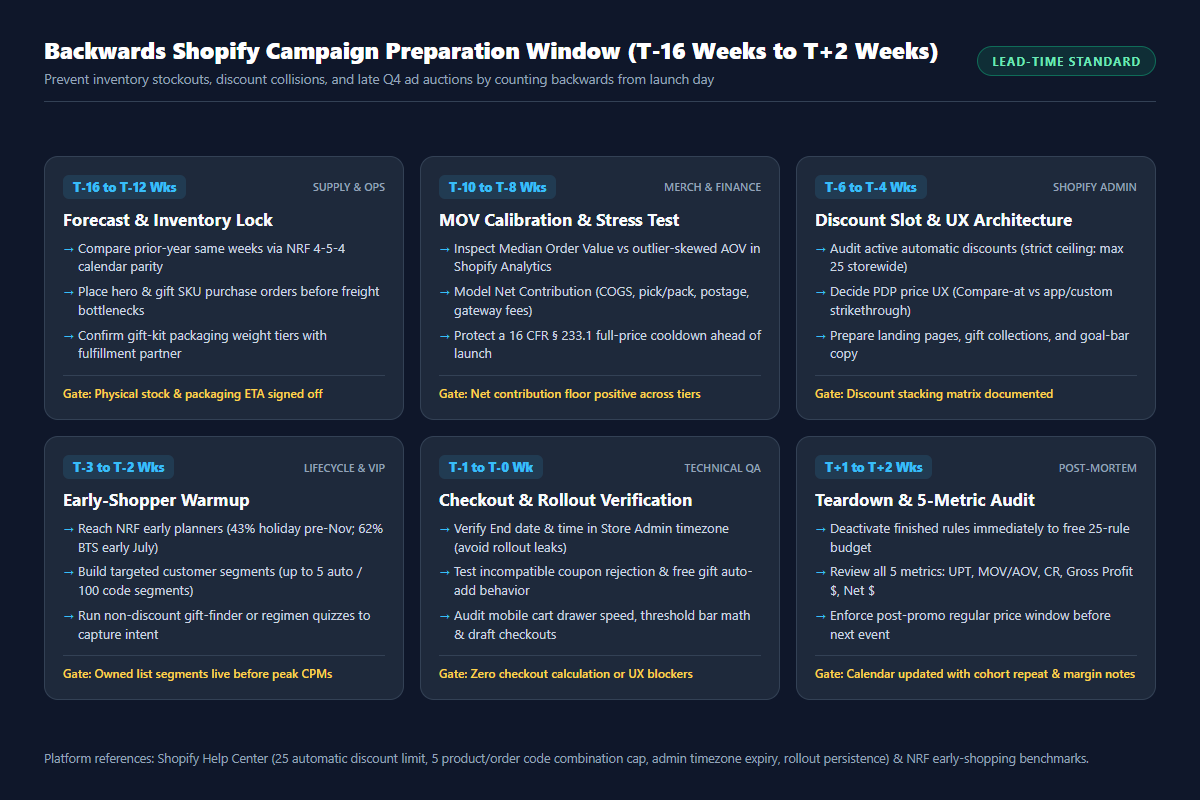
- T-16 to T-12 Weeks (Supply Chain & Inventory Lock): Review prior-year demand using the NRF 4-5-4 week structure so comparable weekend counts align. Lock purchase orders for both primary hero products and secondary gift-with-purchase SKUs, accounting for factory transit and custom kit-box lead times. Never schedule a calendar gift-with-purchase if the bonus item shares raw packaging or bottlenecks with a top-selling paid SKU.
- T-10 to T-8 Weeks (Offer Design, MOV Calibration & Margin Stress Test): Build the promotion spreadsheet using net contribution formulas rather than top-line discount guesses. Verify how fulfillment weights jump when shoppers unlock two- or three-item tiers, and confirm a sufficient full-price window precedes any former-price advertising per 16 CFR § 233.1.
- T-6 to T-4 Weeks (Shopify Rules Audit & Merchandising Build): Audit live discounts in Shopify Admin. Shopify permits a maximum of 25 active automatic discounts storewide (including app-based discounts). Retire obsolete rules early so seasonal campaigns have room. Build collection landing pages and decide how sale prices appear on PDPs, aligning storefront discovery with your promotional merchandising structure.
- T-3 to T-2 Weeks (Early-Shopper Warmup & Owned List Capture): Activate quizzes, wish-list gift guides, and early-access signups targeting NRF’s early-planner cohorts (the 43% of winter holiday buyers starting before November and 62% of back-to-school shoppers starting by early July). Create customer segments upfront: Shopify supports up to 5 customer segments per automatic discount and up to 100 per discount code.
- T-1 to T-0 Week (Pre-Launch Shopify QA): Run the full verification steps documented in our BFCM promotion QA checklist, checking store admin timezone settings, rollout behavior, checkout discount combination messages, and mobile cart drawer speed.
- T+1 to T+2 Weeks (Deactivation & 5-Metric Post-Mortem): Immediately deactivate ended rules to reclaim automatic discount slots, restore regular prices, and score campaign performance across unit velocity, net contribution, and customer cohort retention before opening the next planning block.
Worked Promotion Economics: Gross Profit vs. Net Contribution Across the Calendar
A retail promotion calendar that evaluates offers only on gross revenue or percentage margin routinely misallocates budget toward heavy, low-net-contribution orders. To illustrate how calendar timing and offer structure reshape order profitability, consider the following explicitly modeled single-order examples under controlled assumptions for a hypothetical US personal-care storefront (a category representing 24% of NRF winter holiday gift requests):
- Modeled Catalog SKUs: Flagship Barrier Renewal Serum (30ml, retail $68.00, landed COGS $19.00), companion Ceramide Travel Cream (15ml, retail $32.00, landed COGS $8.00), and daily Gentle Cleanser Refill (200ml, retail $24.00, landed COGS $7.20).
- Operational Cost Assumptions: Fulfillment labor modeled at $2.50 base pick/pack plus $0.50 per extra physical unit; packaging at $1.20 (single-item mailer) or $1.85 (corrugated kit box); merchant-funded domestic US ground parcel postage scaling by weight ($5.60, $6.20, $7.40, or $7.90); and payment processing modeled at an illustrative US Shopify Payments domestic consumer card benchmark of 2.9% + $0.30 per order. Note that per Shopify Payments US card-type documentation, commercial, corporate, American Express, and international cards carry surcharges above base Standard consumer rates—merchants should verify live rates under Settings → Payments → View payment rates in Shopify Admin.
- Modeled vs. Campaign Distinction: The numbers below measure single-order unit economics only under fixed simulation assumptions. They must never be confused with storewide campaign profitability, which also depends on conversion rate shifts, paid customer acquisition cost (CAC), return rates, and repeat-purchase elasticity.
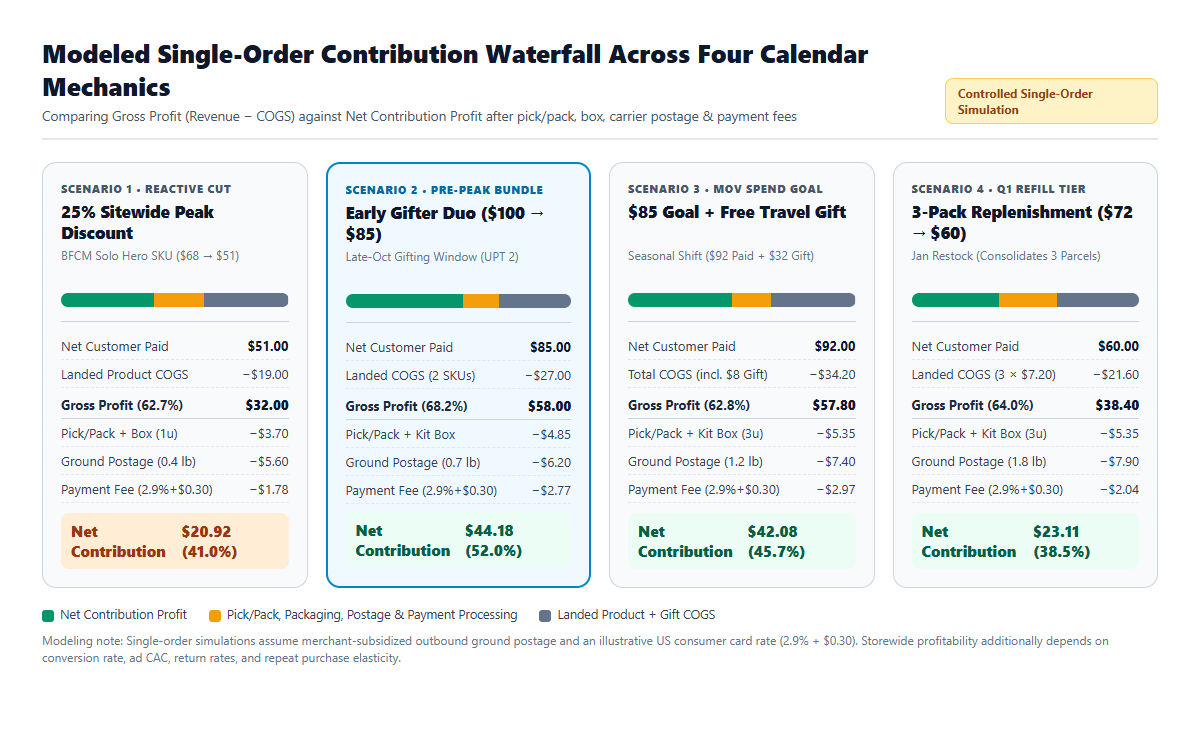
| Scenario & Window | Catalog, Discount & Paid | COGS & Gross Profit | Ops & Payment Deductions | Net Contribution Profit |
|---|---|---|---|---|
| 1. Reactive Peak 25% Cut (BFCM Solo Serum, 1 unit) | Catalog: $68.00 Cut: -$17.00 (25% off) Paid: $51.00 | COGS: $19.00 GP: $32.00 (62.75%) | $11.08 total ($2.50 pick + $1.20 bag + $5.60 ship + $1.78 fee) | $20.92 (41.02%) |
| 2. Early-Gifter Duo Bundle (Late-Oct Window: Serum + Cream, 2 units) | Catalog: $100.00 Cut: -$15.00 kit save Paid: $85.00 | COGS: $27.00 GP: $58.00 (68.24%) | $13.82 total ($3.00 pick + $1.85 box + $6.20 ship + $2.77 fee) | $44.18 (51.98%) |
| 3. MOV Spend-Goal Free Gift (Seasonal Shift: Serum + Refill + Free Cream, 3 units) | Paid items: $92.00 Cut: $0.00 ($32.00 gift at $85.00 goal) Paid: $92.00 | COGS: $34.20 (incl. $8.00 gift COGS) GP: $57.80 (62.83%) | $15.72 total ($3.50 pick + $1.85 box + $7.40 ship + $2.97 fee) | $42.08 (45.74%) |
| 4. Q1 Replenishment 3-Pack (Jan Refill: 3 × Cleanser Refill, 3 units) | Catalog: $72.00 Cut: -$12.00 tier ($4.00/unit off) Paid: $60.00 | COGS: $21.60 GP: $38.40 (64.00%) | $15.29 total ($3.50 pick + $1.85 box + $7.90 ship + $2.04 fee) | $23.11 (38.52%) |
Notice two operational insights invisible on a superficial gross-margin sheet:
- Solo discounts compress Net Contribution far harder than Gross Profit: Scenario 1 looks passable on paper at 62.75% gross margin ($32.00 gross profit), yet fixed per-parcel postage ($5.60), pick/pack ($2.50), mailer ($1.20), and processing ($1.78) consume over a third of that gross margin—leaving just $20.92 before paid ad spend. By contrast, Scenario 2 keeps the standalone $68.00 Serum anchor untouched and pairs a high-margin $32.00 companion ($8.00 COGS) into an $85.00 early-October gift bundle, expanding single-order net contribution to $44.18 (+$23.26 per order under identical postage absorption assumptions).
- Weight-tiered shipping and free-gift COGS punish uncalibrated giveaways: In Scenario 3, the $32.00 retail Travel Cream generates high perceived value at only $8.00 COGS, yet shipping 3 physical units bumps weight into a $7.40 ground tier plus $3.50 pick/pack and $2.97 gateway fee ($15.72 operational overhead). Had a merchant set that giveaway threshold too low—say at $50.00—the combined $8.00 gift COGS and $15.72 fulfillment/fee bill would have crushed single-order net cash. Similarly, Scenario 4’s $7.90 heavy liquid postage yields $23.11 net contribution on one parcel while saving the store from three separate $5.60 shipments ($16.80 combined postage across three standalone refill orders).
The 5-Metric Contribution Matrix and MOV vs. AOV Threshold Calibration
Focusing exclusively on Average Order Value leads to “AOV Tunnel Vision”—pushing basket size upward with costly discounts or heavyweight add-ons while conversion rate falls or net contribution dollars shrink. Every event on your retail promotion calendar should pass a balanced five-metric review covering both order behavior and pocketed cash.
| Metric | What It Diagnoses on Your Calendar | Common Calendar Failure Mode | Operational Guardrail Target |
|---|---|---|---|
| Units Per Transaction (UPT) | Whether the campaign solved a multi-item need (gifting, routine pairing, refills) or discounted single units | Running 20–25% codes that convert the exact same 1-unit orders at a lower margin | Prioritize bundles, multi-pack refills, and companion add-ons when UPT stagnates near 1.1–1.2 |
| AOV & Median Order Value (MOV) | Where the true majority of carts cluster vs. distortion from rare bulk/wholesale orders | Setting a free-shipping or gift threshold above Mean AOV when typical buyers sit far lower | Anchor spend thresholds 15%–25% above MOV (middle order), never blindly above an outlier-inflated Mean AOV |
| Conversion Rate (CVR) | Whether seasonal intent, checkout clarity, and price perception reduced hesitation | Hiding promo mechanics in coupon fields that send shoppers offsite searching for codes | Audit PDP clarity, cart progress visibility, and mobile checkout load alongside CVR changes |
| Gross Profit Dollars ($) | Total contribution left after subtracting product COGS AND bonus free-gift COGS | Celebrating higher percentage margin on discounted small carts while total profit dollars drop | Evaluate total GP dollars per session rather than headline revenue alone |
| Net Contribution Profit ($) | True pre-ad cash remaining after pick/pack labor, packaging boxes, parcel postage, and card fees | Subsidizing heavy multi-item parcels or free gifts on low-margin SKUs | Require every calendar promotion tier to pass a strict minimum Net Contribution dollar floor |
Why Median Order Value (MOV) Must Anchor Spend Thresholds
Shopify’s Average Order Value guide explicitly instructs merchants to separate Mean (AOV), Median Order Value (MOV), and Mode—warning that when the mean sits much higher than the median, large outlier orders skew AOV upward and distort threshold design. Suppose a store’s typical single-bottle shopper sits at a $70.00 Median Order Value, while wholesale-style $300 orders drag the arithmetic AOV up to $98.00. Setting a spend-goal gift at $115.00 based on Mean AOV asks the median customer to add nearly $45.00 (often causing cart abandonment), whereas calibrating the goal at $85.00 (21% above the $70.00 MOV, matching Scenario 3’s $85.00 unlock) asks a typical $68.00 hero buyer to add one $24.00 consumable. Review our dedicated guide to choosing a free shipping threshold before finalizing Q2–Q4 tier lines.
Behavioral Science Safeguards—And Where Shopify Storefront Friction Breaks Them
Behavioral economics provides clear principles for timing and framing seasonal promotions, yet academic findings fail immediately when storefront UX contradicts the underlying mental model. Before launching any event from your discount psychology playbook, verify both the consumer rule and the specific Shopify technical trap that breaks it.
| Peer-Reviewed Research (Verified DOI) | Operational Calendar Rule | Storefront / Checkout UX Friction That Breaks the Mechanism |
|---|---|---|
| Thaler (1985) — Mental Accounting and Consumer Choice (DOI: 10.1287/mksc.4.3.199) | Customers derive positive transaction utility when a context-earned promotional price sits noticeably below a credible, regularly maintained reference price. | Broken by hidden cart-only discounts: Shopify discloses that native discounts apply in cart/checkout and do not display crossed-out strikethrough prices on PDPs or collections without compare-at pricing, custom code, or an app. Without PDP visibility, shoppers never register transaction utility while browsing. |
| Prelec & Loewenstein (1998) — The Red and the Black: Mental Accounting of Savings and Debt (DOI: 10.1287/mksc.17.1.4) | Bundling companion items under one unified price softens the per-item “pain of paying” compared to tallying separate add-ons line by line. | Broken by itemized surcharge shocks at checkout: Separating a core product, mandatory gift-box fee, and shipping charge in the final checkout summary re-couples individual pain points and spikes late abandonment—avoid surprise box fees or unannounced shipping jumps above bundle totals. |
| Kivetz, Urminsky & Zheng (2006) — The Goal-Gradient Hypothesis Resurrected (DOI: 10.1509/jmkr.43.1.39) | Buyer effort accelerates as shoppers close the visible distance to a reward threshold, particularly when initial cart items visibly advance the meter. | Broken by static or resetting cart bars: If a progress bar fails to dynamically update via Ajax when variants change—or displays an impossible MOV-misaligned goal requiring 2× current spend—shoppers ignore the incentive and abandon mid-session. |
| Shampanier, Mazar & Ariely (2007) — Zero as a Special Price (DOI: 10.1287/mksc.1060.0254) | Free ($0) reward tiers create stronger affective pull than small positive-price add-ons, making Gift-With-Purchase compelling in gifting & seasonal windows. | Broken by manual “Buy X Get Y” cart hurdles: Native Shopify automatic Buy X Get Y rules require shoppers to manually add both buy and get items to cart. If a qualifying shopper forgets to hunt down and add the free gift SKU, zero-price affect instantly turns into post-purchase support complaints. |
| Raghubir & Corfman (1999) — When Do Price Promotions Affect Pretrial Brand Evaluations? (DOI: 10.1177/002224379903600206) | Save public discounts for recognizable, expected seasonal anchors (e.g., BFCM, holiday gifting) rather than off-cycle ad-hoc markdowns that signal distress. | Broken by empty discount-code boxes during cooldowns: Keeping prominent “Enter Promo Code” UI prompts above the fold on full-price months triggers bargain-hunting abandonment, sending first-time buyers to search third-party coupon aggregators before completing checkout. |
Configuring Seasonal Promos on Shopify Without Rule Collisions
Even the sharpest retail promotion calendar breaks at launch week if overlapping Shopify rules reject legitimate carts or trigger runaway double-discounting. Before locking Q3–Q4 dates, document these verified platform ceilings across your team:
- Strict 25-automatic-discount cap: Shopify enforces a hard ceiling of 25 active automatic discounts storewide, and that count includes app-based automatic discounts and custom Functions.
- Predictable combination arithmetic: Customers can stack a maximum of 5 product or order discount codes plus 1 shipping discount code on a single order. Shopify always evaluates discounts sequentially: product discounts apply first, order discounts apply second to the reduced subtotal, and shipping discounts calculate last. Incompatible codes halt checkout with the alert: “Discount couldn’t be used with your existing discounts.” Review Shopify discount combinations before permitting code-on-automatic stacking.
- Admin timezone & rollout pitfalls: Automated end dates execute in your store’s Shopify Admin timezone, not individual customer timezones. Additionally, Shopify warns that applying a discount rollout permanently removes a rule’s end date (unless its start date lies in the future), so teams testing segmented rollouts must audit deactivated states manually afterward.
- Custom Functions resource bounds: Engineering teams building bespoke seasonal pricing apps via Shopify Functions (latest 2026-10 limits) must fit within 11 million execution instructions, 128 kB input, and 40 kB output for carts up to 200 line items (plus 256 KiB binary and 10 MiB runtime memory), meaning bloated all-catalog transformation arrays can fail under peak cart loads.
Selecting the right execution mechanism depends on whether your seasonal event relies on simple price reductions, targeted segment codes, auto-added threshold gifts, or complex ERP pricing rules. The comparison below reflects verified Shopify documentation and live Shopify App Store listing data as of November 12, 2026.
| Execution Option | Primary Calendar Fit | Gift Auto-Add & Goal Bar | Shopify Architecture & Limits | Verified Pricing & Considerations |
|---|---|---|---|---|
| Shopify Native Automatic Discounts | Simple storewide or collection-wide price breaks and shipping thresholds | Auto-add: No (buyer adds item) Goal bar: No (cart/checkout only) | Native Admin (counts toward 25-rule max; max 5 segments/rule) | Included in Shopify plans (Basic from $19/mo yearly / $25/mo monthly); requires Compare-at prices or theme/app code for PDP strikethroughs |
| Shopify Native Discount Codes | VIP early access, influencer attribution, and email win-back segments | Auto-add: No (code + manual item) Goal bar: No (checkout validation) | Native Admin (up to 100 customer segments/code; max 5 product/order + 1 shipping code) | Included in Shopify plans; susceptible to public coupon extension leakage when reused broadly |
| Custom Shopify Functions App | Complex tiered B2B catalogs, bespoke bundles, ERP-synced rules | Auto-add: Yes (Cart Ajax + Function) Goal bar: Yes (custom theme block) | Wasm Functions (11M instructions, 128 kB input, 40 kB output up to 200 items; shares 25-rule cap) | Custom developer engineering & hosting cost; requires developer changes when promo logic shifts |
| ED Buy One Get One, Order Goal (Easy Apps) | Threshold Free Gift-With-Purchase, BOGO kits, and MOV order goals | Auto-add: Yes (adds qualifying gifts) Goal bar: Yes (storefront gift & shipping meter) | Shopify Functions app (counts toward 25-rule max; supports combination settings) | Free (verified live App Store listing; 1.0 rating across 2 reviews; launched Oct 16, 2026). Early-stage reviews—test bundle compatibility before launch |
Pre-Launch and Post-Promo Governance Checklist
Before flipping any campaign live from your seasonal calendar—or closing it at the end of a buying window—run this operational governance checklist across merchandising, finance, and technical teams:
- Verify active demand window & hemisphere alignment: Confirm creative messaging addresses the active buyer job (gifting confidence, seasonal shift, refill convenience, or curated discovery) with shipping cutoffs adjusted for local geography.
- Check MOV threshold distance: Confirm any spend threshold sits within reach of Median Order Value rather than an outlier-inflated AOV, and validate Net Contribution Profit at each cart weight tier.
- Audit Shopify’s 25-rule budget and combinations: Deactivate leftover automatic offers, verify Product → Order → Shipping stacking rules, and test discount combinations alongside any gift-with-purchase auto-add rules in a live theme preview.
- Test storefront UX breakpoints: Verify mobile cart drawer progress meters, PDP reference-price clarity, and zero hidden checkout fees before driving paid or email traffic.
- Schedule post-promo teardown & 16 CFR § 233.1 cooldowns: Confirm exact expiry dates in Admin timezone, verify no permanent rollout stripped your end date, and log all five contribution metrics in your quarterly retail calendar review before planning the next campaign cycle.
Editorial & Research Disclosure
All Shopify platform constraints, fee card-type policies, US National Retail Federation (NRF) consumer timing surveys, Federal Trade Commission pricing guidance (16 CFR § 233.1), Shopify App Store listings, and peer-reviewed behavioral studies cited in this article were verified against primary sources on November 12, 2026. The four worked SKU contribution scenarios are explicitly hypothetical, controlled single-order simulations designed to demonstrate net contribution accounting and must not be read as storewide campaign forecasts or universal profit guarantees. Easy Apps is the publisher of both the EasyAppsLab merchant education blog and ED Buy One Get One, Order Goal; the capability comparison above documents verified public features, free pricing, limitations, and early review status alongside native Shopify alternatives so merchants can evaluate fit objectively.